
Learn how to launch your cleaning tablet brand with a private label OEM manufacturer—from formulation to production, MOQ, and compliance. Start smart.
You have the logo, the Instagram grid, the pre-orders piling up — and no idea how to actually make a tablet that dissolves cleanly instead of turning into a fizzing mess at the bottom of the bottle. That gap between a brilliant brand plan and a physical, shelf-stable product is where most new cleaning brands stall.
This guide walks through exactly how brand owners, distributors, and retail buyers move from concept to production using an OEM manufacturer — what the process looks like, what you need to bring to the table, and how to sidestep the mistakes that quietly kill first orders.
The Problem Every New Cleaning Brand Hits First
Picture a founder who has spent months perfecting packaging mockups and a marketing calendar. Everything is ready — except the product itself. When they finally try to source a supplier, they discover that making an effervescent or dissolvable cleaning tablet is a specialist discipline. Compression pressure, moisture control, disintegration timing, and label compliance are not skills you pick up over a weekend.
That's the core pain: the branding is the easy part. The chemistry, the equipment, and the regulatory paperwork are where good ideas go to die.

The Real Pain Points Behind "Just Make Me a Tablet"
- No in-house chemist to build an effervescent or dissolvable formula
- No compression equipment or clean-room space to run production
- Confusion over MOQ, unit cost, and the margin math that makes it viable
- Fear of a product that crumbles, clumps, or fails in the bottle
- Regulatory uncertainty around labeling, safety data sheets, and shipping restrictions
What an OEM Manufacturer Actually Solves
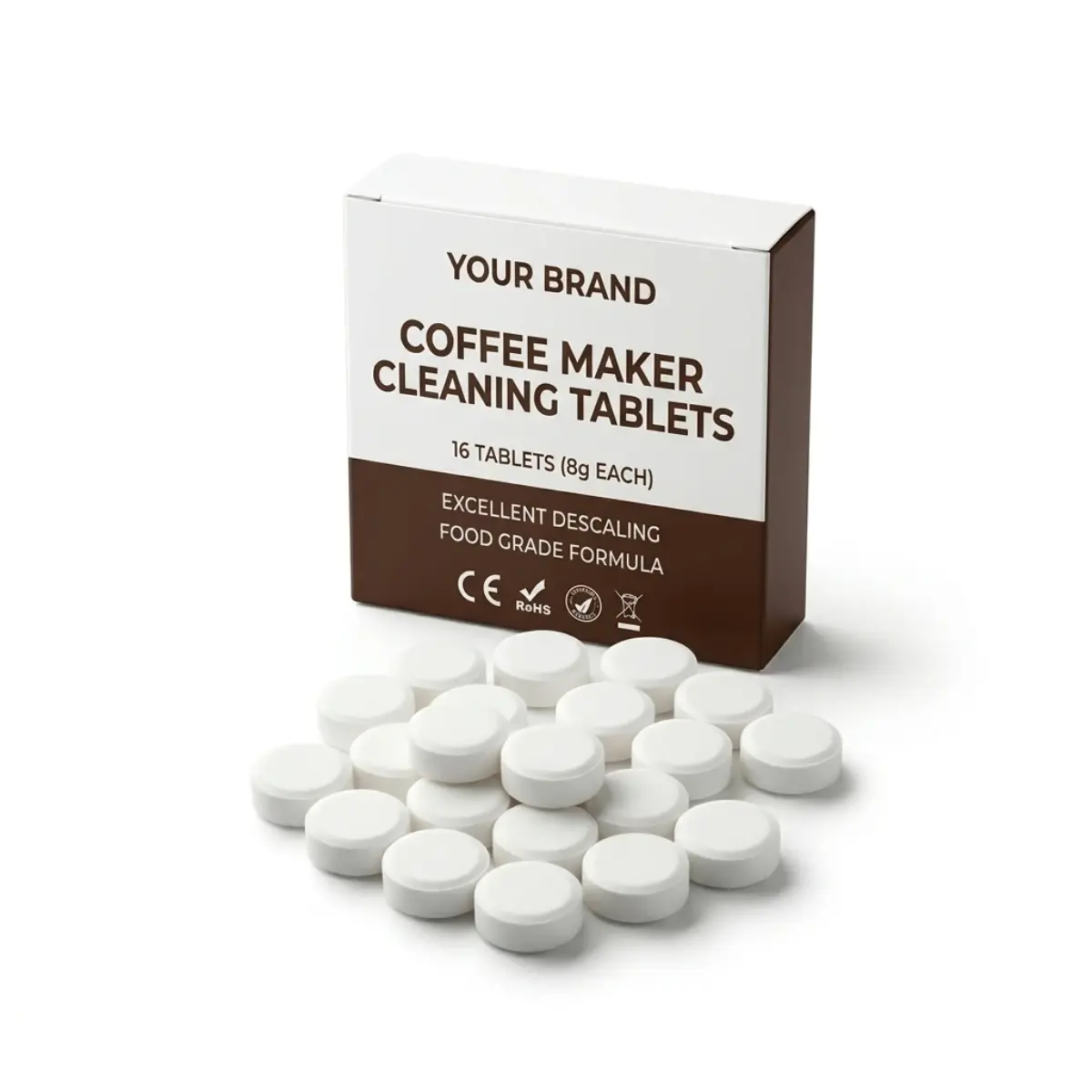
A capable OEM cleaning tablet supplier turns your concept into a shelf-ready product without you buying a single tablet press or hiring a lab team. You keep the brand, the story, and the customer relationship. The factory handles the science and the scale.
In practice, a good private label cleaning tablets manufacturer functions as your outsourced R&D and production department — carrying the equipment cost, the technical staff, and the compliance burden so you don't have to.
Where OEM Support Begins and Ends
Setting expectations early prevents most friction. Here's the typical division of labor.
| Brand Owner Provides | OEM Manufacturer Delivers |
|---|---|
| Brand vision, target market, budget | R&D formulation and lab samples |
| Fragrance and color preferences, claims | Compression, coating, effervescent technology |
| Artwork and regulatory territory | Stability testing and quality control |
| Forecast and order volume | Filling, packaging, batch documentation |
White Label vs. Custom Development
This distinction trips up more first-time buyers than anything else, so decide early which route fits.
- White label / private label: a proven base formula wearing your branding — faster, cheaper, and lower MOQ. Ideal for testing a market.
- Custom eco-friendly cleaning tablet formulation: bespoke chemistry that becomes your intellectual property — slower and more expensive, but far stronger on differentiation.
The OEM Development Process, Made Simple
It sounds complex, but the whole journey breaks into five manageable stages. Understanding each one removes the mystery — and the anxiety.
Step 1 — Brief & Discovery
You share the essentials: intended use (toilet, glass, floor, laundry, or dishwasher), the claims you want to make, your target price, and your destination market. The clearer the brief, the fewer sampling rounds you'll pay for.
Step 2 — Formulation & Sampling
The lab builds a prototype and ships you samples. You test dissolution speed, foam level, scent, and — most importantly — actual cleaning performance against the surface it's meant for.

Step 3 — Approval & Stability Testing
Once you approve a sample, accelerated stability testing simulates 3 to 6 months of shelf life under controlled heat and humidity. Effervescent tablets are moisture-sensitive, so this step protects you from a batch that degrades before it sells.
Step 4 — Packaging & Compliance
Now you lock in format: blister, tube, pouch, or child-resistant options. Artwork goes through proofing, and the manufacturer reviews your safety data sheet and label claims against the rules of your target country.
Step 5 — Pilot Batch & Mass Production
A small validation run confirms everything scales cleanly. Then full production follows, complete with batch records and a Certificate of Analysis (COA) for each lot.
Typical Timeline at a Glance
| Phase | Typical Duration |
|---|---|
| Brief & first sample | 2–3 weeks |
| Revisions to approval | 2–4 weeks |
| Stability testing | 4–12 weeks (can run in parallel) |
| Packaging finalization | 2–3 weeks |
| Production & QC | 3–5 weeks |
| Total to first shipment | ~10–16 weeks |
What You Need to Prepare at Each Step
The brands that launch fastest are the ones that arrive prepared. Knowing exactly what's expected of you keeps the back-and-forth short and builds trust with your factory.
Before You Contact a Supplier
- Your target cleaning application and desired format (effervescent vs. compressed)
- A rough annual volume and per-unit target cost
- Any sustainability requirements — biodegradable actives, plastic-free packaging
During Sampling
- Written feedback on scent, color, dissolution, foam, and residue
- A benchmark competitor product for the lab to match or beat
Before Production
- Final approved artwork with correct claims and regional icons
- Confirmed packaging format and MOQ acceptance
- A purchase order and a realistic forecast
Real-World Scenarios: Which Path Fits You?
Most buyers see themselves in one of three stories. Find yours to shortcut the decision.
The First-Time DTC Founder
Limited budget, wants a small first run, and needs speed to validate the concept. This founder is best served by a proven white label dissolvable cleaning tablets base — minimal risk, quick launch, and room to iterate once sales prove the demand.
The Established Retailer or Distributor
Already moving volume and needs tiered pricing, consistent private label quality, and dependable lead times. Their attention should go to a factory's capacity and its QC documentation — COAs, batch records, and repeatable hardness specs matter more than a novel formula.
The Sustainability-Led Brand
Wants a genuinely differentiated, plastic-free product with defensible green claims. This brand should invest in custom R&D, biodegradable surfactants, and relevant certifications rather than settle for a generic base. The premium is worth the ownership.
Answering the Fears That Stall Most Deals
These are the objections that keep buyers up at night. Address them directly and the deal moves.
"What's the real MOQ — can I start small?"
The minimum order quantity for private label cleaning products depends heavily on how custom you go. White label routes exist precisely to lower that entry barrier for smaller brands.
| Development Path | Typical MOQ (indicative) | Relative Unit Cost |
|---|---|---|
| White label, existing formula | 3,000–5,000 units | Lowest |
| Semi-custom (scent/color change) | 10,000–20,000 units | Moderate |
| Full custom formulation | 30,000+ units | Highest per SKU |
"Will my tablets crumble or clump in transit?"
This is where hardness testing earns its keep. A reliable OEM controls tablet friability, seals product in moisture-barrier packaging, and adds desiccants where the formula demands it. Ask for the tablet hardness range and the packaging's moisture-vapor transmission rating before you commit.

"Who owns the formula?"
With a shared white label base, the manufacturer owns the recipe and you license the finished product under your brand. With custom cleaning tablet development, you typically own the formulation — but get that in writing, including exclusivity terms, before sampling begins.
"How do I know it's compliant to sell?"
A trustworthy partner provides a safety data sheet, helps substantiate your label claims, and flags region-specific requirements — from EU detergent labeling to shipping classifications for oxidizers. Never assume; ask for the paperwork upfront.
How a Capable OEM Partner Proves Itself
You don't need a sales pitch to judge a factory. You need evidence. Here's what a genuine OEM effervescent cleaning tablets supplier can show you when asked.
Capabilities Worth Confirming
- In-house R&D and formulation lab, not a broker outsourcing to a third party
- Both effervescent and compressed tablet lines under one roof
- A stability chamber and documented QC testing procedures
- A GMP-aligned facility with relevant certifications such as ISO 9001 and ISO 14001
- Flexible packaging: blister, tube, and water-soluble film options
Red Flags to Avoid
- Refusal to provide samples before you commit to a large order
- No batch documentation or COA on offer
- Vague, shifting answers on lead time or MOQ
Ready to Turn Your Concept Into a Shelf-Ready Tablet?
If you've been sitting on a brand plan with no clear way to build the product behind it, this is the step that moves you forward. Understanding how to start a cleaning tablet brand is really just knowing which questions to ask — and which partner can answer them with samples, not slides.
Share your brief — the application, your target market, and rough volume — and request a sample to test in your own hands. A good private label cleaning products OEM partner will start you with a no-obligation consultation and small-batch options, so your first step carries the least possible risk. Send over your idea, and let's put a working tablet in your hands within weeks.
Frequently Asked Questions
Q: How much does it cost to develop private label cleaning tablets?
A: Expect sampling fees of roughly $200–$800 per formulation round, minimal or no tooling for standard tablet shapes, and finished per-unit costs commonly landing between $0.08 and $0.40 depending on actives, packaging, and order volume. Custom formulas and premium eco packaging push toward the top of that band.
Q: Can I request an eco-friendly or plastic-free formula?
A: Yes. Many manufacturers work with biodegradable surfactants, plant-derived actives, and dissolvable film sachets, paired with recyclable tubes or compostable pouches. If green claims are central to your brand, confirm the supporting certifications early.
Q: How long before I can launch?
A: Plan for roughly 10 to 16 weeks from initial brief to your first shipment, assuming stability testing runs in parallel with packaging development. White label projects can compress this timeline noticeably.
Q: Do I need my own formula to start?
A: Not at all. The white label route lets you launch on a proven, market-tested base with only your branding applied — the fastest and lowest-risk way to enter the category and learn what your customers actually want.
Q: Can the manufacturer help with packaging and artwork?
A: A full-service partner offers artwork proofing, dieline templates, and compliant labeling review for your destination market, so your design lands print-ready and legally sound.