
Source concentrated cleaning tablets wholesale for EU private label. Cut freight costs, meet PPWR compliance, and capture demand with certified OEM formulations.
- Concentrated cleaning tablets strip out water weight entirely, cutting freight and warehousing costs in ways liquid formats simply cannot match — the unit economics shift is real and significant.
- The EU Packaging and Packaging Waste Regulation (PPWR) is pushing refill-and-reuse formats from a marketing talking point to a compliance requirement, and the timeline is tighter than most buyers expect.
- Private label captures the value gap between premium eco brands and cheap conventional cleaners — a space most national brands have left wide open.
- Consumer demand is already there. Formulation quality and credible certification are the genuine barriers, not category awareness.
- Brands moving now are locking in supplier capacity and shelf position before the scramble. That window is closing.
A Retailer Buyer's Quiet Bet That Paid Off
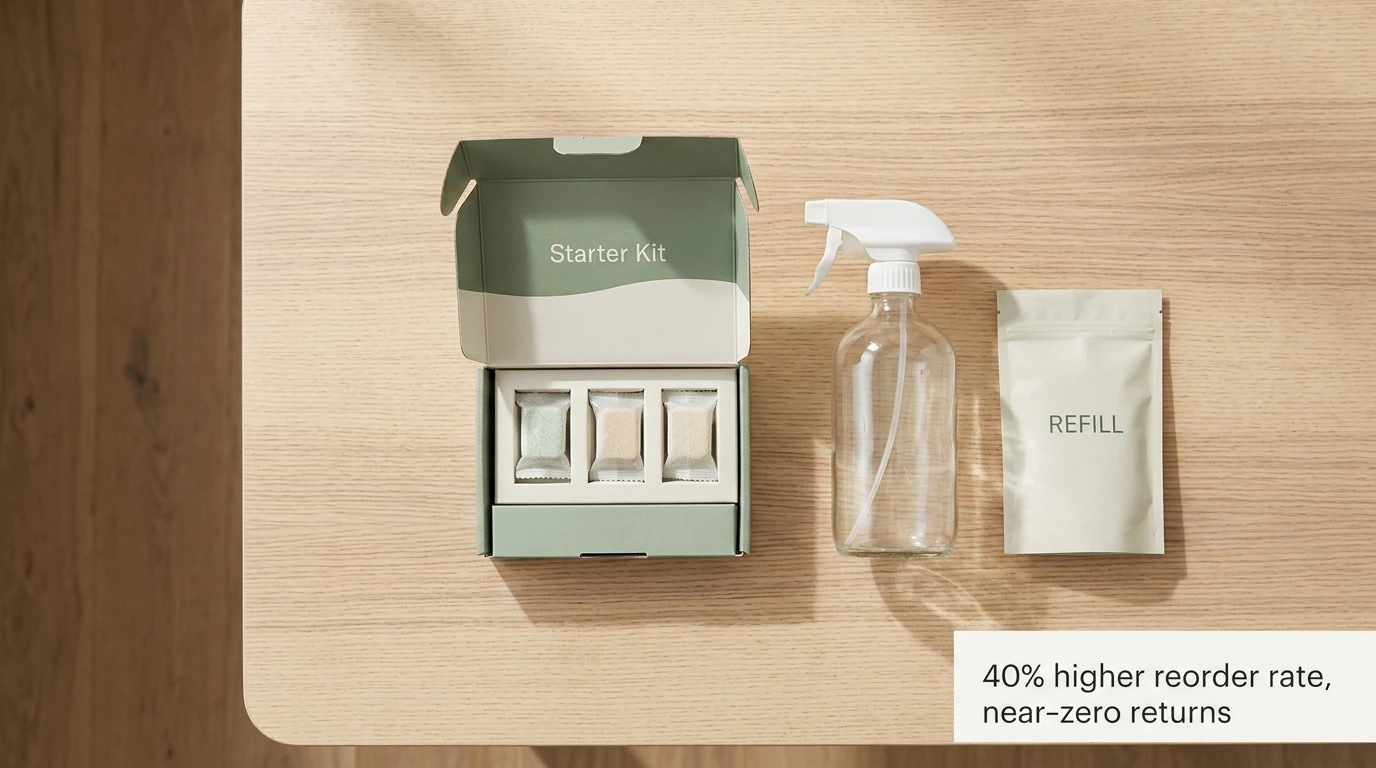
A mid-size grocery chain in the Netherlands — the kind with 80-odd stores and a category manager who reads every reorder report herself — pulled one spray bottle SKU from a cleaning products gondola in early spring. She replaced it with a starter kit: a reusable bottle and a strip of concentrated tablets. The price point was nearly identical. She told her team not to expect much in the first quarter.
Six months later, the tablet refill SKU had a reorder rate 40% higher than the bottle it replaced. The starter kit had sold through completely twice. More telling: the return rate was close to zero, and the margin per square meter of shelf space had improved materially. She hadn't run a promotion. She'd just swapped the format and let the economics do the work.
That story isn't unusual anymore. It's becoming a pattern. And for brand owners and category managers still sitting on the fence about private label eco concentrated tablets, patterns like this one deserve serious attention.
What Changed: The Core Question, Answered Early
The honest answer to whether there's a real private label opportunity in eco-friendly cleaning tablets is yes — and the timing right now is probably as favorable as it's going to get for early movers. Three forces are converging at once: packaging regulation is tightening, the logistics math has shifted, and a well-defined shopper segment is actively looking for exactly what a good private label tablet program can deliver.
This isn't a niche trend that might go mainstream. Refillable cleaning solutions and zero-waste household products have already crossed that line in Germany, Scandinavia, and the UK. The question isn't whether the category will grow — it's whether your brand is in it when it does.
The short version for busy readers
Private label concentrated cleaning tablets work because they cost less to ship, generate higher perceived value than conventional cleaners, and sit squarely in the compliance direction EU regulators are moving. Demand is established. The barrier is finding the right OEM partner and getting the formulation and certification stack right. Both are solvable problems — but they take time, which is why moving early matters.
The Market Reality: Where Demand Actually Sits
Reading the European green cleaning shift
The European household cleaning market is worth north of €12 billion annually by most industry estimates, and the sustainable segment has been growing at two to three times the rate of conventional products for several years running. That headline number matters less than where the growth is concentrated: Germany, Austria, and Switzerland lead on sustainability certification expectations; the Nordics lead on refill adoption; France has seen rapid mainstream uptake of eco-certified cleaning products since the country's anti-waste legislation tightened; and the UK, post-Brexit, is running its own parallel regulatory track that largely mirrors EU ambition.
These aren't fringe markets anymore. Concentrated cleaning tablets went from health-food-store curiosity to mid-market grocery fixture in under five years in most DACH markets. The distribution question has been answered. What's still open is which brands will own the shelf position that remains.
The shopper the category was built for
The buyer driving this category isn't an ideological environmentalist who'll pay whatever it costs. She's a pragmatic household decision-maker — typically 28 to 45, urban or suburban, tracking her spending carefully — who wants to feel good about what she buys but won't accept a 40% premium to do it. She'll switch formats if the quality holds and the convenience is comparable. She's also the exact shopper private label sustainability wins, because she's not loyal to a national eco brand; she's loyal to the outcome.
Tablet and refill formats fit her life. They're compact, they reduce plastic guilt without requiring much behavior change, and when the refill attach rate is strong, she keeps coming back without being pushed. That's the repeat purchase driver conventional liquid formats struggle to replicate at equivalent price points.

| Market Signal | Conventional Liquid Cleaner | Eco Concentrated Tablet |
|---|---|---|
| Water content shipped | ~90% by weight | Near zero |
| Plastic per use (indexed) | High — single-use bottle | Reduced via refillable cleaning solutions |
| Typical shelf price position | Low to mid | Mid / premium-accessible |
| Repeat purchase driver | Habit / price promotion | Refill loyalty and format commitment |
| Logistics cost per unit | High relative to sales price | Materially lower in dry format |
Figures above are indicative industry ranges drawn from category-level analysis, not audited data from any single source.
The Margin Argument Practitioners Care About
Logistics: selling the bottle back to the shopper
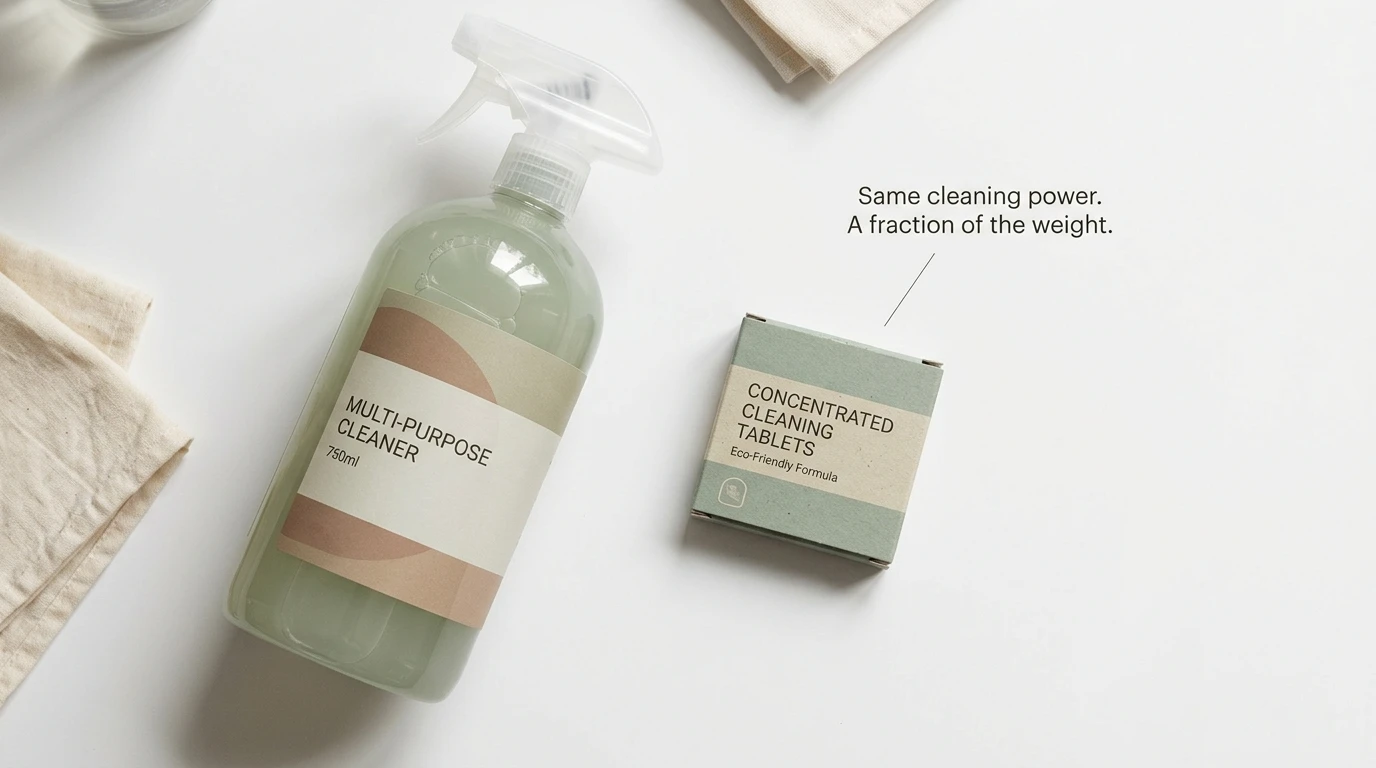
The single most underrated advantage of concentrated tablet formats for buyers running eco friendly cleaning tablets bulk buy programs is freight. A standard spray bottle is roughly 750ml of liquid, of which something like 90% is water. You're paying to ship water across Europe — usually more than once, through a distribution center or two — and then pricing that cost into a product with relatively thin category margins.
Remove the water, and the economics shift dramatically. A year's supply of all-purpose cleaner tablets might fit in a box the size of a paperback novel. The palletization efficiency alone changes the landed cost structure meaningfully, and that saving goes somewhere — usually into margin, competitive pricing, or both. For a concentrated cleaning tablets wholesale supplier working at volume, this isn't a marginal improvement; it's a structural one.
Where private label margin comes from
The value stack for a private label tablet program looks different from reselling a national eco brand, and that difference is mostly favorable. You control the formulation brief, the packaging spec, and the certification investment. You don't pay a brand premium on top of the product cost. And because refillable formats generate ongoing attach revenue rather than one-time bottle sales, the lifetime value per acquired customer is structurally higher.
The certification investment — EU Ecolabel, biodegradability standards, European green packaging compliance — looks like a cost upfront. Over a two-to-three-year product life, it's better understood as a moat. Retailers asking for credentialed sustainable household cleaning products OEM supply are asking for documentation that takes time to earn. Brands that have it early enjoy a supplier scarcity advantage that newer entrants won't be able to close quickly.
| Cost / Value Lever | Impact on Private Label P&L |
|---|---|
| Freight per unit | Materially lower in dry format vs. liquid equivalent |
| European green packaging compliance | Upfront cost; ongoing competitive differentiation |
| Refill attach rate | Recurring revenue stream, higher customer lifetime value |
| Certification investment | Barrier to entry that protects margin long-term |
| Brand premium avoided | Full retail margin retained vs. national brand resale |
The Compliance Angle Nobody Should Ignore
PPWR and the refill mandate direction
The EU Packaging and Packaging Waste Regulation — the PPWR, which moved through trilogue negotiations and is now working its way into member state transposition — sets targets for reuse and refill formats across several product categories, household cleaning included. The specific reuse targets and timelines vary by format and product type, and the implementing details are still being worked out in some jurisdictions. But the direction is unambiguous: single-use plastic-heavy formats face increasing regulatory headwind, and refill-compatible concentrated formats are structurally aligned with where legislation is heading.
Brands that wait for full regulatory clarity before investing in private label tablet formats are, in practical terms, waiting until their competitors have already locked in supplier relationships and shelf space. The compliance advantage of moving early isn't just reputational — it's operational. Reformulating an existing liquid range under PPWR pressure, on a shortened timeline, with a supplier you don't yet know, is a significantly harder problem than building the format from scratch now.
Certifications that actually move buyers
When European retailers brief private label cleaning categories, the certification shortlist is fairly consistent. The EU Ecolabel is the most recognized and broadly applicable — it covers both formulation and packaging, and carries genuine weight with category managers across DACH, France, and the Nordics. Cradle to Cradle certification is increasingly requested for premium positioning, particularly in the natural and organic channel. For biodegradable cleaning tablets white label programs, independent biodegradability testing to OECD 301B or equivalent is often a baseline requirement before anything else is considered.
Some retailers — particularly German discounters and Dutch supermarket groups — have their own private label sustainability requirements that layer on top of these. If you're sourcing through a major European retailer's own-brand program, expect their standard to be the floor, not the ceiling. Getting these certifications takes six to eighteen months depending on formulation complexity. That's the real lead time in this category, not production.
Sourcing Smart: What Separates a Good OEM Partner From a Risky One
Formulation depth and dissolution performance
Tablets are deceptively simple looking. The chemistry underneath — surfactant blend, pH balance, solubility profile, fragrance stability in a compressed solid — is genuinely complex, and the gap between a tablet that dissolves cleanly and performs across surface types and a tablet that leaves residue, dissolves unevenly in cold water, or smells nothing like its brief describes is significant. That gap shows up in reviews, return rates, and ultimately reorder data.
When evaluating a potential concentrated cleaning tablets wholesale supplier, dissolution performance testing across water hardness ranges is non-negotiable. The UK and Germany both have regions with hard water that will expose a weak formulation quickly. Ask for data, not just samples. Ask what happens to their tablet at 10°C in 400ppm hardness water. If the answer is vague, keep looking.
MOQ, lead time, and white-label flexibility
Minimum order quantities for sustainable household cleaning products OEM sourcing at tablet scale typically start around 10,000 to 50,000 units per SKU for established manufacturers, with some suppliers offering development-stage runs in the 5,000-unit range at a cost premium. Lead times from brief approval to first production run tend to run 12 to 20 weeks when certification is already in place; add six months or more if you're pursuing a novel formulation that needs fresh testing.
White-label flexibility varies more than MOQ. The questions worth asking upfront: Can the supplier adjust fragrance and formulation within the certified parameters without full re-certification? What packaging customization is available, and at what volume threshold does bespoke packaging become viable? What's their documented capacity utilization, and how are they prioritizing new versus existing customers when demand spikes? A supplier who can't answer the last question clearly is probably not running the operation you want to be dependent on.
An Honest Look at the Risks
Consumer education friction
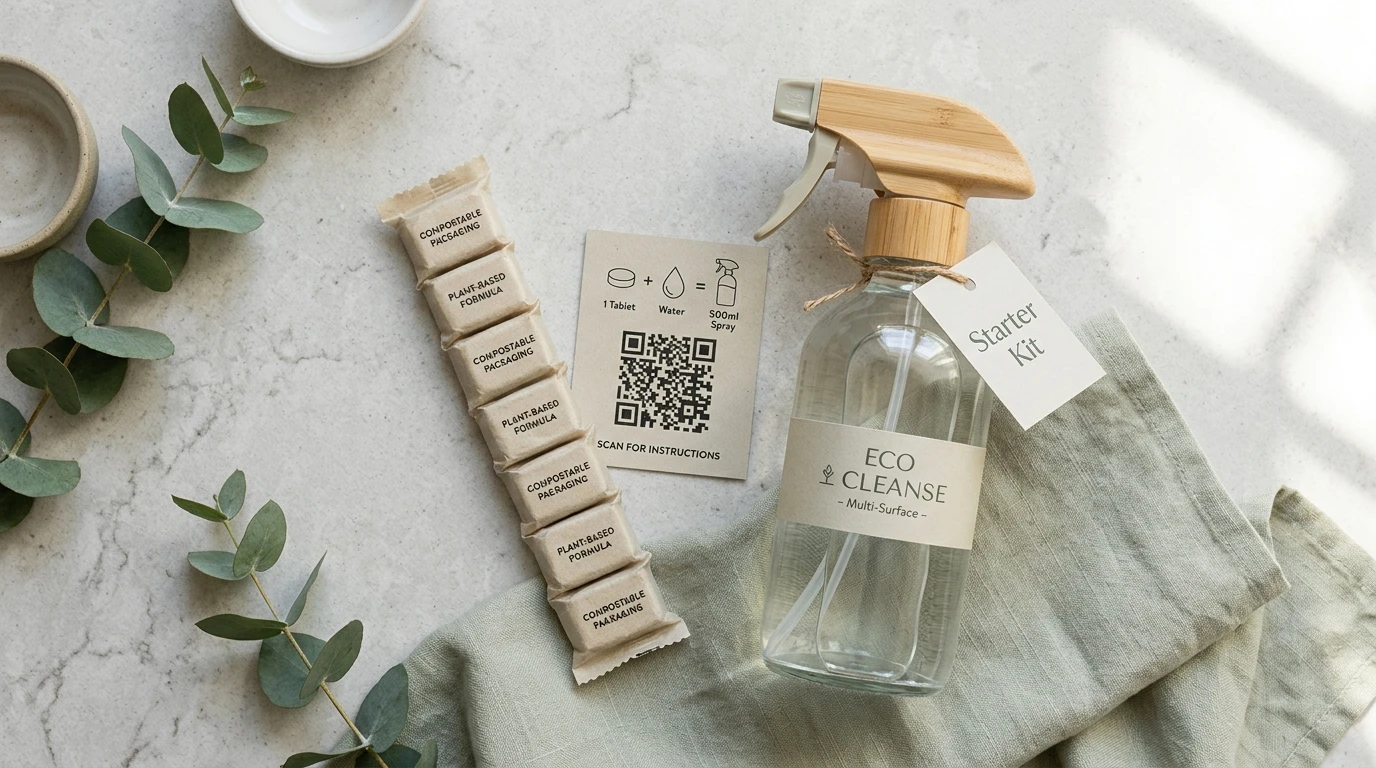
Tablets require a behavior change, and behavior change has a friction cost. Shoppers who've bought spray bottles their entire adult lives need to understand what to do with a tablet, how much water to add, and why that's worth doing. Brands that skip this step — launching a tablet SKU with packaging that assumes the shopper already knows the format — see higher return rates and poor reviews in the first quarter.
The mitigation is straightforward but requires investment: clear on-pack dosing instructions, a starter kit SKU that removes the "I don't have the right bottle" barrier, and digital touchpoints (QR codes, short video) that show the format in use. Brands that do this well convert first-time buyers into refill subscribers at high rates. Brands that skip it spend months diagnosing why a product that should be working isn't.
Greenwashing exposure
The EU Green Claims Directive, alongside national consumer protection enforcement in Germany and France particularly, has significantly raised the legal and reputational risk of unsubstantiated environmental claims. "Natural," "eco," "sustainable," and "biodegradable" are all terms that require substantiation — and in an increasing number of EU jurisdictions, pre-notification or pre-approval before use in marketing materials.
The answer is not to avoid sustainability claims — they're central to the category's value proposition. The answer is to earn them honestly and document the evidence trail before the claims appear in market. A certification from a recognized body is far more defensible than a house style claim, and it costs less in the long run than a regulatory investigation or a retailer audit that exposes a gap.
The Window Is Open — Move Before It Narrows
The Netherlands category manager from the opening of this piece didn't do anything revolutionary. She read the reorder data, trusted the format, and moved before her direct competitors did. Twelve months later, her refill SKU had a shelf position her competitors were asking their buying teams to replicate — and the supplier she was working with had a six-month backlog on new private label onboarding.
That's the real risk in waiting: not that the category might not work, but that the capacity and shelf position available to early movers is finite. Formulation development takes time. Certification takes time. Retail ranging cycles have fixed windows. The brands in the strongest position right now started their private label eco cleaning programs 18 to 24 months ago. The brands that start now will look like that to the brands that wait another 18 months.
The EU packaging regulation trajectory, the shopper behavior data, the logistics math — they all point in the same direction. The only question that remains is whether your brand is in the category when European grocery shelves complete their transition to refill-dominant formats, or watching from the outside while someone else owns the space.
Work with us on your private label tablet range
We work with brand owners, buyers, and category managers across Europe to develop concentrated cleaning tablet ranges from formulation brief through to retail-ready private label supply. That includes formulation development and dissolution testing, certification pathway support for EU Ecolabel and biodegradability standards, packaging design and European green packaging compliance, and flexible white-label production from development run through to full-scale supply.
If you're evaluating whether a tablet format belongs in your next category review, or you've already decided and need a supplier who can deliver the quality and documentation European retailers require, we'd like to have that conversation. It's a straightforward discussion about your timeline, your target retail environment, and what a well-built program looks like for your specific category — not a sales call, but a working session.
Get in touch to start the conversation about your private label cleaning tablet program. The brands moving now are the ones that will own the shelf position when the rest of the market catches up.
FAQ
Q: Are eco-friendly cleaning tablets actually cheaper to stock than liquids?
A: The landed cost per unit is typically lower for tablets once you account for freight, because you're not shipping water weight. A pallet of tablets covers far more cleaning doses than an equivalent pallet of liquid product. Where the cost is higher is formulation and certification — good tablet chemistry isn't cheap to develop or validate. The net P&L impact is positive for most well-run programs, but it requires upfront investment that liquid private label doesn't.
Q: What certifications do European retailers expect for private label cleaning tablets?
A: The EU Ecolabel is the most commonly requested across the major European markets and covers both formulation performance and packaging impact. Biodegradability verification to OECD 301B standard is a near-universal baseline for biodegradable cleaning tablets white label programs. Cradle to Cradle is increasingly requested in the premium and natural channel. Specific retailers — particularly the large German and Dutch groups — may have their own private label sustainability standards that supplement these. It's worth mapping your target retail partners' requirements before choosing your certification path, since the investment and timeline vary meaningfully between them.
Q: What's a realistic minimum order for a white-label tablet launch?
A: Most established OEM suppliers set MOQs in the 10,000 to 50,000 unit range per SKU for first production runs. What drives it is primarily packaging complexity — a fully bespoke box requires tooling investment that needs to be amortized across volume — and fragrance or formulation customization. Some suppliers offer smaller development runs at 5,000 units to help new brands validate the market before committing to full volume. If a supplier is quoting MOQs of 1,000 units for a fully certified, custom-packaged product, it's worth probing whether the certification documentation is actually in order.
Q: Do concentrated tablets clean as well as conventional cleaners?
A: For most everyday surface applications — kitchen worktops, bathroom tiles, general hard surfaces — a well-formulated tablet performs at parity with conventional liquid cleaners once correctly dissolved. The important caveat is "correctly dissolved": tablets that aren't given adequate contact time with water, or that are used in very cold or very hard water without a formulation designed for those conditions, underperform. Heavy-duty or specialist applications — oven degreasers, limescale removers, disinfectants — have more variable performance profiles and require careful formulation briefs. The quality gap between a well-formulated tablet and a poorly formulated one is larger than in liquids, which is why supplier selection and formulation depth matter so much.