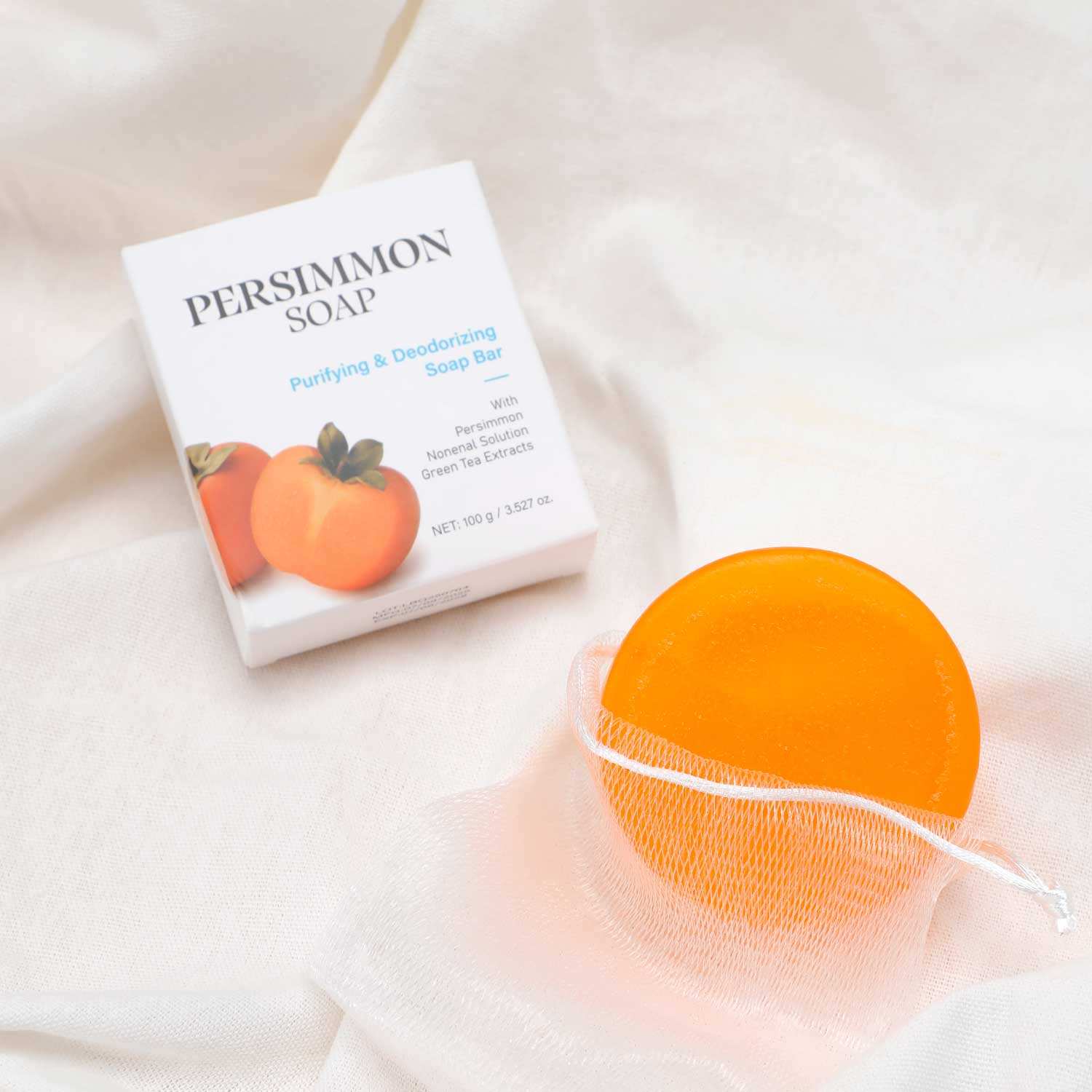

Persimmon soap vs charcoal soap for odor: does persimmon soap remove smell? A formulator ranks tannin bars for underarm odor by ingredients & cost.
Do persimmon (kakishibu) soaps genuinely control body odor, or is it clever marketing? Short answer: the good ones neutralize odor chemically rather than perfuming over it — but formula quality varies wildly. This is a formulator's comparison, judged on five things: active tannin concentration, deodorizing mechanism, skin compatibility, lather and rinse behavior, and cost-per-use. No fluff, no marketing roundup — just how these bars actually behave against real odor molecules.
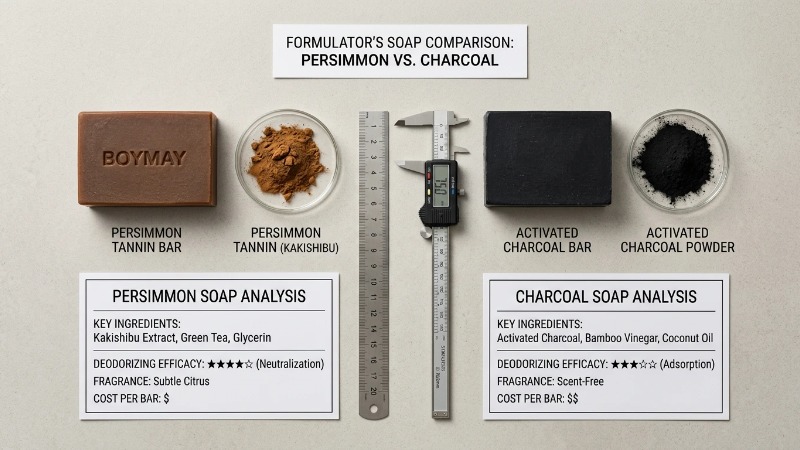
How Persimmon Tannin Actually Neutralizes Odor
Kakishibu — fermented juice from astringent Japanese persimmon — is loaded with condensed tannins (proanthocyanidins). These polyphenols carry abundant hydroxyl groups that latch onto odor-causing compounds and pull them out of the air-liquid interface, so your nose never registers them.
Two mechanisms run in parallel. First, tannins bind amines and volatile fatty acids like isovaleric acid (foot/sweat sourness) and 2-nonenal, forming larger, non-volatile complexes. Second, tannins are mildly antibacterial, suppressing the skin flora that convert sweat into stink in the first place. Bind the odor, starve the source.
Persimmon Tannin vs. Masking Fragrance — The Key Distinction
Here's where most articles wave their hands. A fragranced soap covers odor for maybe 20 minutes until the perfume fades and the amines re-volatilize. Tannin doesn't hide anything — the offending molecule is chemically bound and structurally changed, so it can no longer reach an odor receptor.
Think of it as the difference between spraying air freshener over a spill versus wiping the spill up. When someone asks does persimmon soap remove smell, the honest answer is that a real tannin bar removes it at the molecular level; a fragrance-only "persimmon" bar just masks it.
Nonenal and Aging-Related Body Odor
Persimmon soap gets pushed hard for "aging odor," and there's a real reason. As we age, skin lipids oxidize and produce 2-nonenal, a greasy, grassy note that ordinary soap struggles to shift. Tannins bind nonenal effectively, which is why these bars became a Japanese bathroom staple.
Effective bars typically carry a persimmon extract loading in the 0.1–0.3% range. Below that, you're mostly buying color and scent. Genuine persimmon deodorizing soap ingredients should show meaningful tannin content, not a trace splash.
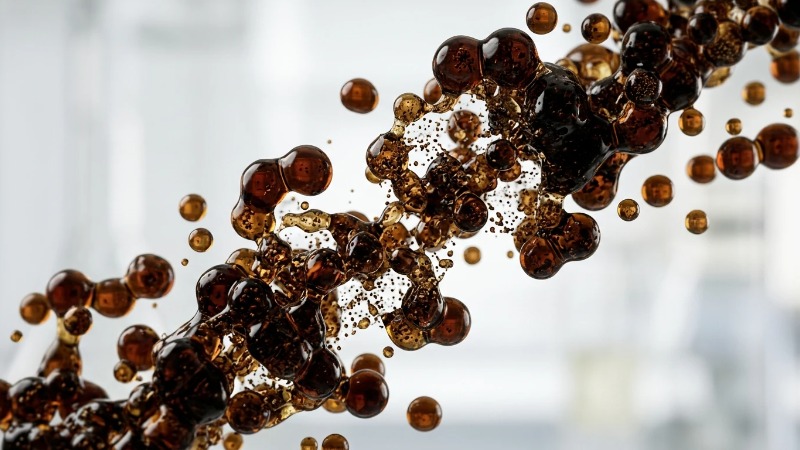
Evaluation Criteria for This Comparison
- Active tannin concentration — is there enough kakishibu to matter?
- Deodorizing mechanism — binding, adsorption, antibacterial, or all three?
- Skin compatibility — pH, astringency, dryness risk.
- Lather and rinse — clean rinse without tannin residue staining.
- Cost-per-use — price against bar longevity.
What "Effective" Means for a Deodorizing Bar
Let's set honest expectations. "Effective" here means measurable amine reduction on skin, a drop in odor-forming bacterial load after washing, and a residual effect that carries for several hours. It does not mean 24-hour antiperspirant performance. Any bar claiming all-day dryness is overreaching.
Formula Comparison: Persimmon vs. Charcoal vs. Sulfur vs. Combination Bars
| Formula Type | Primary Active | Deodorizing Mechanism | Best For | Typical Price (per bar) |
|---|---|---|---|---|
| Pure persimmon tannin | Kakishibu extract | Amine binding + antibacterial | Underarm & aging odor | ~$8–14 |
| Persimmon + charcoal | Tannin + activated carbon | Binding + adsorption | Oily skin, sweat odor | ~$10–16 |
| Charcoal-only | Activated carbon | Adsorption/absorption | Mild daily odor | ~$6–12 |
| Sulfur bar | Colloidal sulfur | Antibacterial/keratolytic | Body acne + odor | ~$7–13 |
Note: price bands reflect typical mid-market retail ranges.
Pure Persimmon Tannin Bars
These do one thing exceptionally well: neutralize amine and nonenal odor with a gentle, astringent finish. Skin feels tightened but not stripped. The trade-off is they're weaker against heavy sebum — if your problem is oily buildup rather than smell, tannin alone won't fully clear it. They also sit at the higher end on cost. Best for underarm odor and that "morning collar" staleness.
Persimmon + Charcoal Hybrids
The dual-action logic is sound. Charcoal's porous structure adsorbs excess oil and larger odor particles, while tannin handles the amines charcoal can't bind. For sweat-prone, oily skin this combination tends to outperform either single active. Watch the downside: stacking two astringent-drying actives can over-dry, so look for hybrids with a bumped superfat level.
Sulfur vs. Charcoal Deodorizing Bars
This is the comparison people run before they discover persimmon. In the sulfur vs charcoal deodorizing bar matchup, sulfur wins on bacterial odor and body acne thanks to its antibacterial, keratolytic action — but it's harsh and carries that distinctive rotten-egg note. Charcoal is far gentler and pleasant, yet works only by adsorption, so it fades once the pores saturate.
Persimmon often beats both on amine-type odor specifically, because binding chemistry addresses the exact molecules charcoal merely traps and sulfur only indirectly reduces. Different tools, different jobs.
Skin Compatibility and Formulation Trade-offs
Tannins are astringent by nature. That tightening feel is the tannin cross-linking surface proteins — useful for pore refinement, risky for compromised or very dry skin. A well-built bar keeps pH near 8–9 (soap territory) and pairs a milder surfactant base with 5–8% superfat to buffer the drying pull.
If you have eczema or a damaged barrier, introduce any tannin bar slowly and limit contact time. For persimmon soap for underarm odor, a short lather-and-rinse rather than prolonged scrubbing gives the odor benefit without over-stripping delicate skin.
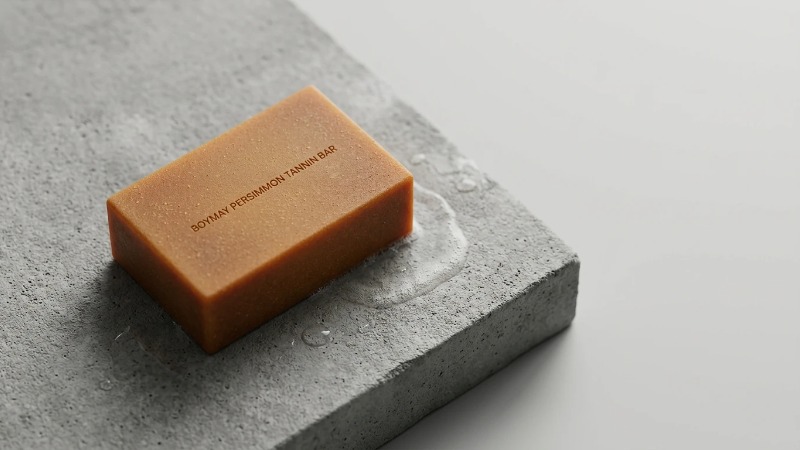
Reading the Ingredient Label
The single most useful skill: read the INCI list. Genuine tannin content appears as Diospyros kaki (persimmon) extract or fruit juice positioned reasonably high, not buried at the tail beside the fragrance. If "persimmon" shows up only inside the fragrance blend, you're buying scent, not kakishibu odor-eliminating ingredients. Real permingaki extract soap formulation lists the botanical as an actual active.
The Verdict: Best-Fit Recommendations
There's no universal winner — match the formula to your dominant odor type.
Best for Underarm Odor
A pure persimmon tannin bar. Amine binding directly targets the compounds behind armpit smell, and the gentle finish suits daily use. This is the strongest pick for best persimmon soap for body odor when the issue is smell, not oil.
Best for Oily Skin
A persimmon + charcoal hybrid. You get odor binding plus oil adsorption in one pass — ideal for heavy sweaters and warm climates.
Best Budget Pick
A charcoal-only bar for mild daily odor. It won't match tannin on amines, but for light control at a lower price, it's a reasonable entry. Settling the persimmon soap vs charcoal soap question really comes down to whether your odor is amine-driven (persimmon) or oil-driven (charcoal).
Next Steps
Use the comparison table to match a bar to your primary odor type — amine-driven odor points to persimmon, oil-driven odor to charcoal or a hybrid. Always patch-test on your inner forearm for 48 hours before switching product lines or committing to a bulk order, especially if your skin runs sensitive.
For formulators and retailers: request a tannin-concentration spec sheet before sourcing, and confirm the Diospyros kaki extract is a functional active rather than a fragrance component. That single check separates a bar that works from a bar that only smells like it should.
FAQ
Q: Does persimmon soap actually remove smell, or just mask it?
A: A genuine tannin bar neutralizes odor by chemically binding amines and nonenal into non-volatile complexes — it removes the smell at the source rather than covering it. A fragrance-heavy imitation only masks, so check the ingredient list before assuming it works.
Q: Is persimmon soap better than charcoal soap for body odor?
A: For amine-type odor (underarm, aging odor), persimmon usually wins because tannin binds those specific molecules. Charcoal is better for oily skin and mild daily odor since it works by adsorption. Hybrids give you both.
Q: How long does the deodorizing effect last?
A: Realistically several hours, not all day. It's a wash-off product, so residual protection depends on your activity and sweat level. Reapply with your next wash rather than expecting antiperspirant-level endurance.
Q: Can it replace deodorant?
A: It complements deodorant, it doesn't fully replace it. Persimmon soap reduces the odor load at the source, but heavy sweaters will still want a topical deodorant or antiperspirant for all-day coverage.