
You poured a candle, it smelled incredible in the jar, and you couldn't wait to light it. Then you did, and the fragrance practically disappeared into thin air. Sound familiar?
This is one of the most common frustrations new candle makers run into. The good news is that weak or uneven scent is almost always fixable once you understand a few key principles. Let's break it down step by step, no chemistry degree required.
Why Scenting Candles Is Trickier Than It Looks
Scenting a candle feels like it should be simple: add fragrance, stir, pour. But the reality is that several factors work together to determine how a candle actually smells once it's burning.
The type of scent you choose, how much you add, the temperature when you add it, and even how long you wait before lighting all play a role. Get one wrong and the whole thing can fall flat. Get them all right and you'll have a candle that fills the room.
The Difference Between "Cold Throw" and "Hot Throw"
When candle makers talk about candle scent throw, they're describing how far and how strongly a fragrance travels. There are two kinds, and knowing the difference helps you troubleshoot.
Cold throw is the scent you smell when the candle is unlit, sitting on a shelf. Hot throw is the scent released when the candle is burning and the wax pool warms up.
Most beginners nail the cold throw but struggle with hot throw. That's the gap we're going to close.
Choosing Your Scent: Fragrance Oils vs. Essential Oils
Before you measure anything, you need to decide what kind of scent you're working with. There are two main options, and each comes with tradeoffs.
Fragrance Oil for Candle Making
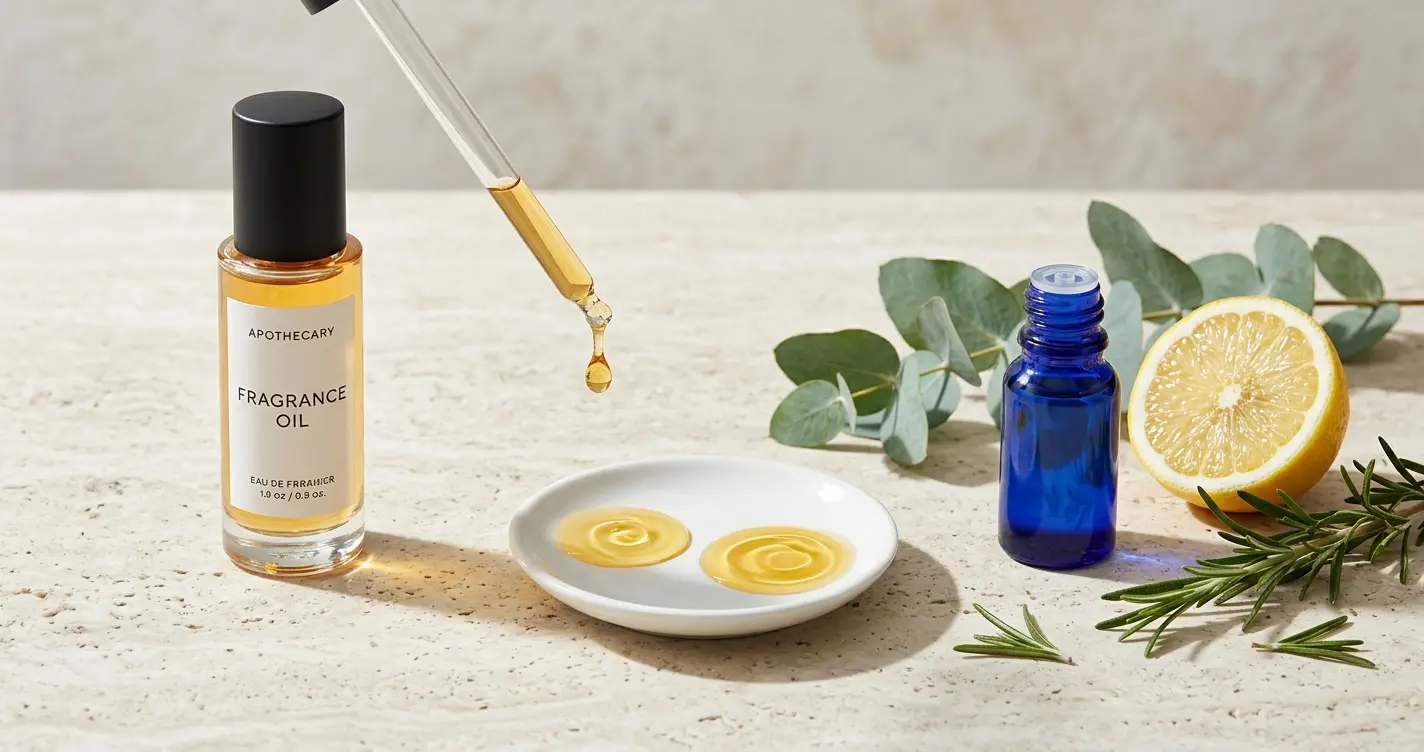
Fragrance oils are synthetic or partly synthetic blends designed specifically to perform in wax. They're the go-to choice for most makers because they deliver strong, consistent throw and come in an almost endless range of scents, from bakery and fruity to floral and complex designer dupes.
When shopping, look for fragrance oil for candle making rather than oils meant only for skin care. Candle-specific oils are formulated to handle the heat of a burning wick.
Pay attention to the flashpoint too. This is the temperature at which the oil can ignite, and it tells you the safe range for adding it to your wax.
Essential Oils for Candles
Essential oils are the natural alternative, distilled directly from plants. They appeal to anyone wanting a clean, botanical product, and scents like lavender, eucalyptus, and citrus are popular.
Be realistic about throw, though. Many essential oils for candles burn off quickly or fade once heated, so the hot throw is often softer than with fragrance oils.
Some perform better than others. Heavier oils like patchouli, cedarwood, and clove tend to hold up in wax, while delicate citrus oils can vanish fast. They're also more expensive, since it takes a lot of plant material to produce a small amount of oil.
Quick Comparison Table
| Factor | Fragrance Oils | Essential Oils |
|---|---|---|
| Throw strength | Strong and reliable | Variable, often softer |
| Cost | More affordable | Higher |
| Natural vs. synthetic | Synthetic blends | Plant-derived |
| Ease of use | Beginner-friendly | Requires more testing |
| Scent range | Huge variety | Limited to botanicals |
How Much Scent to Add: Getting the Load Right
This is the make-or-break section. More than any other factor, the amount of fragrance you use determines whether your candle delivers.
What Fragrance Load Percentage Actually Means
Fragrance load percentage is simply the weight of fragrance relative to the weight of your wax. So a 10% load means the fragrance equals 10% of the wax weight.
Here's the part that trips people up: more is not always better. Every wax has a saturation point, and adding past it won't boost your scent.
Overloading can actually cause problems like oil sweating on the surface, a poor burn, or wasted fragrance. There's a sweet spot, and going beyond it backfires.
Recommended Fragrance Load by Wax Type
Different waxes hold fragrance differently. Here are practical starting ranges, though you should always check the maximum load listed for your specific wax.
Soy wax: typically 6% to 10%
Paraffin wax: often up to 10% or slightly more
Soy-paraffin blends: usually 8% to 10%
Coconut and apricot blends: can sometimes handle 10% to 12%
Since soy is the most popular beginner wax, it's worth a closer look. When adding scent to soy wax, many makers find 8% to 9% gives the best balance of strong throw without sweating. Soy can be a bit fussy, so testing in small batches pays off.
How to Calculate Your Fragrance Amount
The math is easier than it sounds. Take the weight of your wax and multiply by the percentage you want.
Say you're using 16 ounces of wax and aiming for an 8% load. Multiply 16 by 0.08 and you get 1.28 ounces of fragrance oil.
Want a 10% load instead? Multiply 16 by 0.10 for 1.6 ounces. Always measure by weight on a kitchen scale, not by volume, for accuracy.
When and How to Add Fragrance for Maximum Throw
You've picked your scent and dialed in the amount. Now timing and technique come into play, and these are the two things beginners most often overlook.
The Right Temperature to Add Scent
Adding fragrance at the correct wax temperature helps the oil bind properly into the wax. For most soy waxes, that's around 180 to 185°F, but check your wax and oil guidance.
If the wax is too hot, the fragrance can burn off before it even sets. If it's too cool, the oil won't fully incorporate and you'll get uneven scent or pockets of oil.
Stirring and Binding Properly
Once you add the fragrance, stir gently but thoroughly for about two minutes. This distributes the oil evenly throughout the wax.
Don't rush this or whip it aggressively. Slow, complete mixing is what you're after, so every part of the candle carries the same scent.
The Importance of Curing Time
Here's the step almost everyone skips: curing. After pouring, the candle needs time to rest so the fragrance can fully bind with the wax.
For soy candles, a cure of one to two weeks dramatically improves hot throw. It feels like forever when you're excited, but the difference between a freshly poured candle and a properly cured one can be night and day.
Troubleshooting Weak or Uneven Scent
If your candle isn't performing, run through this quick checklist before giving up on a recipe.
My Candle Smells Great Cold but Weak When Lit
This is the classic complaint. The usual suspects are a wick that's too small to create a full melt pool, a fragrance load set too low, or simply not enough cure time.
Try sizing up your wick, bumping the load closer to your wax's maximum, and giving the candle a full two-week cure before judging it.
My Candle's Scent Is Too Strong or Overpowering
Yes, this happens too. If a candle is headache-inducing or the oil is sweating out, you've likely oversaturated the wax.
Scale the fragrance back to within the recommended range. Remember, going past saturation doesn't make it stronger, it just creates problems.
Matching Wick Size to Scent Throw
Your wick does more than hold a flame. It determines how big your melt pool gets, and the melt pool is what releases fragrance into the air.
A wick that's too small leaves a weak throw no matter how much oil you add. Testing a couple of wick sizes is often the fastest way to unlock better hot throw.
When DIY Reaches Its Limits: Scaling Up With a Manufacturing Partner
At some point, a hobby can turn into something bigger. Maybe friends keep asking to buy your candles, or you're dreaming of launching your own brand.
That's an exciting leap, but it comes with a challenge. Pouring ten candles by hand is one thing. Producing hundreds or thousands with the exact same scent strength every single time takes specialized equipment and serious expertise.
What Professional Manufacturing Adds
A certified manufacturer can lock in a consistent fragrance load, reliable throw, and safety compliance batch after batch, something that's tough to guarantee on a home stovetop.
This is where experience matters. Since 1995, Boymay has specialized in OEM/ODM manufacturing of bath bombs, shower steamers, and personal care products, building the kind of process control that keeps quality steady at volume.
With a 40,000㎡ facility and 16 automated production lines, the scale is there to grow with your brand while keeping every unit true to your formula.
Customization and Low Minimums for Growing Brands
One of the biggest worries for emerging brands is being forced into huge orders before they're ready. Boymay works differently, offering a low minimum order quantity starting at just 1,000 pcs, which makes a custom product realistic for smaller and growing labels.
Customization runs deep too. You can tailor scent profiles, sizes, and packaging to match your vision rather than settling for an off-the-shelf product.
And because trust matters when you're putting your name on something, it helps to know production is backed by internationally recognized GMP, ISO, FDA, and SMETA certifications.
Ready to Turn Your Scent Ideas Into a Product?
If your kitchen experiments are starting to feel like the beginning of a real brand, you don't have to scale alone. Whether you need private label support or fully custom manufacturing, the right partner can bring your fragrance ideas to life.
Reach out to Boymay to talk through your concept, and see how a flexible, certified manufacturer can help you go from a single jar to a shelf-ready collection.
Frequently Asked Questions
Q: How much fragrance oil should I use per pound of wax?
A: A pound of wax is 16 ounces, so an 8% load means about 1.28 ounces of fragrance and a 10% load means about 1.6 ounces. Always check the maximum load your specific wax can handle, since pushing past it causes problems rather than a stronger scent.
Q: Can I mix essential oils and fragrance oils together?
A: Yes, blending the two is perfectly fine and a popular approach. Many makers use fragrance oils for a reliable base throw and add essential oils for a natural, botanical character, just keep your total within the wax's recommended load.
Q: Why does my candle lose its scent after a few days?
A: Fragrance naturally evaporates over time, especially if the candle sits uncovered in warm or sunny spots. Store candles in a cool, dark place and keep a lid on them between burns to preserve the scent much longer.
Q: How long should candles cure before burning?
A: For soy and most natural waxes, aim for a one to two week cure. This resting period lets the fragrance fully bind with the wax, which significantly improves hot throw compared to lighting a candle right after pouring.
Q: Are essential oils safe to burn in candles?
A: They can be, but you need to mind the flashpoint, the temperature at which the oil could ignite. Use essential oils suited for candle making, add them within safe temperature and load guidelines, and test in small batches to be sure they perform safely.