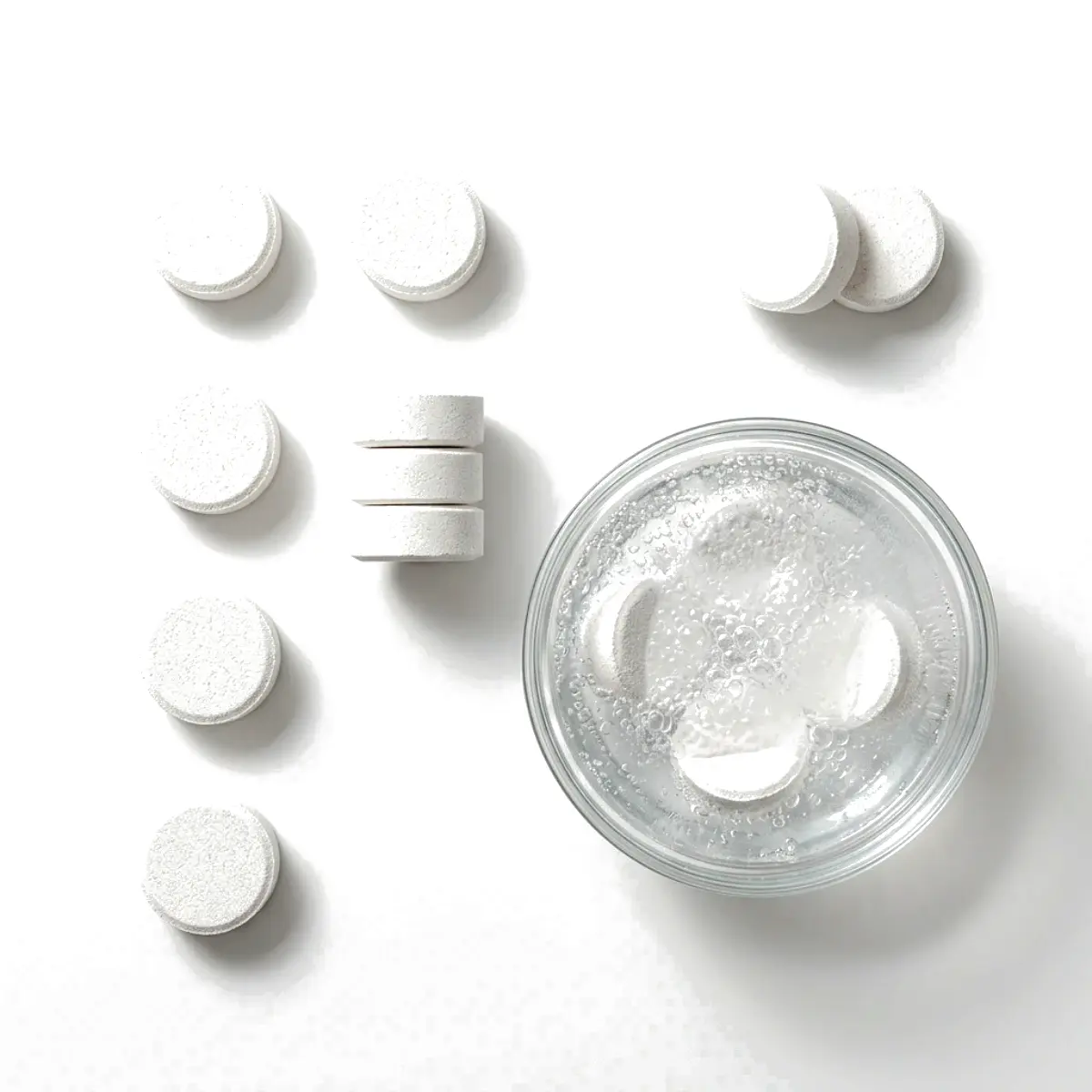

If you've ever opened the dishwasher to find a chalky lump wedged in the dispenser, or watched a bath fizzy sit half-dissolved at the bottom of the tub, the usual culprits are surprisingly few: cold water, hard water minerals, not enough water movement, or a tablet that's old or stored badly. This affects almost everyone who uses tablets — dishwasher and laundry users, toilet and denture tablet users, and people buying effervescent bath products. What's happening is a chemistry problem, not magic, and it matters because incomplete dissolving wastes product, leaves films on surfaces, and gives you a weaker clean than you paid for.
Quick Answer: The 4 Most Common Reasons
When a tablet won't break down, it's almost always one of these:
- Water temperature is too low — cold water slows the whole reaction.
- Hard water minerals interfere — calcium and magnesium form insoluble films.
- Not enough water movement or soak time — stagnant water stalls dissolution.
- Old, compressed, or poorly stored tablets — moisture and age change density.
Key Takeaways
- Most dissolving failures are usage-related, not product defects.
- Warmer water dramatically speeds up disintegration and dissolution.
- Hard water is the single most common cause of white residue and spotting.
- Tablets need moving water and enough time — not just submersion.
- Humidity exposure during storage can "pre-set" a tablet so it won't break down later.
How a Cleaning Tablet Is Actually Supposed to Dissolve
The basic chemistry in plain language
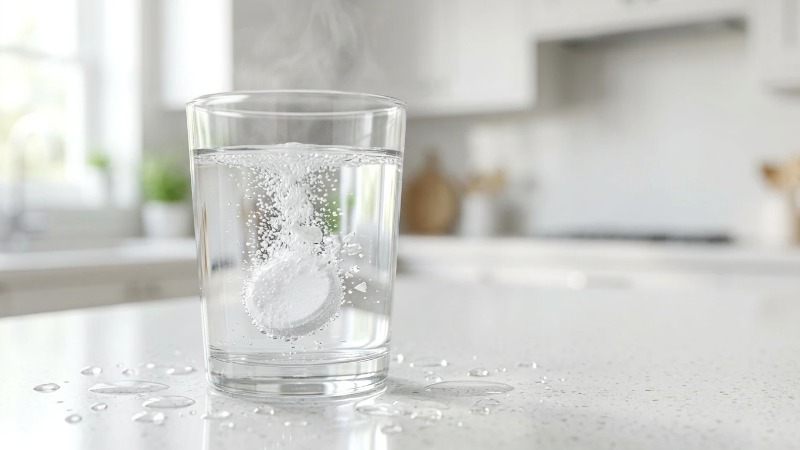
A tablet doesn't "melt." It goes through a sequence: the surface gets wet, water penetrates the compressed matrix, the tablet swells and breaks apart (disintegration), and then the active ingredients actually dissolve into the water. The effervescent tablet dissolution rate depends on how fast each of those steps happens.
In effervescent types, a reaction between an acid (often citric acid) and a carbonate releases carbon dioxide. Those bubbles physically push the tablet apart from the inside — which is why a working fizzy tablet erupts rather than slowly shrinking.
Effervescent vs. compressed (non-fizzing) tablets
There are two dominant families. Effervescent tablets rely on gas generation to self-disintegrate quickly. Compressed non-fizzing tablets — many dishwasher and laundry formats — depend on water penetration, mechanical agitation, and heat to break apart. That difference explains a lot: a bath fizzy left in still water still works, but a dense dishwasher tablet in a cold, short cycle often won't.
Why speed varies by product type
Expected behavior differs by design. A bath or denture effervescent tablet usually breaks apart in a minute or two in warm water. A dishwasher tablet is engineered to release across a longer heated cycle, and a laundry tablet depends on tumbling and water volume. None of these are meant to vanish instantly.
Reason 1: Water Temperature Is Working Against You
The cold-water problem
The water temperature effect on dissolving tablets comes down to molecular speed. Warmer water molecules move faster, penetrate the tablet quicker, and carry dissolved particles away more efficiently. Cold water does the opposite — everything slows, and the tablet can sit intact long after the cycle logic expects it gone.
Real-world example
A classic case: someone runs a short "eco" or "quick" dishwasher cycle that never fully heats. The tablet gets partially wetted, forms a gummy outer layer, and the inside stays dry. Result — a chalky film on glasses and a half-tablet stuck in the dispenser door.
| Water Temperature | Dissolve Speed | Residue Likelihood | Best-Use Note |
|---|---|---|---|
| Cold (below ~20°C) | Slow / incomplete | High | Avoid for dense tablets |
| Lukewarm (~25–35°C) | Moderate | Medium | Fine for most bath/soak tablets |
| Hot (~45–60°C) | Fast and complete | Low | Ideal for dishwasher/laundry |
General guidance only — exact behavior varies by formulation.
Reason 2: Hard Water and Mineral Buildup
What hard water does to solubility
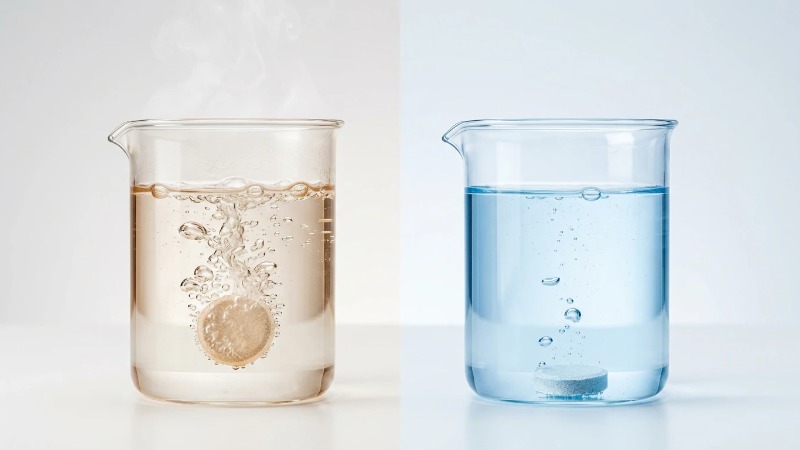
The hard water impact on tablet solubility is underrated. Calcium and magnesium ions react with surfactants and binders, forming insoluble compounds — the same chemistry behind soap scum and limescale. Instead of rinsing clean, these form a film that clings to dishes, fabric, and tub surfaces.
How to know if hard water is your issue
Look for the signs: a persistent white film on glassware, spotting after drying, scale around faucets, and residue that returns no matter which product you try. If your region is known for hard water, that's usually your answer before you blame the tablet.
| Water Hardness | Typical Classification | Expected Residue Impact |
|---|---|---|
| Soft | 0–60 mg/L (as CaCO₃) | Minimal |
| Moderately hard | 61–120 mg/L | Occasional spotting |
| Hard | 121–180 mg/L | Noticeable film |
| Very hard | Over 180 mg/L | Heavy residue, slow rinse |
Ranges follow common water-authority classification conventions; check your local utility's hardness report for exact figures.
Reason 3: Not Enough Agitation or Dwell Time
Why water movement matters
Water right next to a dissolving tablet quickly becomes saturated. Without movement, that saturated layer acts like a barrier and dissolution stalls. Agitation — tumbling, spray arms, or a quick stir — refreshes the contact surface and keeps the reaction going. This is one of the most common reasons behind undissolved tablet residue causes that have nothing to do with the product itself.
Soak time and placement mistakes
People trip over small things: a tablet jammed in a closed dispenser, dropped into a bone-dry drawer where it never gets wet early enough, or used in a cycle that's simply too short to finish. For soak-type tablets, pulling the item out before the fizz finishes leaves half the active behind.
Reason 4: The Tablet Itself — Formulation, Age, and Storage
Ingredients that affect dissolving
Several cleaning tablet formulation ingredients shape dissolve speed — binders that hold the shape, fillers that add bulk, disintegrants that help water penetrate, and the compression pressure used during pressing. Press a tablet too hard and it becomes dense and slow; too soft and it crumbles. Good manufacturing finds the balance.
Humidity and shelf life
Moisture is the quiet enemy. If a tablet is exposed to humidity in storage, its surface can partially react and harden — forming a shell that later refuses to break apart in water. That's why effervescent and cleaning tablets ship in sealed foil or moisture-resistant packaging, and why they should be kept dry, sealed, and out of bathrooms with steam exposure.
When a manufacturing or quality issue is to blame
To be fair: most dissolving problems trace back to water or usage, not the factory. But chronic residue across a full batch — regardless of water or cycle — can point to inconsistent compression, poor ingredient distribution, or weak QC. This is where standards matter. Buyers should expect suppliers working under GMP and ISO-type quality systems that control compression force, ingredient uniformity, and moisture during production.
Undissolved Residue: Is It Harmful or Just Annoying?
Safety and surface concerns
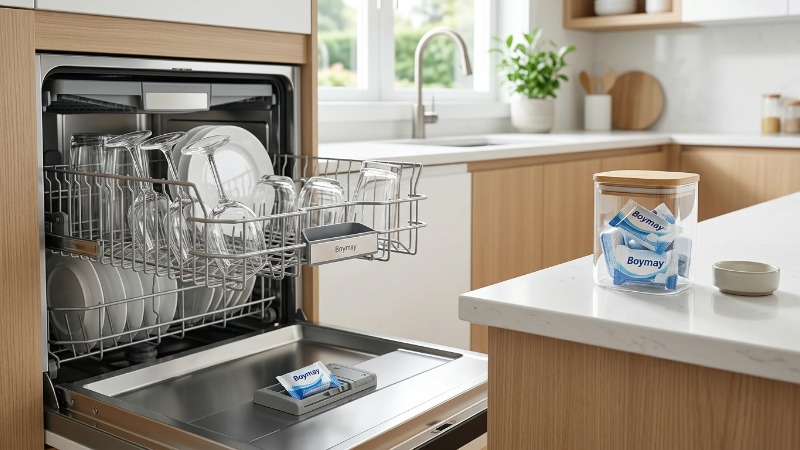
In most cases, leftover residue is cosmetic rather than dangerous — a film you can rinse or re-wash away. That said, for anything with food contact (dishes) or skin contact (bath and personal-care tablets), thorough rinsing matters. If you notice persistent film on items that touch food or skin, run an extra rinse and review your water and product factors rather than ignoring it.
Cost and performance impact
The practical cost adds up: wasted product, extra wash cycles, higher water and energy use, and uneven cleaning that makes you reach for more product than you actually need. Over a year, repeated re-washes quietly inflate both your bill and your frustration.
Pros & Cons: Tablets vs. Powders vs. Liquids
| Factor | Tablets (Advantages) | Tablets (Limitations) |
|---|---|---|
| Dose control | Pre-measured, no guessing or spills | Can't adjust for light loads |
| Convenience | Clean, portable, easy to store | Needs correct temperature and cycle |
| Residue risk | Low in warm, soft water | Higher in cold or hard water than liquids |
| Cost | Reduces overdosing waste | Often higher per-use than powder |
| Dissolve speed | Fast when well-formulated | Slower than liquids by nature |
Liquids dissolve instantly and suit cold water; powders are cheap and flexible but easy to over-pour. Tablets win on precision and tidiness — as long as the conditions are right.
How to Fix Incomplete Dissolving (Step-by-Step)
For appliance tablets (dishwasher and laundry)
- Raise the water temperature — skip ultra-cold eco modes for heavy loads.
- Use a longer cycle so the tablet has time to release fully.
- Clean the dispenser; stuck residue blocks the next tablet from wetting.
- Add a rinse aid to cut mineral spotting in hard water.
- If hardness is severe, consider a water softener or salt-based system.
For soak, bath, and personal-care tablets
- Use enough warm water — small volume saturates and stalls dissolution.
- Give it a gentle stir to keep fresh water in contact with the surface.
- Let the fizz finish before removing the item from the water.
- Use fresh product from sealed packaging; discard anything that feels hard or damp.
For brands, these last two points tie directly into formulation flexibility — a well-designed effervescent base dissolves cleanly even in less-than-ideal home conditions.
What This Means for Brands and Private-Label Buyers
Formulation choices that reduce residue
Solubility can be engineered. The right disintegrant, controlled compression, careful ingredient selection, and moisture-protective packaging all shift a tablet from "stubborn" to "clean-rinsing." Vegan formulation options and animal-cruelty-free development are increasingly expected by retailers in North America, Europe, and the Middle East, and they don't have to compromise dissolve performance.
At Boymay, this is the practical side of what we do. Since 1995 we've focused on OEM and ODM manufacturing of bath bombs, shower steamers, cleaning tablets and personal-care products across a 40,000-square-meter facility with 16 automated lines. For buyers testing a new concept, development stays accessible — custom samples typically in 7–14 days, bulk lead times of 25–30 days, and an MOQ starting at 1,000.
Forward look
Heading into 2027, the clear direction is faster-dissolving, cleaner-rinsing, and more sustainable tablet formulations — lower residue, friendlier ingredient lists, and packaging that protects against the humidity that quietly ruins shelf performance.
Conclusion
Dissolving problems look mysterious, but they almost always come down to water temperature, hardness, movement, or an aging tablet — and every one of those is fixable once you spot it. Match the right tablet to the right conditions and the residue disappears.
If you're a brand or retailer looking to launch tablets or personal-care products that rinse clean and perform reliably — whether in soft or hard water — we're glad to help with custom, fast-dissolving formulations developed under GMP, ISO, FDA, and SMETA-certified standards, with low MOQ and quick sampling. Reach out to Boymay to talk through your concept and we'll build a sample worth testing.
Frequently Asked Questions
Q: Why does my tablet leave white residue even in hot water?
A: Heat rules out temperature, so the likely cause is hard water. Calcium and magnesium react with the tablet's surfactants to form an insoluble film. A rinse aid or water softener usually solves it.
Q: Does water temperature really matter that much?
A: Yes. Warm water speeds penetration and dissolution significantly, while cold water can leave dense tablets half-intact — especially in short appliance cycles.
Q: How long should a cleaning tablet take to dissolve?
A: It depends on type. Effervescent bath and denture tablets break apart in roughly 1–3 minutes in warm water; dishwasher and laundry tablets are designed to release across a full heated cycle, not instantly.
Q: Can old tablets stop dissolving properly?
A: They can. Humidity exposure during storage lets the surface partially react and harden, forming a shell that resists breaking down. Keep tablets sealed, dry, and away from steam.
Q: Are undissolved residues dangerous?
A: Usually they're cosmetic rather than harmful. Still, rinse thoroughly for anything touching food or skin, and address the underlying water or product cause if residue is persistent.
Q: Can a tablet be reformulated to dissolve faster?
A: Absolutely. Adjusting disintegrants, compression pressure, and ingredient selection can meaningfully improve dissolve speed and reduce residue — a standard part of custom development.