
How to choose a cleaning tablet manufacturer: verify certification scope, MOQ and lead times, formula ownership, and spot trading firms posing as OEMs.
I've sat on both sides of the table. For years I ran production at a cleaning tablet plant — effervescent lines, blister packers, the whole noisy, dusty mess — and I've watched brand owners walk in with a beautiful spec sheet and walk out with a container of tablets that had fused into a solid brick somewhere off the coast of Singapore. Most "how to choose a supplier" articles are written by people who have never smelled a compression room at 2 a.m. This one isn't. I'll tell you what actually separates a real cleaning tablet OEM manufacturer from a trading company with a rented conference room, and the exact questions I'd ask if I were the one signing the purchase order.
The short version, if you're skimming
- A trading company and a factory look identical on a sourcing platform. The tells are in the certificate scope, the MOQ logic, and whether anyone will let you see the line live.
- MOQ is negotiable; lead time mostly isn't. Private label runs in this category typically start around 20,000–50,000 tablets per SKU, with 25–40 days of production after artwork approval.
- Certification you can verify beats certification you're shown. Match the ISO 9001 or ISO 22716 scope against your actual product category, not the cover page.
- Formula ownership is the hidden deal-breaker. Whoever owns the formula owns the relationship. Get it in writing before tooling starts.
- Price per tablet should never be your first column. Freight, breakage, and rework costs routinely dwarf a two-cent gap.
What does a cleaning tablet manufacturer actually do?
From raw powder to a tablet that survives the ocean
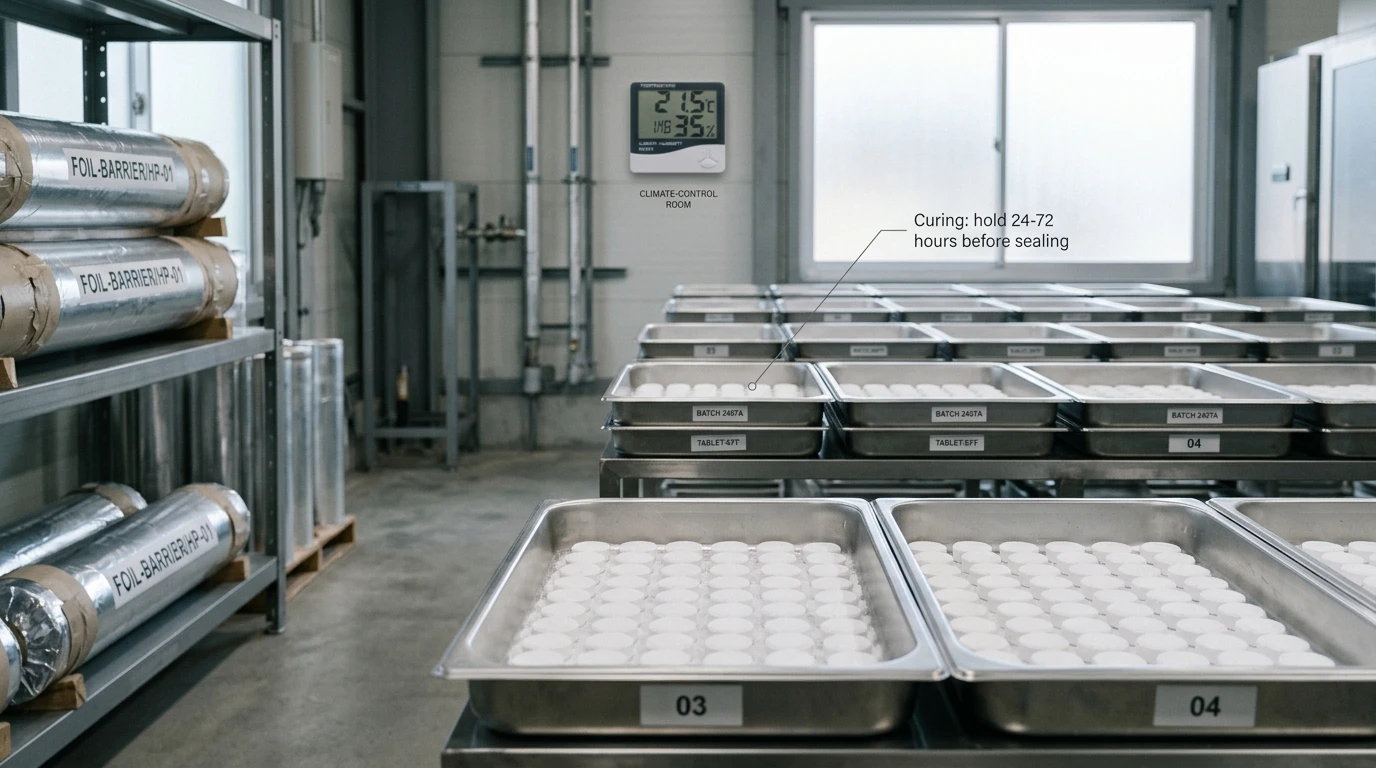
The line flow is boringly consistent across serious plants: incoming raw material QC, granulation, drying, blending, compression, optional coating, curing or aging, then blister or bulk packaging, then a stability spot-check on the retained samples. Nothing exotic.
The step buyers ignore is curing. Freshly compressed tablets are still chemically restless — effervescent systems especially, because any residual moisture starts reacting the moment the tablet is sealed. A plant that ships the same week it compresses is either running a formulation with almost no reactive content, or it's quietly betting your reputation on a coin flip. We age effervescent stock before packing, and that waiting time costs us warehouse space. It also costs money, which is precisely why the cheapest quote usually skips it.
The three types of suppliers you'll meet
- True factory (OEM/ODM): owns the presses, the mixing hall, the QC lab, and the people who run them.
- Trading company or sourcing agent: quotes everything, owns nothing, and disappears when a batch fails.
- Hybrid: a genuine factory that outsources one step — often tableting, sometimes packaging — to a partner. This is frequently the honest middle ground, provided they disclose which step and to whom.
Why this choice matters more than the formula
Effervescent and tablet-format cleaning products have grown fast across household, appliance, and light industrial segments, and private label demand has pulled hundreds of new "manufacturers" into the market. The number of suppliers listing cleaning tablets has multiplied in a few short years, but real compression capacity — presses, humidity-controlled halls, curing space — has not grown anywhere near as quickly. That gap is where your risk lives. You are not short of options. You are short of options that can actually make the thing.
What should you look for in a cleaning tablet OEM manufacturer?
First — can they actually compress your formula?
Not every plant can run high-surfactant or strongly alkaline blends; those wear tooling differently and behave badly in humid air. Ask directly: what's your maximum compression force, how do you control room humidity during tableting, and can you handle an effervescent system? A supplier who answers in marketing language instead of technical terms is a reseller. There's no third possibility.
Certifications that matter — and exactly what to check
This is where I see the most wasted diligence. Buyers collect PDFs like trading cards and never read the scope.
| Certification / Standard | What it actually covers | What a buyer should verify |
|---|---|---|
| ISO 9001:2015 | Quality management system | Scope names a relevant product category, not just "chemical trading" |
| ISO 22716 (GMP) | Good manufacturing practice for cosmetics and consumer care products | Signals real housekeeping and hygiene discipline — common where personal care lines run alongside |
| REACH / SDS compliance | EU chemical safety documentation | A current, revision-dated SDS per SKU, not one generic sheet for the whole catalogue |
| BRCGS or equivalent | Retailer-grade consumer goods safety | Often a hard gate for supermarket private label programs |
| Halal / Kosher (if relevant) | Formulation and facility compliance | Certified line, not merely a certified ingredient |
| Third-party audit report | SGS, Intertek, BV or similar | Dated within 12 months, with the supplier's legal entity name — not a group affiliate's |
MOQ and certification — the two numbers that decide everything
MOQ is a function of changeover cost, not greed. Every time a line stops, you lose the cleaning cycle, the first-off rejects, and several hours of output. That's why a factory quoting 5,000 units on a custom effervescent tablet is either lying to you or planning to fill your order from somebody else's stock under your label.
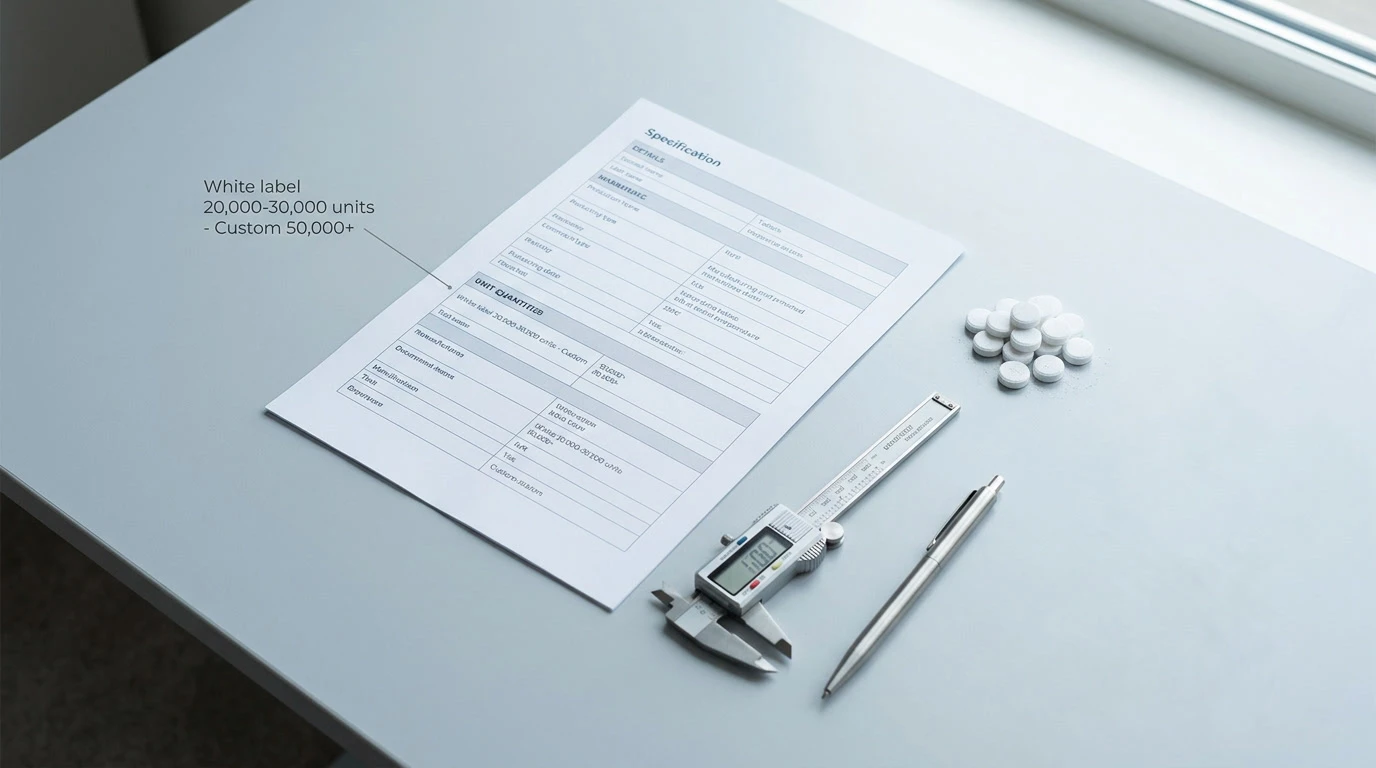
As a working benchmark: white-label tablet runs in this category usually open around 20,000–30,000 units per SKU, and custom formulations with new molds tend to start at 50,000 and climb. If your volumes are genuinely below that, the honest path is private label first — not a supplier who says yes to everything and then sub-contracts your job to a competitor.
How to vet a cleaning tablet supplier — a process I'd actually follow
Step 1 — Build a one-page requirement sheet
Tablet weight and diameter, target dissolution time, fragrance load, active percentage, primary and secondary packaging format, and the regulatory regime of your destination market. One page. If it runs to six, you haven't made the decisions yet. This sheet is also what makes quotes comparable — without it, you're comparing prices for five different products.
Step 2 — Ask five questions that reveal the truth
- Who owns the formula after development? The right answer is you, with a written assignment of IP. A vague "we'll share it" means you're renting your own product.
- Can I see the compression line on an unedited live call? Not a plant tour video from 2019. Live, with them walking to the machine. Refusal is an answer.
- What's your historical breakage rate on a comparable SKU? Serious plants track this. Anything under about 2% is healthy for well-packed bulk; 4–6% tells you the tablet is brittle or the packaging is wrong.
- Which parts of my order would be outsourced? Outsourcing isn't disqualifying. Undisclosed outsourcing is.
- What happens if a batch fails QC after it leaves your dock? Look for a specified rework or replacement clause, not goodwill.
Step 3 — Order samples from three suppliers, blind
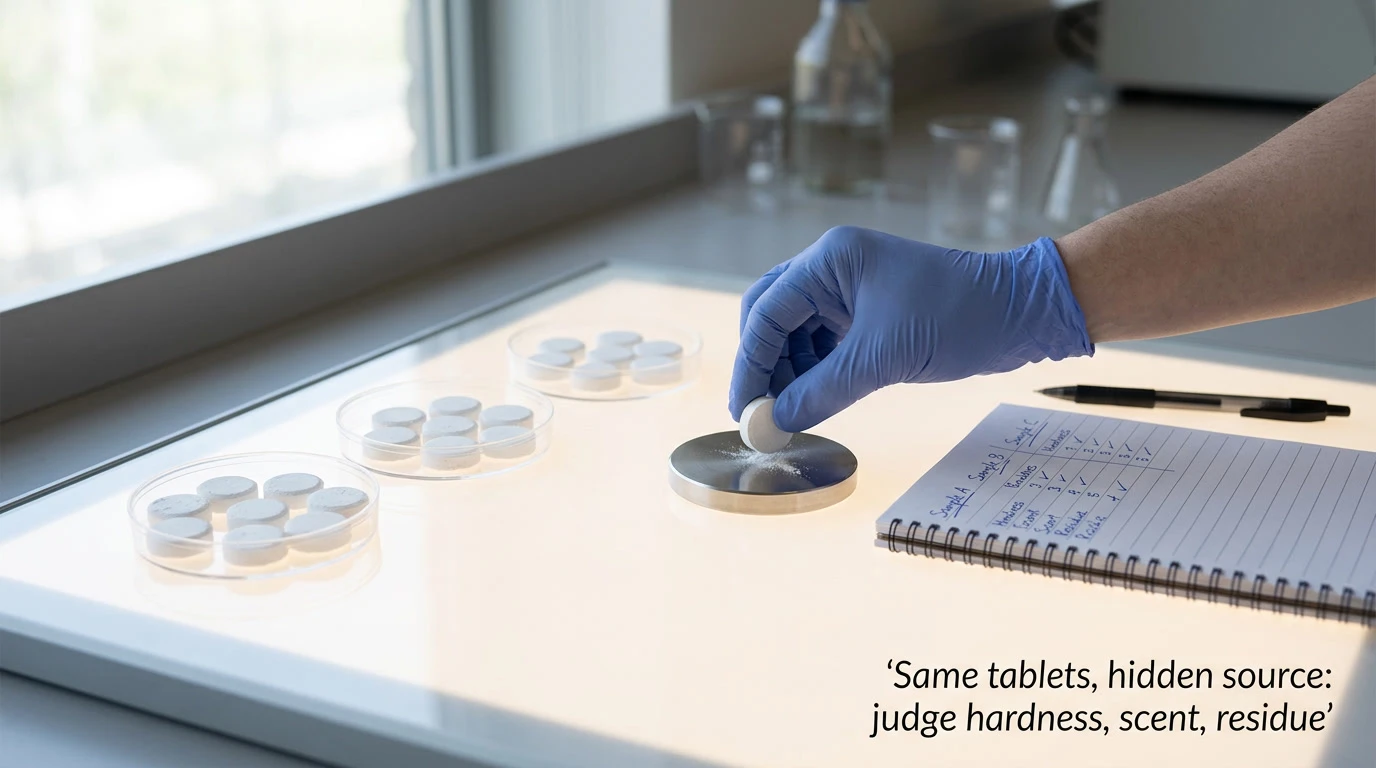
Relabel them before they reach your team. Ask people who don't know the source to judge hardness, fragrance carry-through, residue after the cycle, and whether the blister survived being dropped. Brochures don't fail; tablets do.
Step 4 — Run a small trial order before the big one
A fair pilot is usually one full batch at reduced scale, priced without the development fee if you commit to a follow-on volume. If a supplier won't run a pilot at all, they're either too busy to want your business or too thin to risk it.
Step 5 — Lock the terms in the contract
Formula ownership, exclusivity by market, tooling ownership, specification tolerances per parameter, and the rework clause. Get this right at signature, because fixing it later means paying twice.
Private label vs. custom OEM — which do you need?
Private label: fast, cheap, not yours
Existing formulas, your logo on the blister. It's the fastest route to shelf and the right call for testing demand. Just accept that your competitor can buy the identical tablet next month.
Custom OEM: slower, costlier, defensible
New formulation, your specification, your intellectual property. This is where a custom cleaning tablet OEM supplier earns its keep — and where the manufacturer selection criteria above actually bite.
| Factor | Private Label | Custom OEM |
|---|---|---|
| Typical MOQ | 20k–30k units | 50k+ units |
| Development time | 2–4 weeks | 8–16 weeks |
| Formula ownership | Usually the manufacturer | Negotiable — insist on buyer |
| Differentiation | Weak | Strong |
| Unit cost | Lower upfront | Higher upfront, better at scale |
The hybrid route most brands actually take
Launch on a white-label SKU, watch which variant sells, then migrate the winner to a custom formulation with your own fragrance and dissolution profile. You spend your development budget on the product that has already proven itself instead of on a guess. It's less glamorous than a bespoke launch and it converts far more often.
Common mistakes that cost buyers real money
- Trusting a certificate screenshot instead of checking the issuing body's registry. Screenshots are free.
- Comparing quotes without normalizing freight, packaging, and payment terms. A 3% price difference can vanish in Incoterms.
- Skipping the stability test on effervescent tablets. They are the most moisture-sensitive format in the category, and accelerated aging is the only way to know.
- Letting the supplier own the formula "for convenience." You are handing over your margin, permanently.
- Choosing on unit price and discovering a 4–6% in-transit breakage rate after the container lands.
- Never visiting, or at minimum never doing a live unedited walkthrough of, the actual line.
- Approving artwork before the physical sample. Blister films print differently than they photograph.
The bottom line
The right manufacturer is the one who lets you see the line, tells you plainly what they can't do, and puts formula ownership in writing without being asked twice. Everything else — the glossy deck, the "we can make anything" email, the price that seems too good — is price theater. Bring a spec sheet, ask the five questions, and let the answers sort the field for you.
Send me your spec and I'll tell you what's realistic
And if you're holding a quote right now and something about it doesn't add up, send it over. We'll walk through it with you — the MOQ logic, the certification scope, the lead time — and tell you honestly whether it holds up. Since 1995 we've run our own compression lines across a 40,000 m² facility with 16 automated production lines, GMP, ISO, FDA and SMETA certified, with minimum orders from 1,000 units and custom samples typically ready in 7–14 days. We'd rather give you a straight answer than a convenient one. Reach out and let's look at your spec together.
FAQ
Q: How do I verify a cleaning tablet manufacturer is a real factory?
A: Cross-check their legal entity name against business registries and the name on their audit reports. Ask for a live, unedited video walkthrough of the compression hall. And request their production license category — a real plant holds one that names manufacturing, not trading.
Q: What's a realistic MOQ for private label cleaning tablets?
A: Expect 20,000–30,000 units per SKU for established white-label formulas, and 50,000-plus for custom work with new tooling. MOQ moves with format: a single blister SKU carries one setup cost, while four fragrances in three pack sizes carries twelve.
Q: Which certifications should a cleaning tablet supplier have?
A: At minimum ISO 9001:2015 and compliant, revision-dated SDS documentation for every SKU. ISO 22716 adds real value where personal care lines run under the same roof. Retail private label usually requires BRCGS or an equivalent third-party audit.
Q: Can I own the formula?
A: Yes, and you should. Structure it as a written development agreement with IP assignment on payment of the development fee, plus an exclusivity clause covering your markets for a defined term. Never rely on verbal assurances here.
Q: How long does it take from sample approval to delivery?
A: Roughly this: 7–14 days for custom samples, 5–10 days for artwork and packaging approval, 25–40 days of production, then transit. Sea freight to North America or Europe is typically another 25–40 days, so plan on 10–14 weeks door to door for a first order.
Q: Is a cheaper supplier ever the right call?
A: Sometimes, yes — for a commodity SKU with no differentiation requirement, in a market where you compete purely on price. Then you buy the cheapest tablet that passes your basic QC. The moment you want a proprietary fragrance, a specific dissolution curve, or a retail listing that audits your supply chain, cheap stops being cheap.