
Real cleaning tablets minimum order quantity ranges, bulk wholesale prices, and cost per unit for private label MOQ runs — from the manufacturer side.
Most sourcing teams get quoted a price and a minimum order in the same breath — and then quietly assume the two are separate levers. They aren't. Get that relationship wrong and you either overpay by roughly 30% on a small run, or you tie up cash in a year's worth of tablets you can't move. This guide unpacks the real numbers behind cleaning tablet MOQs and unit costs, written from the manufacturing side of the table.
Where the Cleaning Tablet Market Sits Right Now
The tablet format has quietly eaten a bigger slice of the cleaning category over the past few years. Concentrated and effervescent formats — toilet cleaners, multi-surface tablets, dishwasher and laundry pods, degreasers — keep gaining shelf space because they cut water weight out of shipping and appeal to brands chasing a lower plastic footprint.
That shift has changed how MOQ conversations play out. Five years ago, custom tablet chemistry was mostly the domain of large national brands. Now DTC startups and regional distributors want private label runs too, which pushes suppliers to publish clearer minimums instead of quoting each buyer from scratch.
The demand drivers behind bulk ordering
Three things move volume. Concentrate-and-refill lines mean a brand reorders the same tablet SKU predictably. Hospitality and foodservice buyers run steady reorder cycles because housekeeping and kitchen sanitation never stop. And DTC cleaning brands, once they validate a product, jump from sample quantities to five- or six-figure orders fast.
Why MOQ is a manufacturing decision, not a sales tactic
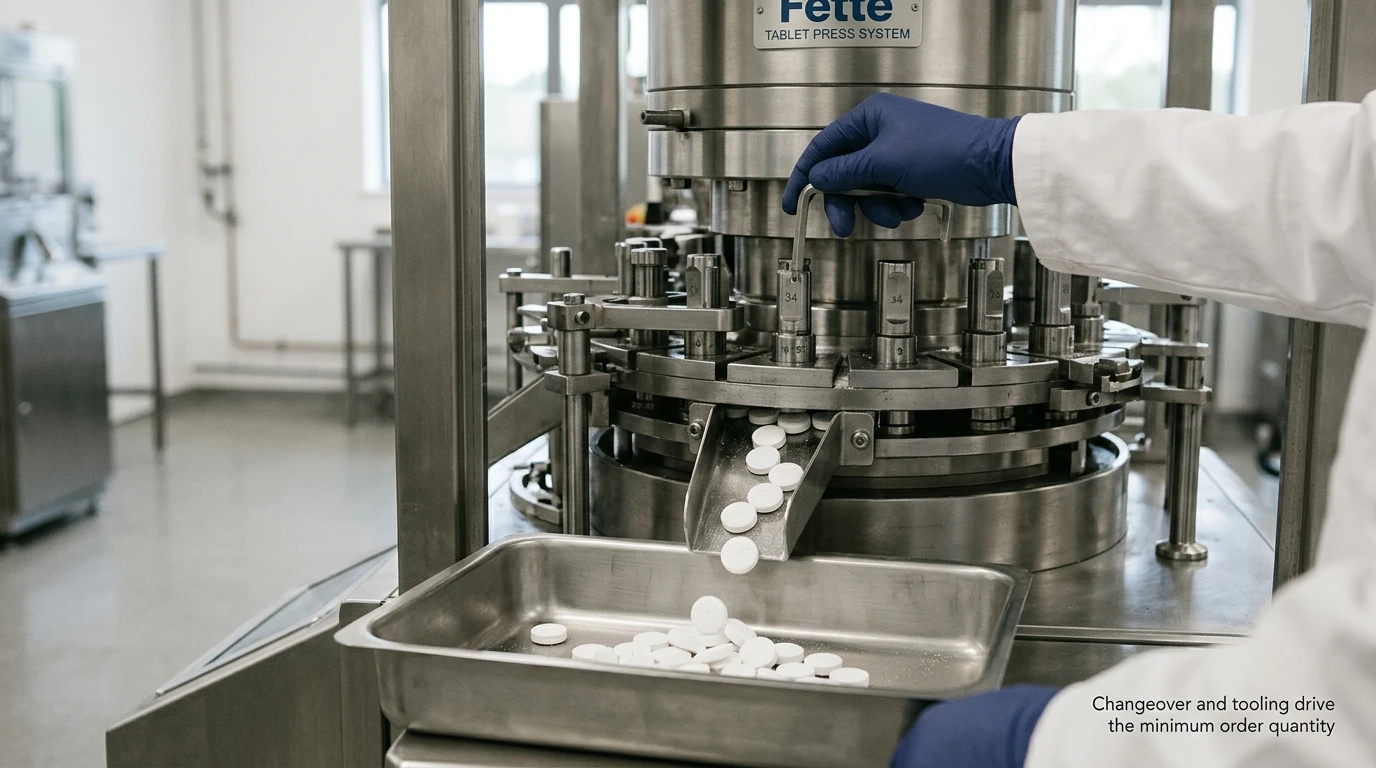
Buyers often read a minimum order as the supplier being difficult. It usually isn't. A tablet press has to be cleaned, tooled with the right punch dies, and calibrated for weight and hardness before a single good tablet drops. That changeover eats hours regardless of whether you run 5,000 units or 50,000.
Blends have their own floor too. Surfactants, effervescent bases and sequestrants are mixed in batch minimums — you can't accurately weigh a 2 kg trial of a formula designed for a 400 kg mixer. The MOQ exists to spread that fixed setup across enough units to make the run worth running.
What Is the Typical MOQ for Cleaning Tablets?
Short answer: for an existing stock formula, expect a minimum around 5,000–10,000 tablets. For a fully custom chemistry and packaging run, the cleaning tablets minimum order quantity climbs to 25,000 or more. Sample and trial runs sit far below both, often a few hundred pieces.
Standard stock formulas vs. custom blends
Buying an established formula is cheaper to start because the R&D is already paid for and the blend is proven. The supplier isn't gambling on a first-time batch. A custom run is different — new raw material sourcing, stability testing, and a first production batch that carries all the setup risk. That's why the cleaning tablet manufacturer MOQ jumps so sharply once you leave the shelf-ready recipes.
Private label cleaning tablets MOQ: what changes
The tablet itself is only half the story. Printed sachets, branded tubes, custom label plates and blister tooling each carry their own minimums. A printed foil sachet supplier, for instance, may not run under 20,000 units economically. So your private label cleaning tablets MOQ is frequently set by the packaging, not the chemistry.
MOQ tiers at a glance
| Order tier | Typical MOQ | Who it suits |
|---|---|---|
| Sample / trial | 200–1,000 tablets | Formula validation, photography, focus testing |
| Small brand launch | 5,000–10,000 | DTC startups, boutique retailers |
| Distributor / regional | 25,000–50,000 | Wholesalers, multi-SKU brands |
| National retail | 100,000+ | Chain listings, private-label programs |
Cleaning Tablets Cost Per Unit: The Real Breakdown
Direct answer: most cleaning tablets land somewhere between $0.08 and $0.45 per unit before packaging, depending on formula complexity, tablet weight and order size. Individually wrapped premium tablets can push past $0.60.
What goes into the per-unit price
A rough share breakdown helps. Active ingredients and effervescent base typically account for 40–55% of the tablet cost. Coating or blistering runs another 15–25%. QC, testing and documentation take maybe 10%, with the balance covering labor, overhead and margin.
Formula complexity and ingredient sensitivity
An enzyme or oxygen-bleach formula costs noticeably more per gram than a basic surfactant tablet. Enzymes are temperature-sensitive and need controlled handling; oxygen-release chemistry demands moisture barriers in both the tablet and the pack. Those requirements ripple straight through to your cleaning tablets cost per unit.
Bulk cleaning tablets wholesale price: how volume moves the number
Volume mostly attacks the fixed-cost portion. A worked example: a mid-weight surfactant tablet might quote at $0.28/unit at 10,000 pieces, drop to $0.19 at 50,000, and settle near $0.14 at 100,000. The raw material cost barely moves — what shrinks is the per-unit share of setup, tooling and QC. That's the mechanics behind any bulk cleaning tablets wholesale price curve.
Packaging as a hidden cost multiplier
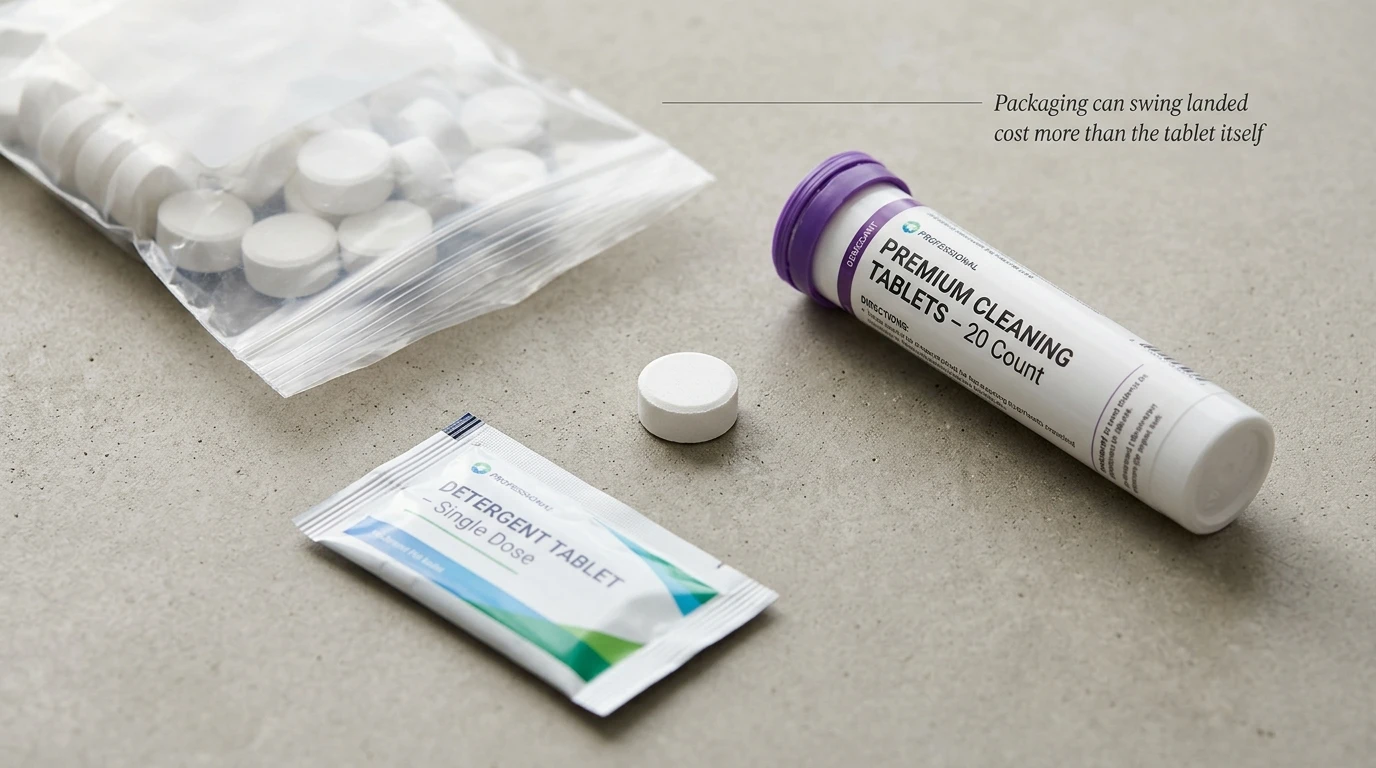
Packaging can swing landed cost more than the tablet does. A bulk poly bag adds pennies. An individually printed foil sachet can add $0.06–$0.12 per unit. A branded tube with a desiccant cap sits higher still. Two identical tablets in different packs can differ 40% in final cost.
MOQ vs. Cost: Reading the Trade-Off Like a Buyer
The break-even math on committing to a higher MOQ
Bigger orders look cheaper per unit, but that's only real money if you'll actually sell through before shelf life ends. Run the simple math: reorder frequency, product shelf life (many effervescent tablets are rated 18–24 months), warehouse cost, and the cash locked in inventory. If a 100k order won't clear in two years, the "savings" are just capital sitting in a pallet.
Negotiating MOQ down without wrecking your price
There are honest levers. Accepting the supplier's proven stock formula removes their R&D risk. Offering flexible lead times lets them slot you into an efficient production window. Combining multiple SKUs into one blend batch, or structuring a deposit that de-risks the run, both give a manufacturer room to lower the floor without cutting corners on the tablet.
Red flags in a "cheap cleaning tablets supplier" quote
A suspiciously low quote usually hides something. Common culprits: underdosed actives that fail in real use, no certificate of analysis (COA) offered, or tooling and plate fees that appear only after you commit. If a bulk cleaning tablet pricing quote undercuts the market by half, ask for the actives percentage and a COA before you celebrate.
Sourcing Logistics That Affect Your Landed Cost
Regional supply dynamics
Most contract tablet manufacturing capacity sits in Asia, with domestic North American and European fillers serving faster-turn, higher-touch orders. Overseas suppliers often offer lower per-unit pricing and higher minimums; domestic ones flip that — smaller MOQs, quicker lead times, higher unit cost. Sample turnaround commonly runs 7–14 days, with bulk production around 25–30 days.
Certifications and compliance that gate your supplier list
Compliance is not optional and it filters your shortlist fast. You'll need a compliant Safety Data Sheet (SDS) and GHS-compliant hazard labeling for cleaning chemistries. Facility credentials like ISO 9001, GMP and SMETA audits signal process control, and FDA registration matters where the product touches food-contact or personal-care applications. Ask for these documents up front.
Shipping, duties, and how they change per-unit economics
A low FOB price can lose to a higher one after the container is loaded. Effervescent tablets are light but bulky, so freight is often volume-driven, not weight-driven. Add duties and the MOQ needed to fill a container efficiently, and the real wholesale cleaning tablets cost per unit shifts. Always compare landed cost, not the factory-gate number.
Outlook: Where MOQs and Pricing Are Heading
Input-cost pressure on surfactants and packaging film hasn't fully eased, so expect firm-to-rising base pricing through the next cycle. The more encouraging trend: automation and quicker changeover systems are letting some manufacturers accept smaller custom runs than before. For newer brands, that means the effervescent cleaning tablets bulk order threshold is slowly becoming more reachable — though packaging minimums remain the stubborn constraint.
Ready to Compare Real Quotes?
Send every supplier the same spec sheet so quotes come back genuinely comparable: target formula or stock reference, actives percentage, tablet weight, packaging format, quantity tiers, required certifications (SDS, GHS, ISO/GMP), and your delivery terms. Then request a tiered MOQ-and-cost breakdown across at least three order sizes.
Boymay has manufactured personal-care and cleaning products since 1995, running 16 automated lines across a 40,000 m² facility with GMP, ISO, FDA and SMETA certification. If you want a clear, tiered breakdown with a starting MOQ of 1,000 and full custom options, reach out for a comparable quote today — and finally see the MOQ-to-cost relationship laid out honestly.
Frequently Asked Questions
What's the smallest order a cleaning tablet manufacturer will accept?
Sample runs can be a few hundred tablets for validation. True production minimums usually start around 5,000 for a stock formula and rise from there once custom chemistry or printed packaging enters the picture.
How much do bulk cleaning tablets cost per unit?
Roughly $0.08–$0.45 per tablet before packaging, driven mainly by formula complexity, tablet weight, order volume and how the tablet is wrapped. Individually foiled premium tablets sit at the top of that range.
Can I get private label cleaning tablets at a low MOQ?
Yes, with conditions. Sticking to a proven stock formula and simpler packaging keeps the private label cleaning tablets MOQ lower. Custom foil printing or branded tubes will push the minimum up regardless of the tablet inside.
Why is my custom formula quote so much higher than stock tablets?
You're paying for R&D, raw material sourcing, stability testing and a first production batch that carries all the setup risk. Stock formulas have already absorbed those costs across earlier runs.
Does a higher MOQ always mean a lower price?
No. The per-unit number drops, but if the volume outlasts shelf life or drains your working capital, the total cost of ownership can be worse than a smaller, faster-moving order. Judge it on sell-through, not the quote alone.