
Crumbly bars, sweating, rancidity, lye pockets or thick trace? Diagnose every cold process soap defect and get the exact fix you can use today.
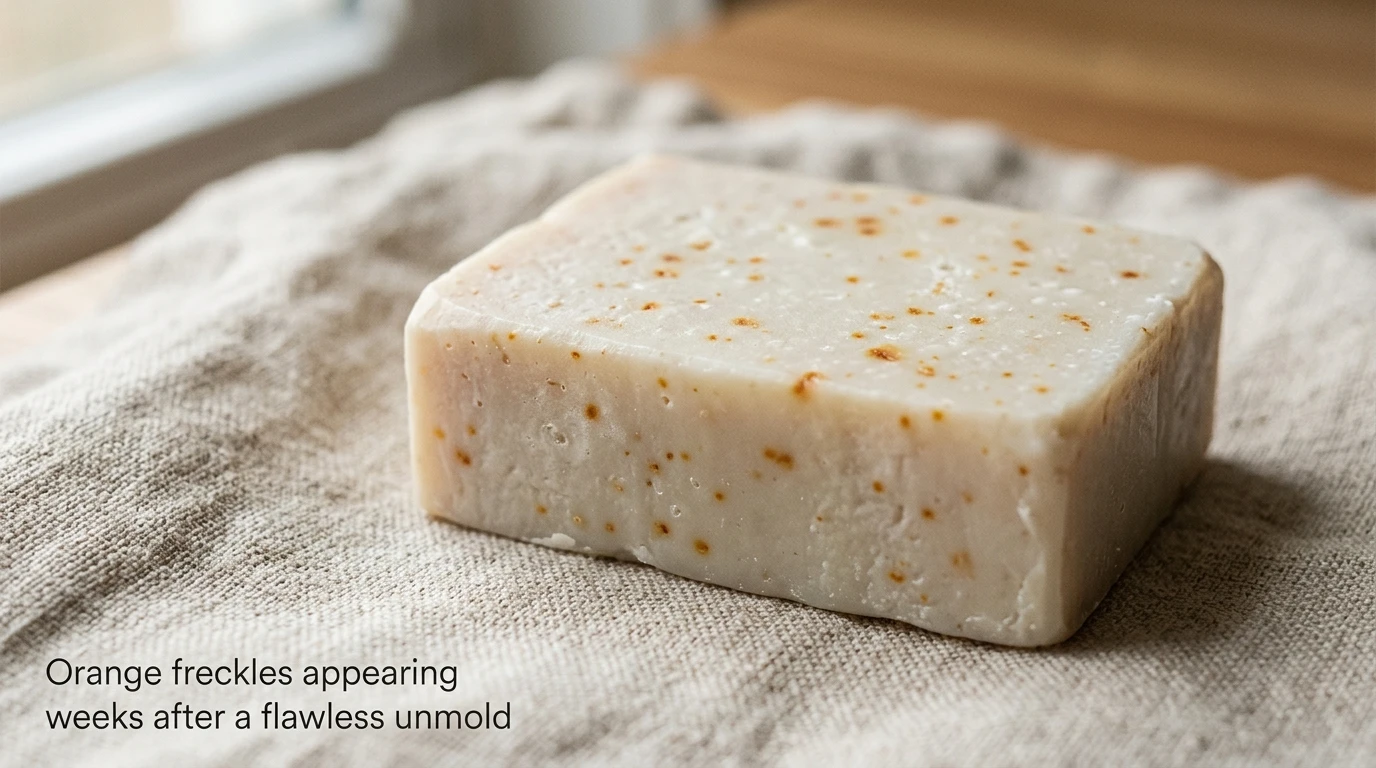
A bar unmolds flawlessly on Sunday. Three weeks later, days before a market, it breaks out in orange freckles like an overripe banana. Every soapmaker who sells their work has lived some version of that — and the sting isn't just the ruined bar. It's the wasted oils, the refunded order, and the repeat buyer who quietly stops coming back.
Here's the part most tutorials skip: nearly every defect on that list is diagnosable, and most are preventable. This guide names each one, explains the chemistry driving it, and hands you a fix you can act on today.
Key Takeaways
- Most soap defects trace back to just three things — measurement error, temperature control, or oil freshness.
- Soda ash, sweating, and glycerin rivers are cosmetic. Ugly, sometimes, but safe to sell after cleanup.
- Lye pockets and lye-heavy soap are safety-critical. They get rebatched or discarded, never sold.
- DOS (dreaded orange spots) is a message about your oils, not your stirring technique.
- A batch log — dates, oil lots, temperatures — catches patterns no single inspection ever will.
Why Soap Quality Problems Happen in the First Place
Soap is a chemical reaction, not a recipe you assemble. Saponification is fats plus sodium hydroxide converting into soap and glycerin. Every defect you'll ever chase is that reaction going slightly off-script somewhere.
Three levers cause the vast majority of trouble: your recipe math, your working temperatures, and the quality of your oils. Get all three right and problem batches become rare. Let one drift and you'll spend weekends troubleshooting.
This is why serious makers treat a batch record like a lab notebook. When the same fault appears twice, the log tells you what changed — the oil lot, the room temperature, the new fragrance. Traceability isn't bureaucracy; it's how you stop guessing.
The Role of Your Lye Calculation
Superfat — the small percentage of oils left unsaponified, usually 5–8% in cold process — is your buffer against a lye-heavy result. Skimp on it and you leave no margin for scale error.
The silent killer is swapping oils without re-running the SAP values. Palm and olive oil don't saponify at the same rate, so substituting one for the other without a fresh calculation quietly shifts your whole batch. Always re-run the lye calculator, even for a "small" tweak.
Cosmetic Defects: Ugly But Usually Harmless
Soda Ash on Soap Surface
That chalky white film across the top is sodium carbonate. It forms when unsaponified lye at the surface meets carbon dioxide in the air before saponification finishes.
To prevent soda ash on soap, spray the poured surface with 91% isopropyl alcohol, then insulate to push a full gel phase. Already have it? Steam the bars lightly or wash under running water and re-cure. Purely surface-level, never a safety concern.
Handmade Soap Sweating (Glycerin Dew)
Glycerin is a natural byproduct of saponification and it's hygroscopic — it pulls moisture from humid air straight to the bar's surface. Those beads aren't a flaw in your recipe so much as a flaw in your storage.
The reliable handmade soap sweating fix is environmental: cure and store below 55% relative humidity, ease off humectant-heavy additives like honey or excess sugar, and never shrink-wrap before a full cure locks moisture in.
| Storage Humidity | Expected Outcome |
|---|---|
| Below 45% | Firm, dry bars — ideal for wrapping |
| 45–55% | Stable; safe with airflow |
| 60–70% | Occasional sweating on glycerin-rich recipes |
| Above 70% | Persistent dew; soft bars, wrapping traps moisture |
Uneven Color, Streaking, and Glycerin Rivers
Glycerin rivers — those translucent, crackled veins running through a bar — come from overheating combined with high water content. Titanium dioxide often shows them most.
Whether that's a flaw depends on your brand. Some makers chase rivers as a signature texture. If you don't want them, soap at a lighter water discount and cooler temperatures.
Structural Defects: When the Bar Itself Fails
Why Is My Handmade Soap Crumbly?
If you're asking why is my handmade soap crumbly, start with four suspects: too much lye, too little water, an over-hard oil profile, or salt and clay added dry instead of dispersed.
Learn to tell the two crumbly types apart. Crumbly-from-dry breaks clean and feels chalky; crumbly-from-lye-heavy often crumbles unevenly and may zap on the tongue. The first is a nuisance. The second is a safety problem. Balance hard and soft oils — a common working ratio is roughly 60% hard to 40% soft — and the structural version usually disappears.
Cold Process Soap Lye Pockets
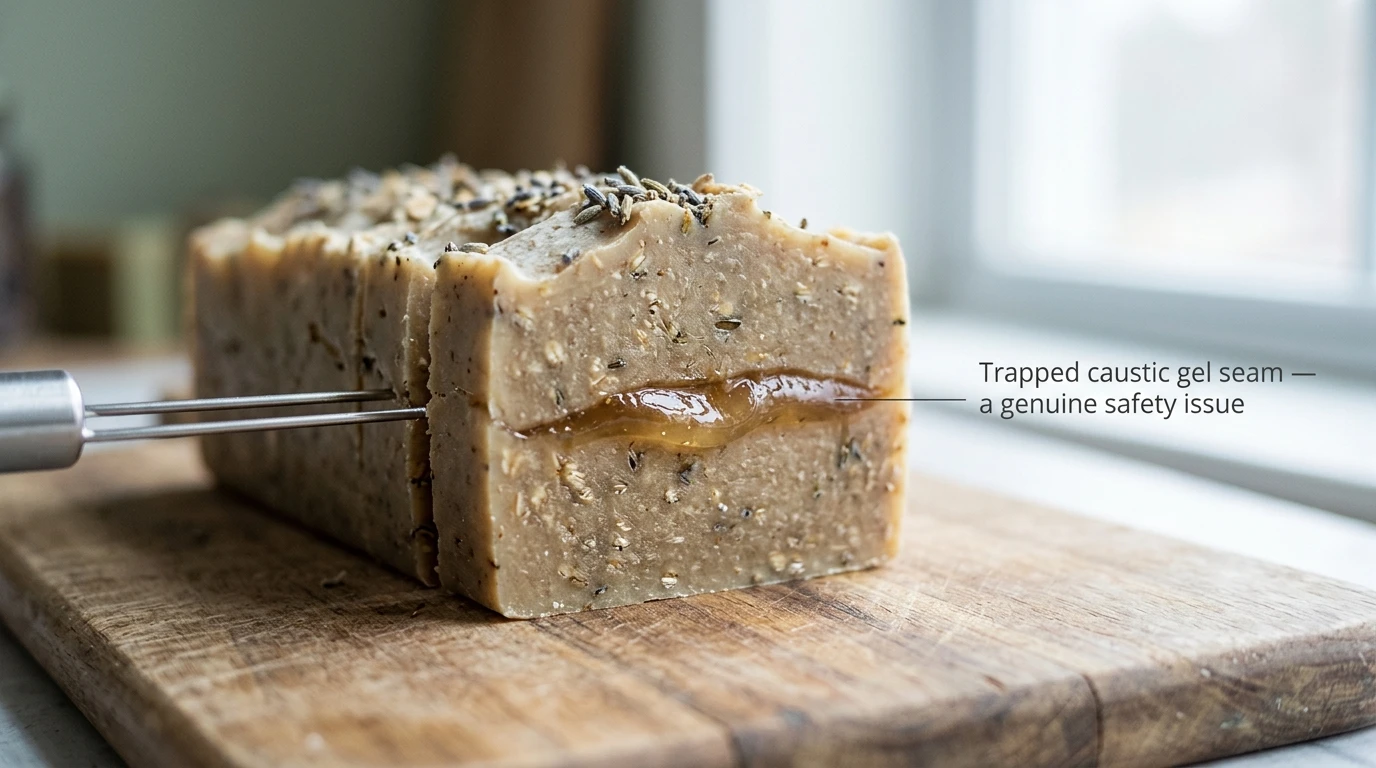
Cold process soap lye pockets are trapped caustic gel — literal pockets of unsaponified lye inside the bar. Cut into one and you get a gooey, sometimes clear seam. This is a genuine safety issue, not a looks problem.
They come from undermixing, false trace (thickening from cooling rather than true emulsification), or poor blending. Test any suspicious spot with the zap test — a light tongue-touch that produces a battery-like sting if raw lye is present. Zap means rebatch or discard. No exceptions.
Soap Seizing and Trace Too Thick
Soap seizing is the batch turning to concrete in seconds — usually triggered by a misbehaving fragrance oil, high temperatures, or a hard floral like clove or cinnamon. You go from liquid to unpourable before you can react.
A soap trace too thick problem is the milder cousin. To fight soap trace acceleration, soap cooler (around 90–100°F), stick-blend in short pulses instead of running it continuously, and add fragrance at light trace rather than at the start. If a batch begins to firm up in the pot, stop blending, hand-stir, and glob it into the mold — a rustic top beats a wasted batch.
Safety-Critical Defects You Cannot Sell
Lye Heavy Soap
Lye heavy soap feels harsh and drying and often zaps on the tongue test. For confirmation, phenolphthalein turns bright pink against excess alkalinity. This is where you stop being a crafter and start being a quality gate.
A lye-heavy bar can burn or irritate skin. It's a non-negotiable — you rebatch it with added oils or you throw it out.
| Symptom | Likely Cause | Action |
|---|---|---|
| Zap on tongue test | Excess lye / undermix | Rebatch or discard |
| Harsh, drying lather | Low superfat | Rebatch with oils |
| Pink under phenolphthalein | High free alkali | Discard if severe |
DOS: Dreaded Orange Spots
DOS is rancidity you can see. Unsaturated fats oxidize over time, often accelerated by trace metals in your water or oils, and leave orange spots that sometimes smell of old crayons. So when someone asks why does homemade soap turn rancid, the honest answer is: it's an oil-freshness question, not a technique question.
Prevention is straightforward. Use fresh oils within their shelf life, add an antioxidant such as ROE (rosemary oleoresin extract), include a chelator like sodium citrate to bind metal ions, and cure somewhere cool, dry, and dark. Oils near their expiry are your biggest DOS risk.
Diagnostic Quick-Reference Table
| Defect | Appearance | Root Cause | Type | Fix |
|---|---|---|---|---|
| Soda ash | Chalky white film | Surface lye + CO₂ | Cosmetic | Steam or wash, spray alcohol next time |
| Sweating | Surface beads | Humid storage | Cosmetic | Lower humidity |
| Crumbly | Chalky or flaky | Water/lye/oil balance | Varies | Zap test, adjust recipe |
| Lye pockets | Gooey seams | Undermixing | Safety | Rebatch or discard |
| Seizing | Instant hardening | Fragrance / heat | Salvageable | Glob into mold |
| DOS | Orange spots | Rancid oils | Safety | Discard; use fresh oils |
Prevention: Building Quality Into Every Batch
Documentation is the single highest-return habit. Log every batch: date, oil lots and their expiry, working temperatures, fragrance supplier. When a fault repeats, the answer is usually sitting in last month's notes.
Control your cure environment — steady temperature, humidity under 55%, real airflow, and a full 4–6 week cure. Rushing the cure is the reason "perfect" bars fail after they ship.
Common Mistakes That Sabotage Good Recipes
- Eyeballing measurements instead of trusting a 0.1g scale.
- Reusing a fragrance oil never tested for cold process behavior.
- Wrapping or selling before the bar has fully cured.
Conclusion & Next Step
Defects feel like bad luck until you have records — then they become patterns you can fix. Nail your measurement, temperature, and oil freshness, and the troubleshooting list shrinks to almost nothing.
If you've outgrown small-batch firefighting and want consistent, certified production at scale, that's exactly where a proven OEM/ODM partner earns its place. Boymay has manufactured bath and personal care products since 1995 — GMP, ISO, and FDA certified, with 16 automated lines and full custom formulation, including vegan and cruelty-free options. Reach out for a private-label consultation and a custom sample within 7–14 days.
Frequently Asked Questions
Q: How long before I know if my soap has DOS?
A: Spots can surface anywhere from a few weeks to several months in. Early DOS shows as faint orange pinpricks, often accompanied by a stale, waxy smell before the color is obvious.
Q: Can I still use soap with soda ash on it?
A: Yes. Soda ash is purely cosmetic. Wipe it under running water or give it a light steam, let it dry, and the bar is perfectly good to use or sell.
Q: Is lye-heavy soap ever safe to fix?
A: Sometimes. Mild cases can be rebatched with extra oils to raise the superfat. If it zaps hard or tests strongly alkaline, don't risk it — discard the batch.
Q: Why did my soap turn out fine last time with the same recipe?
A: Because a recipe isn't the whole picture. Oil freshness, room temperature, water hardness, and even a new fragrance lot all shift between batches — which is exactly why batch records earn their keep.