
You know the moment. You're standing in the shop aisle, holding a bar of soap up to the light, trying to work out whether "sodium cocoyl isethionate" is something you want anywhere near your three-year-old. The packaging says "gentle." It also says "botanical." Neither word is regulated, so honestly they tell you nothing.
I've been down this rabbit hole. I've also talked to the formulators who actually make this stuff. So here's the deal: by the time you finish reading, you'll know what to look for on a label, what to quietly put back on the shelf, and how to test a new bar without turning bath time into a science experiment gone wrong.
Why a Child's Skin Isn't Just "Smaller Adult Skin"
This is the part most articles skip, and it's the whole reason kid soap is even a conversation. A child's skin isn't a scaled-down version of yours. It behaves differently on a structural level.
For one, the outer layer—the stratum corneum—is thinner in young children. So whatever sits on the skin gets absorbed faster and deeper. Combine that with a much higher surface-area-to-body-weight ratio, and a toddler exposed to a harsh cleanser is dealing with a proportionally bigger hit than an adult using the exact same bar.
The Skin Barrier Thing Nobody Explains Well
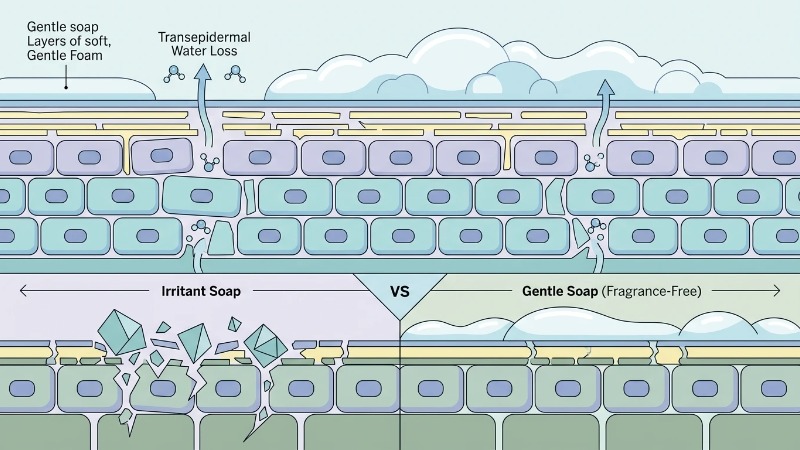
Think of the skin barrier as a brick wall, where skin cells are the bricks and natural lipids are the mortar. In kids, that mortar is still developing. It holds moisture less efficiently and lets water escape more quickly—dermatologists call this transepidermal water loss.
So when a soap strips those natural oils, a child's skin doesn't just feel tight for a minute. It can stay dry, flaky, and reactive for days. That's exactly why a genuinely gentle handmade soap for children matters more than it does for the average grown-up. You're not being precious. You're working with a barrier that's still under construction.
When "Natural" Doesn't Automatically Mean "Safe"
Here's where I'll gently annoy some people. "Natural" is not a safety guarantee. Poison ivy is natural. So is nickel, one of the most common causes of skin allergy on the planet.
Certain essential oils—citrus, cinnamon, peppermint, tea tree—can genuinely irritate young skin or trigger sensitization over time. Citrus oils, in particular, can make skin more reactive to sunlight. A bar labelled "all natural citrus burst" isn't automatically kinder than a plain, boring, fragrance-free one. Sometimes boring wins.
The Ingredients That Belong in Kid-Safe Handmade Soap
Let's talk about what actually helps. Good kid safe handmade soap ingredients tend to be short, recognisable, and doing an obvious job.
Base Oils That Are Gentle on Little Hands
The base oils are the backbone of any bar. They determine how it cleans and how it treats the skin afterward.
Olive oil — the gold standard for mild soap. It produces a low, creamy lather and is famously well tolerated. Castile soap is essentially 100% olive oil, and it's a classic for a reason.
Shea butter — rich in fatty acids, it adds moisturising conditioning and helps a bar feel less "squeaky." Great for dry patches.
Coconut oil — it lathers beautifully and cleans well. But here's the catch: too much of it is drying. In a good kids' bar it's used in moderation, usually under 20%, balanced with gentler oils.
Sweet almond oil — light, softening, and easily absorbed. A lovely supporting player for sensitive skin, though worth noting for families with nut allergies.
A well-made natural handmade soap for babies leans heavily on olive and shea, uses coconut sparingly, and skips the flashy extras.
Why Fragrance-Free (or Barely-Scented) Usually Wins
Fragrance is the single most common cause of soap reactions in children. It's also the thing brands lean on hardest for shelf appeal, because a nice smell sells.
For infants, go fragrance-free. Full stop. A fragrance-free organic soap for babies removes the most likely irritant entirely, and newborns genuinely don't need scent. For toddlers, a whisper of a skin-safe essential oil like lavender or chamomile at a very low dilution is usually fine. Older kids can typically handle light natural scenting without issue—though if there's any eczema history, I'd still keep it minimal.
Ingredients Worth Second-Guessing
None of these are "toxic panic" ingredients. They're just things you can reasonably skip when better options exist:
Synthetic fragrance ("parfum") — a catch-all that can hide dozens of undisclosed compounds.
SLS (sodium lauryl sulfate) — a strong surfactant that can be stripping on delicate skin.
Artificial dyes — pure aesthetics, zero benefit for a child's skin.
Harsh preservatives — some are necessary in water-based products, but a properly cured cold-process bar often needs far fewer.
Handmade Soap Types Compared: Which Suits Your Child?
Not all handmade soap is made the same way, and the method genuinely affects gentleness. Here's a quick, scannable comparison.
Cold-Process vs. Melt-and-Pour vs. Superfatted Soap
| Soap Type | Best For | Gentleness | Moisturizing | Notes |
|---|---|---|---|---|
| Cold-process (superfatted) | Sensitive / dry skin | High | High | Longer cure, milder result |
| Melt-and-pour | Everyday use | Medium | Medium | Watch for added fragrance |
| Castile (olive-based) | Babies, eczema-prone | Very high | High | Fewest ingredients |
| Oatmeal / honey bars | Itchy, reactive skin | High | Medium-high | Soothing add-ins |
Quick translation. "Superfatting" means the maker adds a bit of extra oil beyond what the lye can convert into soap, so those nourishing oils stay behind in the bar. That's why a superfatted cold-process bar feels so much kinder than a mass-market one. Melt-and-pour is convenient and perfectly fine for everyday hands—but it's also where sneaky fragrances tend to hide. Read carefully.
Castile is my default pick for the very young. Fewer ingredients, fewer chances for something to upset the skin. That's exactly what you want in a mild handmade soap for sensitive skin.
A Quick Skin-Type Matching Guide
Normal, no issues — a lightly scented melt-and-pour or cold-process olive bar works fine.
Dry, tight skin — go superfatted with shea butter.
Eczema-prone — plain castile or an oatmeal bar, fragrance-free.
Allergy-prone / reactive — a hypoallergenic handmade soap for toddlers with the shortest possible ingredient list and no essential oils.
How to Read a Handmade Soap Label Without a Chemistry Degree
You don't need to memorise chemistry. You need a fast filter you can run right there in the aisle.
The 5-Second Label Scan
Is the ingredient list short? Fewer than ten items is a good sign.
Can you recognise the first three or four? Those make up the bulk of the bar.
Do you see "fragrance" or "parfum" with no explanation? For a baby, put it back.
Any artificial colour numbers? Skip them.
Does it name its oils—olive, shea, coconut—clearly? Good sign.
That's genuinely it. Screenshot that and use it next time you shop.
Certifications and Claims Worth Trusting
"Hypoallergenic" isn't a legally defined term in most markets. It means the maker believes it's less likely to cause a reaction—but no universal standard sits behind the word. "Dermatologist-tested" means a dermatologist was involved in the testing, not that they endorsed the product. Read both as soft signals, not guarantees.
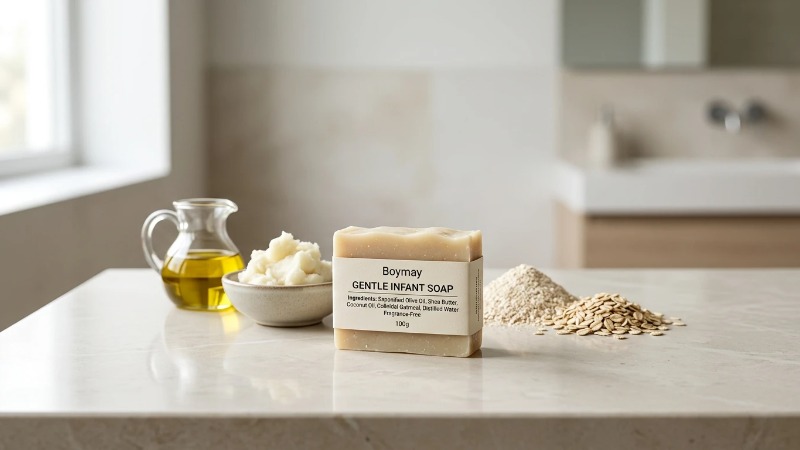
Organic certifications, and things like GMP, ISO, or SMETA, carry more weight. They involve independent auditing of ingredients or manufacturing standards. When a manufacturer holds genuine third-party certifications, it tells you the process is being checked by someone other than their own marketing team.
Patch Testing and Introducing a New Soap Safely
Even the gentlest bar deserves a trial run. Skin is individual. What soothes one child can bother another.
Here's the simple method:
Lather a small amount and apply it to a coin-sized patch on the inner forearm.
Rinse after about a minute, the way you would in a real wash.
Wait 24 to 48 hours. Watch that patch.
No redness, bumps, or itching? You're clear to use it normally.
What to Do If Your Child's Skin Reacts
Stop using the soap right away and rinse the area with plain, lukewarm water. Mild redness usually fades on its own within a day. A gentle fragrance-free moisturiser can help calm things down.
If you see a spreading rash, swelling, blistering, or your child is clearly uncomfortable, that's your cue to check in with a pediatrician or pharmacist. Bring the ingredient list along. It makes identifying the culprit far easier, and it helps you dodge that same trigger next time.
Your Next Step: Choosing With Confidence
Here's what I'd do tonight. Grab the bar sitting in your bathroom right now and run it through that 5-second label scan. Passes? Good. But if it's packed with "parfum" and colour numbers, you now know why your child's skin might be complaining.
Next time you shop, try a small superfatted or castile bar first. Patch test it. Give it a week. Trust what your child's skin tells you over whatever the front of the box promises.
At Boymay, we've been manufacturing personal care and bath products for brands and retailers since 1995, backed by GMP, ISO, FDA, and SMETA certification. Are you a brand or retailer wanting to build a genuinely gentle, customisable kids' soap line—vegan-friendly, cruelty-free, and made to a spec you control? We offer OEM and ODM production with a low minimum order of 1,000 units and custom samples in about 7–14 days.
And if this guide made label-reading a little less daunting, pass it to another parent squinting at a soap bottle. Honestly, that's the best thing you could do with it.
Frequently Asked Questions
Q: At what age can babies use handmade soap?
A: Many pediatricians suggest plain water for the first few weeks, then a very mild cleanser around one to two months, as needed. When you do start, a simple fragrance-free castile bar is one of the gentlest options for a natural handmade soap for babies. Keep washing brief, and always follow with moisturiser.
Q: Is fragrance-free soap really necessary for children?
A: For infants, yes—fragrance is the most common trigger for soap reactions, so removing it removes the biggest risk. For older toddlers and kids without skin issues, lightly scented natural bars are usually fine. If eczema or allergies run in the family, fragrance-free is the safer bet.
Q: Can handmade soap help with my child's eczema?
A: The right bar can absolutely help—by not making things worse. A superfatted or castile soap that preserves natural oils is far kinder than a stripping commercial one. That said, soap handles cleansing, not eczema itself. Pair it with a good emollient and stick to whatever plan your doctor has given you.
Q: How long does a handmade kids' soap bar usually last?
A: A well-cured cold-process bar used by one child typically lasts three to five weeks. Keep it on a draining dish, out of standing water, and you'll see a real difference. A bar that sits in a puddle turns to mush fast.
Q: Are essential oils safe in soap for toddlers?
A: Some are, at low dilution. Lavender and chamomile are generally well tolerated. Citrus, cinnamon, peppermint, and tea tree are more likely to irritate young skin, so I'd avoid those for toddlers. When in doubt, fragrance-free is never the wrong answer.