
Wholesale jewelry bath bombs explained: MOQs, $0.85-$3.60 landed cost, tarnish-proof rings, private label options, MoCRA/CPNP rules and real 25-45 day lead times.
Last spring a buyer sent back 4,800 units. Not because the bombs failed — they fizzed beautifully — but because every ring inside had gone green at the shank within six weeks of sitting in a foil pouch in a Florida warehouse. We took the blame, replaced the order, and then did what we should have done before the PO: explained the alloy and the moisture barrier. That's the whole lesson of this category. The bath bomb is the easy part. The jewelry sitting inside a hygroscopic acid-and-bicarbonate matrix is the engineering problem. This guide is what we now walk buyers through before a first order, straight off our production floor.
Jewelry bath bombs wholesale means buying bath bombs with a sealed jewelry piece inside, at MOQs typically between 500 and 5,000 units, from a manufacturer who handles both the fizzy formulation and the jewelry sourcing and QC. Landed cost usually runs $0.85–$3.60 per unit depending on jewelry grade, scent load, and packaging.
Key Takeaways
- MOQ is driven by tooling and jewelry casting minimums — 500 units on stock components, 5,000+ once you want a custom mold and branded jewelry.
- Only two jewelry tiers really matter for shelf life: copper-bearing brass alloys (cheap, tarnishes) and stainless 316L or 925 sterling (costlier, stable).
- There are exactly three fixes for tarnish — anti-tarnish paper in an individual poly bag, a PVD/stainless substrate, or nitrogen-flushed foil. Everything else is wishful thinking.
- Margin lives in packaging and the reveal, not in the bomb. Retail markup in this segment typically runs 4–6x landed cost versus 2.5–3.5x for plain bath bombs.
- Compliance gates stop shipments: MoCRA listing in the US, CPNP notification plus a CPSR and an EU Responsible Person, CPSC lead and cadmium limits on anything child-facing.
- Real production is 25–45 days, not the 15 days quoted in a chat window. Plan launches off the longer number.
What Exactly Is a Jewelry Bath Bomb? (And Why Retail Keeps Reordering Them)
It's a standard effervescent bath bomb with a jewelry piece — usually a ring, sometimes a bracelet or pendant — sealed inside the core so it's revealed as the bomb dissolves. The product sells twice: once as bath care, once as a surprise.
The Anatomy of the Product
We assemble four things on our line. The base is sodium bicarbonate and citric acid at roughly a 2:1 ratio, with kaolin or cornstarch for hardness. Then the binder and oil phase — a light carrier oil, surfactant if the brand wants foam, fragrance or essential oil, and colorant.
Third is the barrier layer around the jewelry. Fourth is the insert itself. Buyers treat that barrier as packaging. It isn't. It's a chemical isolation step, and if you skip it the citric acid and residual humidity will find the metal.
Why This Category Outperforms Plain Bath Bombs at Shelf
The reveal mechanic does the marketing. A customer filming a dissolve for TikTok is producing your ad for free, and that content converts at a rate a product photo never will.
The commercial effect shows up in three places: higher price tolerance, stronger gift-set attach rate, and genuine repeat purchase because people want a second piece. That 4–6x markup spread over standard bath bombs is the entire business case.
Who's Buying: The Four Buyer Profiles We Ship To
- Subscription boxes — they care about batch-to-batch consistency above all. A ring that looks different in month three generates support tickets.
- Spa and hotel amenity programs — documentation first. They want the safety assessment and allergen statement before they discuss price.
- Amazon and TikTok Shop sellers — the reveal and the dissolve time matter most, plus packaging that survives FBA handling.
- Traditional gift retail — perceived value on shelf. They'll pay for 925 sterling and a rigid gift box.
Jewelry Grades Inside the Bomb: What You're Actually Paying For
Tier Comparison
| Tier | Material | Cost per piece | Tarnish risk | Best for |
|---|---|---|---|---|
| Entry | Brass/zinc alloy, rhodium flash plate | $0.12–$0.30 | High after 3–6 months | Promo, event giveaways |
| Mid | Stainless steel 316L, PVD gold finish | $0.35–$0.80 | Very low | Subscription, e-commerce |
| Premium | 925 sterling, CZ stone set | $1.10–$3.00 | Moderate, manageable | Gift retail, spa amenity |
| Novelty | Resin/acrylic charm | $0.06–$0.15 | N/A | Kids' lines, party packs |
The Tarnish Conversation Nobody Has Before the PO
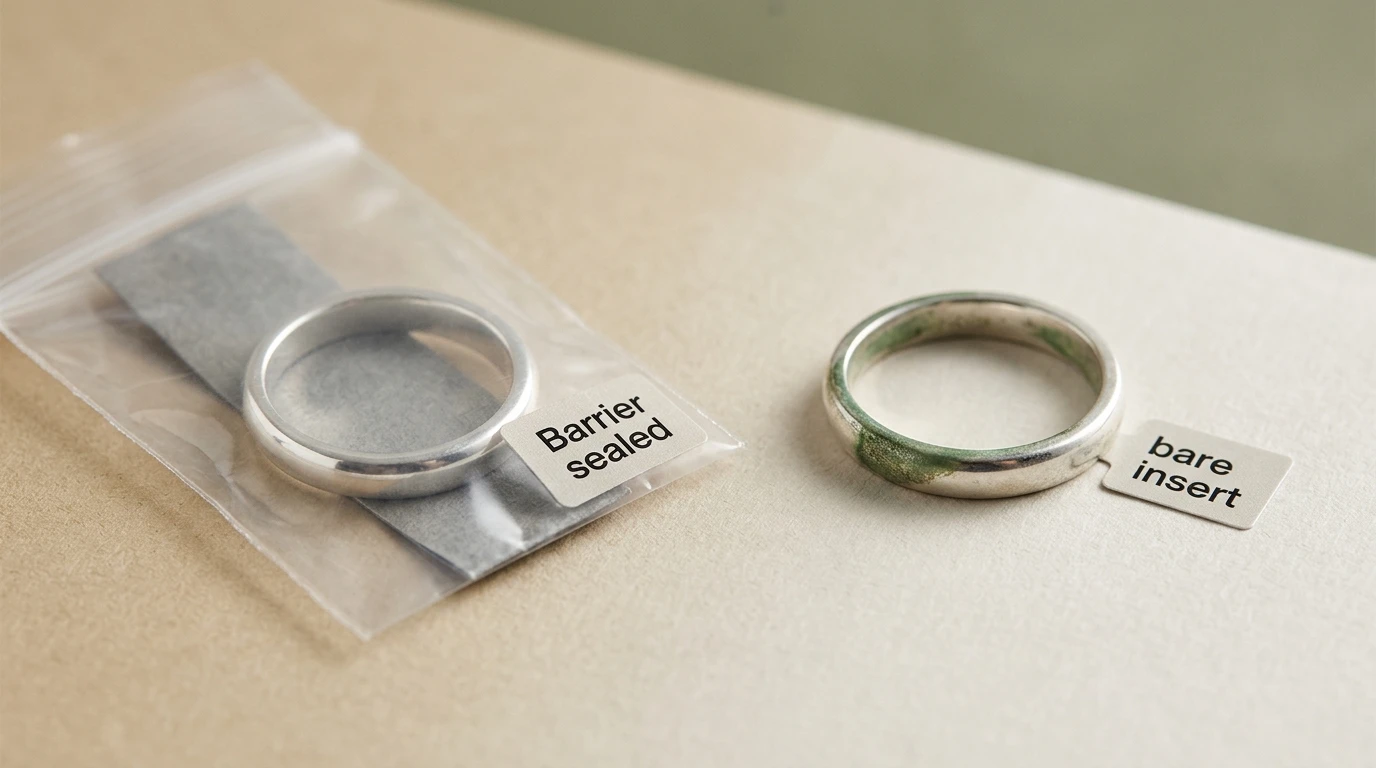
Bath bomb bases pull moisture from the air — that's chemistry, not a defect. Add citric acid and a copper-bearing alloy and you get discoloration. The plating thickness on a $0.15 ring is measured in microns, and it doesn't stand up to that environment.
Three fixes work. Individual poly bag with anti-tarnish paper. A PVD-finished 316L or sterling substrate. Or a nitrogen-flushed foil pouch. We've run the loose-ring, no-barrier version because customers asked for it, and in our own shelf tests roughly 3 in 10 units showed visible discoloration past the 90-day mark. That's a return rate no margin absorbs.
Ring Sizing, Adjustability, and Returns
We push adjustable open-band designs on nearly every project. Fixed-size rings are the single largest complaint driver in this category, because the buyer has no idea who's opening the box.
If a brand insists on fixed sizes, weight the mix heavily toward US 6–8 — something like 15% size 5, 30% size 6, 30% size 7, 20% size 8, 5% size 9 is a workable split for a Western market.
Compliance: The Gates That Stop Shipments
United States
Under MoCRA, cosmetic manufacturing facilities must register and products must be listed with the FDA. Colorants in the fizz base have to be FDA-approved color additives for cosmetic use — this is where cheap imported dye powders fail. If the SKU is marketed to children, CPSC lead and cadmium limits apply to the jewelry insert, and that testing is non-negotiable.
European Union and UK
You need CPNP notification, a Cosmetic Product Safety Report prepared by a qualified assessor, and a Responsible Person established in the EU (a separate one for the UK). The EU Nickel Release Directive limits also govern the insert, since it's a product intended for prolonged skin contact — that rules out a lot of low-cost nickel-bearing alloy.
Documentation Checklist
| Document | Who issues it | When you need it |
|---|---|---|
| CPSR / Safety Assessment | Qualified assessor | Before EU/UK sale |
| MSDS / SDS | Manufacturer | Freight booking |
| Nickel release test report | Third-party lab | EU jewelry inserts |
| Heavy metals report (Pb/Cd) | Third-party lab | Any child-facing SKU |
| Allergen / IFRA fragrance statement | Fragrance house | Labeling |
We supply the SDS, ingredient breakdown, and lab reports. The CPSR and the Responsible Person are the brand's legal obligation, not ours — any factory telling you otherwise is guessing.
MOQ, Pricing, and What Actually Drives Your Unit Cost
Realistic MOQ Bands
- Stock bomb + stock jewelry: 500 units. No tooling, existing insert inventory.
- Stock bomb + custom jewelry: 2,000 units. Driven by casting and plating minimums, not by us.
- Fully custom mold + branded jewelry: 5,000 units and up, so tooling amortizes sensibly.
Cost Breakdown
| Cost component | Share of unit cost | Notes |
|---|---|---|
| Jewelry insert | 30–45% | Largest single lever |
| Base + fragrance | 15–25% | Essential oil vs. fragrance oil swings this hard |
| Primary packaging | 15–30% | Where most brands overspend |
| Labor + QC | 10–15% | Hand-pressed costs more than machine |
| Tooling/setup (amortized) | 3–8% | Drops sharply above 5,000 units |
The Hidden Costs Buyers Forget
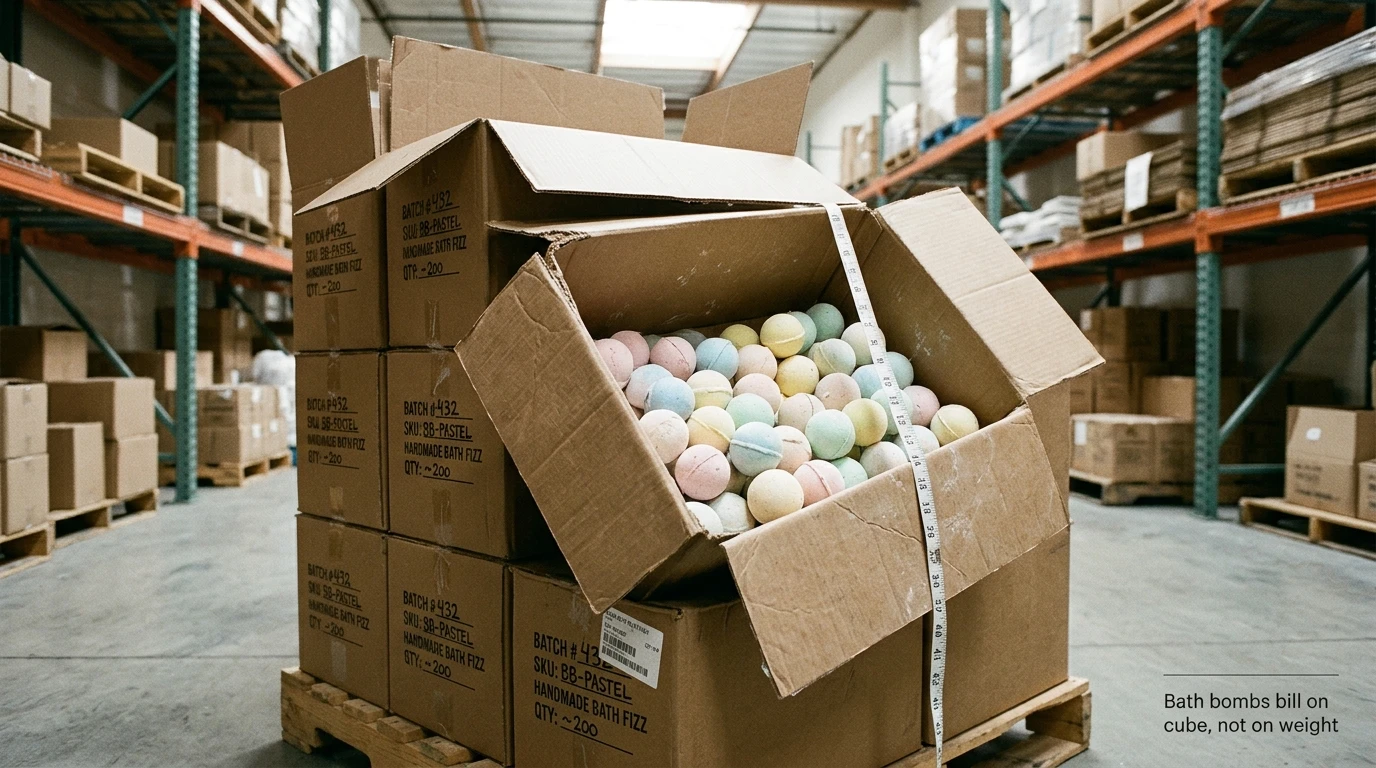
Dimensional weight is the big one. Bath bombs are light and bulky, so you pay for volume, not mass — a full container of 150g bombs bills on cube. Budget a 2–4% breakage allowance, and expect label revision charges if artwork changes after plates are made.
Air freight almost never pencils out here. Sea plus a realistic buffer is the right plan for bulk bath bombs with rings inside.
How to Choose a Jewelry Bath Bomb Manufacturer
Eight Questions to Ask Any Supplier
- Do you source jewelry in-house or broker it? Good answer: named alloy, named plating process, and a sample they can pull today.
- Can I see drop-test data? Good answer: a number in metres and a pass rate, not "very strong."
- Is your curing room humidity-controlled? Good answer: a target RH range, typically 35–45%.
- How do you handle batch traceability? Good answer: lot codes tying bomb batch to jewelry batch.
- What's your sample lead time? Good answer: 7–12 days for stock-based samples.
- Who owns the mold? Good answer: you do, if you paid for it — in writing.
- Which third-party labs do you work with? Good answer: real lab names and recent report dates.
- How do you guarantee reorder consistency? Good answer: retained reference samples from every production run.
Direct Factory vs. Trading Company
| Factor | Direct factory | Trading company |
|---|---|---|
| Unit price | Lower | +8–18% |
| MOQ flexibility | Lower on repeats | Often lower on first order |
| Formulation changes | Direct, fast | Relayed, slow |
| Multi-category sourcing | Limited | Strong |
Honest note: if you're sourcing six SKUs across three categories, a good trading company earns its margin. We're the better fit when the formulation and the insert spec are the hard part.
The Sample Stage: What to Actually Test
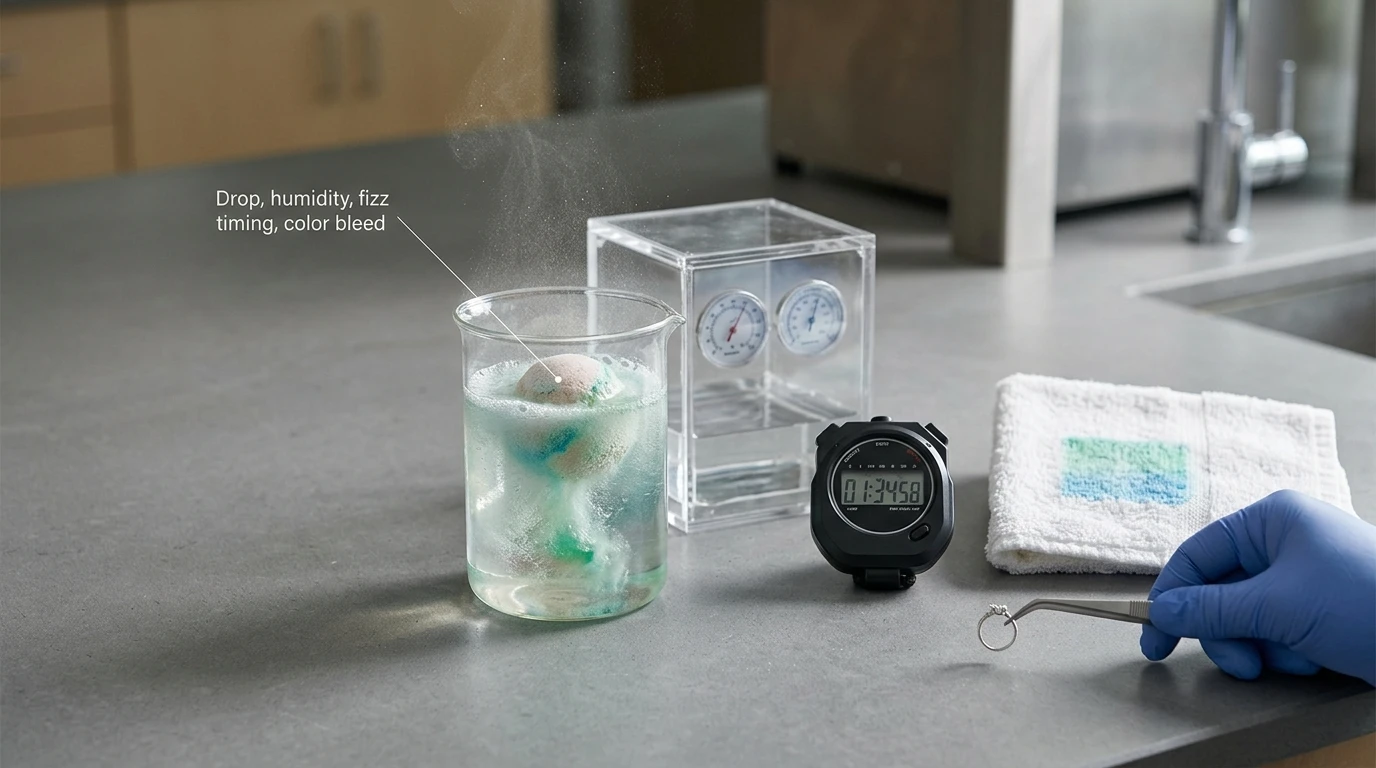
Our protocol, and yours should match it: drop from 1.2m onto a hard floor, 72 hours in a humidity chamber, fizz timing (a 150g bomb should dissolve in 3–5 minutes), color bleed on a white towel, and a close look at the jewelry after it's been in the water.
Private Label and Custom Packaging Options
Packaging Formats Compared
| Format | Cost per unit | Shelf-life impact | Retail presence |
|---|---|---|---|
| Shrink wrap | $0.04–$0.09 | Moderate barrier | Low |
| Foil pouch | $0.10–$0.22 | Best barrier | Medium |
| Kraft box | $0.18–$0.45 | Poor alone; needs inner wrap | High |
| PET clamshell | $0.15–$0.35 | Good, product visible | Medium-high |
| Gift tube | $0.35–$0.90 | Good | Highest |
Pros and Cons: Private Label vs. Fully Custom Development
| Pros | Cons | |
|---|---|---|
| Private label jewelry bath bombs (our existing formulas) | Fast — 25–30 days; low MOQ; proven stability; no tooling cost | Competitors may run the same base; limited differentiation |
| Fully custom (your formula or mold) | Unique shape and scent; defensible brand; higher margin | 45–70 days; 5,000+ MOQ; tooling $400–$1,500 per mold; reformulation risk |
Branding Elements That Cost Almost Nothing
Custom scent naming. An insert card with a QR code to a reveal video. A small hang-tag on the ring itself. Together these add maybe six to twelve cents a unit and do more for perceived value than a thicker box. We recommend all three to nearly every new brand working with custom bath bomb packaging.
Common Mistakes We See on First Orders
- Chasing the cheapest alloy. You hit your price point, then eat returns at four times the savings. The math never works.
- Skipping the humidity test. Samples that looked perfect in a dry October arrive at a July warehouse and soften. Test the worst case, not the convenient one.
- Over-scenting. Above about a 3% fragrance load the oil phase softens the bomb and shortens shelf life. More scent is not more premium.
- Designing packaging before the bomb is finalised. Finished diameter shifts a few millimetres between trial presses. Lock the bomb, then order boxes.
- Ignoring dimensional weight. Brands build a cost model on product alone, then the freight quote lands and the margin is gone.
- Booking a launch off a "15-day" chat message. Nobody presses, cures, seals, tests, and cartons a jewelry SKU in 15 days. Plan for 25–45.
Where We'd Start If We Were You
Define the jewelry tier before you pick a scent. The insert sets your cost ceiling, your shelf life, and your return rate — everything else adjusts around it.
Then order a paid sample set across two tiers, not one. Comparing entry against mid-tier in your own hands settles arguments that no spec sheet will.
Finally, run your own 30-day humidity test before you sign off. Warm cupboard, sealed box, check the metal weekly. It costs you nothing and it's the test that catches the failure we opened this guide with.
Ready to Price Your Spec?
Send us your target retail price and the market you're selling into. We'll reverse-engineer the spec that hits it — jewelry tier, packaging format, compliance documents you'll need, and a lead time we'll actually honour. Quotes back within 48 hours, and we'll ship a sample kit covering two jewelry tiers so you can run the tests yourself before committing a single dollar to production.
Frequently Asked Questions
Q: What is the minimum order for jewelry bath bombs wholesale?
A: Most jewelry bath bomb suppliers start at 500 units when you use stock bombs and stock jewelry. Custom jewelry pushes it to about 2,000 units because of casting and plating minimums, and a fully custom mold typically requires 5,000 or more so tooling amortizes.
Q: How much do bulk bath bombs with rings inside cost per unit?
A: Expect $0.85–$3.60 landed per unit. Entry-tier alloy rings in shrink wrap sit at the bottom of that range; 925 sterling with a CZ stone in a gift tube sits at the top. The jewelry insert alone usually accounts for 30–45% of unit cost.
Q: Is the jewelry inside bath bombs real?
A: It depends entirely on the tier you buy. Entry pieces are plated brass or zinc alloy — real metal, but not precious. Mid-tier is 316L stainless with PVD finish. Premium is genuine 925 sterling silver. Any supplier who won't name the alloy is telling you something.
Q: How long do jewelry bath bombs stay fresh?
A: A properly sealed unit holds 12–18 months. The fizz base itself lasts longer, but fragrance fades and the jewelry is the limiting factor. With individual poly bagging or foil and a stainless or sterling insert, 18 months is realistic; with loose entry-tier rings, plan on six.
Q: Can I put my own logo on the bath bomb itself?
A: Yes, through a custom mold with an engraved cavity — around $400–$1,500 per mold depending on complexity. Fine detail doesn't hold well in a pressed bicarbonate base, so simple marks and short wordmarks reproduce far better than detailed logos.
Q: Do I need FDA approval to sell bath bombs in the US?
A: Bath bombs are cosmetics, and cosmetics don't get pre-market FDA approval. You do have obligations: facility registration and product listing under MoCRA, approved color additives, accurate ingredient labeling, and CPSC heavy-metals compliance if the product is aimed at children.
Q: What's the typical production and shipping lead time?
A: Production runs 25–45 days for private label, 45–70 days for fully custom formulas or molds. Add ocean freight — roughly 30–40 days to the US West Coast and 35–45 days to Northern Europe, plus customs clearance. Build in two weeks of buffer.
Q: Are jewelry bath bombs safe for kids?
A: Only with a child-safe spec. That means a larger insert to reduce choking risk, tested lead and cadmium levels within CPSC limits, nickel-free alloy, and adult supervision language on the label. Small rings marketed to young children are a liability we won't produce.