
Solid shampoo bars have moved from a niche eco-product to a mainstream category, and tea tree formulas sit at the premium end of that shift. Buyers now expect sulfate-free cleansing, plastic-free packaging, and ingredients they can pronounce — and they're willing to pay for it.
For a brand owner, none of that matters if the factory behind the product can't deliver consistency, documentation, and scale. Choosing a manufacturing partner is arguably the single most consequential decision you'll make. This guide walks through what a strong manufacturer actually looks like, where the market is heading, and how to vet suppliers without wasting months on samples that never ship.
What Makes a High-Quality Tea Tree Shampoo Bar Manufacturer?
Before you compare quotes, you need a framework. The cheapest supplier and the best supplier are rarely the same company, and the gap usually shows up six months later in the form of failed reorders or a customs hold. Use the criteria below as your working checklist.
Certifications and Regulatory Compliance
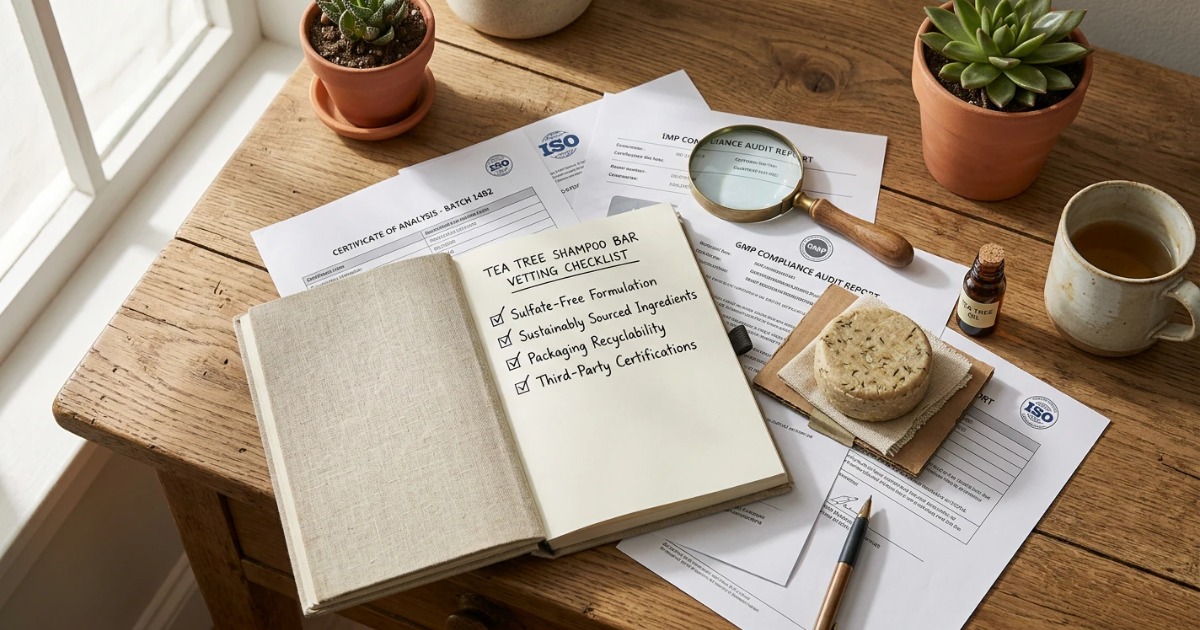
Certifications aren't decoration — they're your entry ticket. A cosmetic product entering the EU must comply with Regulation (EC) No 1223/2009, including a Cosmetic Product Safety Report and a Responsible Person. North American retailers increasingly demand FDA-registered facilities and SDS documentation before they'll list a product.
A factory without GMP or ISO systems can still make a bar that looks fine on the bench. The problem appears at scale, when a distributor's compliance team asks for audit records that don't exist, or when a shipment is stopped because ingredient documentation doesn't match the label.
Certification Comparison Table
| Certification | What It Covers | Primary Market Relevance |
|---|---|---|
| GMP (Good Manufacturing Practice) | Standardized production, hygiene, and traceability procedures | Universally expected; often mandatory for retail buyers |
| ISO 22716 | Cosmetics-specific quality management systems | Strongly favored in Europe and the Middle East |
| FDA Registration | Facility registration and compliance for the U.S. market | North America — required by most major retailers |
| SMETA | Ethical and social compliance audit (labor, safety, environment) | Required by many European and North American chains |
Formulation Expertise and Ingredient Sourcing
A tea tree shampoo bar is a small piece of applied chemistry. Getting it wrong is easy: too much tea tree oil and the bar becomes harsh and irritating; too little and the marketing claim rings hollow. Concentrations typically sit in the 0.5–2% range depending on the surfactant base and the intended scalp benefit.
Sulfate-free production adds complexity. Replacing SLS with milder surfactants such as sodium cocoyl isethionate (SCI) or sodium coco-sulfate changes lather, hardness, and pH behavior. A capable manufacturer manages pH into the roughly 4.5–6.5 range so the bar cleans without stripping the hair cuticle.
Ask a prospective partner how they source their tea tree oil and whether they can supply a certificate of analysis. Genuine Melaleuca alternifolia oil with a verified terpinen-4-ol content behaves very differently from a diluted or synthetic substitute.
Production Capacity and Scalability
Your first order might be modest. Your third order, if a retailer picks up the line, could be ten times larger with a fixed delivery window. A factory running a single manual line can meet the first order and completely miss the third.
Multiple automated production lines and healthy daily output aren't vanity metrics — they're what let a supplier absorb a sudden spike without pushing your lead time out by weeks. Scalability is insurance against your own success.
Quality Control and Consistency
Consistency is where cheap manufacturing quietly fails. A bar that's slightly softer in one batch, or a scent that drifts between production runs, generates returns and erodes reviews.
Look for documented batch testing, stability testing (usually accelerated aging at elevated temperature), and hardness and weight tolerances. A serious partner retains samples from each batch and can trace any complaint back to a specific production record.
MOQ Flexibility and Pricing Transparency
Minimum order quantity determines who can even enter the market. A 10,000-unit MOQ locks out most first-time brand owners, who need to validate demand before committing serious capital.
Pricing should be legible. Watch for costs that appear only after you commit: mold fees, plate charges for packaging, color-matching surcharges, and sample fees that aren't credited against production. A transparent quote lists these up front.
Customization and Private Label Capabilities
There's a meaningful difference between white label and true ODM. White label means slapping your logo on an existing bar. ODM means the manufacturer develops a formula, scent, shape, color, and packaging built around your brief.
For a differentiated private label tea tree shampoo bar, you want the second option — a partner who can adjust the lather profile, add complementary actives, mold a custom shape, and produce packaging that survives shipping while staying plastic-free.
Lead Time Reliability and Communication
In B2B, a reliable "six weeks" beats an optimistic "three weeks" that slips to eight. Predictable lead times let you plan launches, promotions, and inventory financing.
Responsive communication is the quiet differentiator. If a supplier takes four days to answer a pre-sale question, imagine the response time once your money is already in the factory.
Understanding the Tea Tree Shampoo Bar Market
Selecting a partner is easier once you understand what's driving demand and where the margin lives.
Why Solid Shampoo Bars Are Growing
Three forces are converging. First, plastic reduction — a single shampoo bar can replace two or three bottles, which resonates with both consumers and retailers chasing sustainability targets. Second, travel practicality, since solid bars sidestep liquid restrictions and don't leak. Third, the broad move toward natural, sulfate-free formulations.
Market research through 2025 and into 2026 continues to show solid shampoo among the faster-growing segments in personal care, outpacing conventional liquid shampoo growth in several developed markets. The category is no longer experimental.
Why Tea Tree Is a Standout Ingredient
Tea tree oil carries a distinct positioning advantage. Consumers associate it with scalp health, clarifying cleansing, and anti-dandruff benefits — perceptions that support a premium price point.
Because it signals "active ingredient" rather than "fragrance," a tea tree bar can command higher shelf pricing than a generic scented bar while costing only modestly more to produce.
Market Snapshot Table
| Segment | Demand Signal (2026) | Key Regions |
|---|---|---|
| Natural / sulfate-free shampoo bars | Strong, above-category growth | North America, Western Europe |
| Tea tree / scalp-focused bars | Premium niche, expanding | North America, UK, Germany |
| Plastic-free packaging demand | Increasingly expected as baseline | Europe, North America |
| Value / private label bars | Growing retailer interest | Middle East, Europe |
Regional Demand: North America, Europe, and the Middle East
North American buyers prioritize FDA compliance, clean ingredient lists, and retail-ready packaging. Claims must be defensible, since regulatory and consumer scrutiny around "natural" language is real.
European buyers lead on sustainability and expect full CPSR-backed documentation and often ISO 22716 systems. Packaging waste regulations make plastic-free formats a genuine commercial advantage, not just a talking point.
Middle Eastern demand often blends premium personal care with strong fragrance preferences and gift-oriented packaging. Manufacturers serving this market need flexibility in scent intensity and presentation.
Common Challenges When Sourcing a Shampoo Bar Manufacturer
Knowing the obstacles ahead of time saves you the tuition of learning them the expensive way.
High MOQs That Block Small Brands
Large MOQ shampoo bar contract manufacturing requirements are the most common barrier for startups. A five-figure minimum forces you to gamble on unproven demand, and unsold stock ties up cash you can't recover.
Inconsistent Quality and Formulation Gaps
Not every factory that makes soap can make a stable, sulfate-free shampoo bar. Inexperienced suppliers may deliver a good first sample and then fail to reproduce it at scale, or produce a bar that softens and disintegrates faster than expected.
Limited Customization and Slow Communication
Rigid factories treat every client the same and can't support true ODM development. Combine that with slow, translated-once-a-week email threads and a simple color adjustment can drag on for a month.
How to Evaluate and Shortlist Potential Partners
Here's a practical process to move from a long list to a confident decision.
Step 1: Verify Certifications and Factory Audits
Ask for certificate numbers and dates, not just logos on a website. Where possible, request a recent audit report or arrange a video walkthrough of the production floor.
Step 2: Request Samples and Test for Quality
Test the sample the way a customer will use it: real washes over two weeks, checking lather, rinse-out, scalp feel, and how the bar wears down and dries between uses.
Step 3: Assess MOQ, Pricing, and Lead Times
Get a full quote including tooling, packaging, and shipping terms. Confirm lead times in writing and ask what happens if a deadline slips.
Step 4: Evaluate Customization and R&D Support
Give the supplier a small, specific brief — for example, a sulfate-free tea tree bar with a target pH and a custom shape. How they respond tells you whether you've found an OEM solid shampoo bar supplier or a true development partner.
Supplier Evaluation Scorecard Table
| Criterion | Weight | What to Score |
|---|---|---|
| Certifications | 25% | GMP, ISO, FDA, SMETA verified and current |
| MOQ flexibility | 20% | Entry MOQ that fits your launch budget |
| Customization / R&D | 20% | Formula, scent, shape, packaging control |
| Lead time reliability | 15% | Written schedules, track record |
| Production capacity | 10% | Ability to scale reorders quickly |
| Communication | 10% | Response speed and clarity |
Why Boymay Is the Right Manufacturing Partner
Every criterion above describes a category of risk. Boymay was built to remove those risks for brands entering or scaling in personal care.
Three Decades of OEM/ODM Expertise Since 1995
Boymay has specialized in bath bombs, shower steamers, and personal care products since 1995. That's not a recent pivot into a trending category — it's more than thirty years of formulation and production discipline behind every order.
Certified Facility Built for Global Brands
Our 40,000㎡ facility runs 16 automated production lines staffed by 200+ employees, and holds GMP, ISO, FDA, and SMETA certifications. That combination is precisely what North American, European, and Middle Eastern buyers require before they'll place a brand on their shelves.
Capacity and Reliability You Can Scale With
With a daily output of 160,000 sets, we can support a small launch and a national rollout from the same facility — without pushing your lead time out when volumes climb. Stable delivery is treated as a commitment, not a hope.
Low MOQ From 1,000 Units
Our MOQ starts at 1,000 units, which lets an entrepreneur test the market as a custom shampoo bar manufacturer partner without a five-figure gamble. Validate demand first, scale second.
Full Customization for Your Private Label
We support genuine ODM development — formula, tea tree oil concentration, scent, shape, color, and packaging — so your private label tea tree shampoo bar looks and performs like a distinct brand, not a rebadged stock item.
Boymay at a Glance Table
| Attribute | Detail |
|---|---|
| Established | 1995 |
| Facility size | 40,000㎡ |
| Production lines | 16 automated lines |
| Team | 200+ employees |
| Daily capacity | 160,000 sets |
| MOQ | From 1,000 units |
| Certifications | GMP, ISO, FDA, SMETA |
| Markets served | North America, Europe, Middle East |
How to Get Started With Boymay
Getting started is deliberately low-friction. Send us your brief — target formula, scent direction, packaging idea, and volume — and we'll return a clear quote with MOQ, pricing, and lead time.
Order samples to test the bar the way your customers will. From there, we can refine the sulfate-free formulation and lock in your packaging. If you're evaluating an OEM solid shampoo bar supplier and want documentation to verify, we'll provide it. Reach out to request a quote and samples to begin.
Frequently Asked Questions
Q: What is the minimum order quantity for tea tree shampoo bars?
A: Our MOQ starts at 1,000 units, making it practical for entrepreneurs and small brands to launch a new line without over-committing capital.
Q: Can you develop a custom sulfate-free formula for my brand?
A: Yes. Our R&D team develops natural, sulfate-free formulations using surfactants such as SCI, balances pH for hair and scalp, and tunes tea tree oil concentration to your positioning and claims.
Q: Which certifications do your shampoo bars meet?
A: Our facility holds GMP, ISO, FDA, and SMETA certifications, which cover the quality, safety, and ethical-compliance requirements typical of North American, European, and Middle Eastern buyers.
Q: How long does production and delivery take?
A: Lead times depend on order size and customization, but our 16 automated lines and 160,000-set daily capacity allow us to maintain stable, predictable schedules that we confirm in writing before production.
Q: Do you offer full private label and packaging services?
A: Yes. As a full-service OEM/ODM manufacturer, we handle formula, scent, shape, color, and complete packaging design so your private label product is fully differentiated and retail-ready.
Q: Which markets do you supply?
A: We serve B2B clients across North America, Europe, and the Middle East, and our certifications and documentation are built to meet the regulatory expectations of each region.