
Picture this: you're standing in the fragrance aisle, two bottles in hand that look nearly identical. One says "perfume." The other says "body mist." The prices are worlds apart, and the sales associate is tied up with another customer. So which one do you buy? And does the difference even matter?
If you've ever frozen in exactly this spot, you're in good company. The line between a body mist and a "real" perfume blurs fast, and most online explanations just recycle the same tidy dictionary definition without giving you anything you can actually use. This guide does it differently. We'll break down what a body mist really is, how it behaves on your skin, and when it genuinely beats a bottle of pricey parfum.
Body Mist, Defined: More Than Just "Light Perfume"
Call a body mist a "light perfume" and you're not exactly wrong—but you're missing the point entirely. A body mist is a lightly fragranced product designed to be sprayed generously over the whole body, not dabbed carefully on a wrist. That single distinction shapes everything: how it's made, and how you're meant to use it.
Dilution is the key. A perfume packs a heavy dose of fragrance oil into a small amount of liquid. A body mist stretches a tiny amount of scent across a watery, skin-friendly base. The result? Something you can reach for casually, again and again, without the room-clearing punch of a concentrated fragrance.
The Ingredient Story: What's Actually Inside the Bottle
Flip a bottle around and you'll usually spot a short, familiar list. Water often sits near the top. Then a modest hit of alcohol—or sometimes very little—a small percentage of fragrance oil, and a few supporting players like glycerin, aloe vera, or a mild solubilizer that keeps the oil evenly dispersed.
That fragrance oil concentration typically lands somewhere between 1% and 3%. Sounds trivial. But that low ratio is the whole reason a mist behaves the way it does. Less oil means softer scent projection, shorter wear time, and a formula gentle enough to spritz across your arms, your neck, even your clothes.
The added humectants matter too. Aloe and glycerin give some mists a faintly conditioning quality, which is why a good one can leave your skin feeling refreshed rather than tacky. This is a real formulation choice, not marketing fluff—it's the difference between a mist that feels like a treat and one that feels like scented water.
Where the Term Came From
Body mist as a distinct category didn't always exist. For decades, the casual end of the fragrance world belonged to splash colognes and body splashes—cheerful, high-alcohol products you slapped on after a shower. As drugstore and lifestyle brands hunted for something a little more refined but still affordable, the "mist" slotted itself neatly between those old splashes and a proper eau de toilette.
That in-between slot is exactly why the term feels slippery. A body mist borrows the low commitment of a splash and the finer scent construction of a real fragrance, then wraps it in fine-atomizing spray bottles that feel modern. Understanding that lineage explains why nobody can quite agree on what "counts" as a mist.
What Is Body Mist Used For? Everyday Scenarios That Make Sense
Here's where it gets practical. If you're wondering what is body mist used for in real daily life, the honest answer is: pretty much anywhere you want a gentle wash of scent without overthinking it.
- Post-shower refresh. This is the classic move. Skin is clean, slightly damp, and ready to hold onto fragrance.
- The gym bag rescue. A few sprays after a workout when a full shower isn't happening.
- Desk drawer duty. An afternoon pick-me-up that won't overwhelm coworkers sitting three feet away.
- Travel. Lighter formulas and smaller bottles slide easily into a carry-on.
- Hair and linens. A light mist on the ends of your hair or a passing spritz on a scarf—used sparingly and thoughtfully.
Notice the theme: low stakes, high frequency. A mist is the fragrance you use without ceremony.
The "Scent Layering" Angle Most Articles Skip
Most guides stop at "spray and go." But some of the most interesting use of a scented body spray happens when you treat it as a layer rather than a finished product.
Think of a mist as a base coat. Spray a complementary or matching mist over freshly moisturized skin, then apply a small amount of your stronger perfume to your pulse points. The mist fills in the background, softening and extending the top notes of the concentrated fragrance without competing with it.
Professional fragrance lovers use this trick constantly, and it flips the usual hierarchy on its head. Suddenly the "cheap" mist isn't a downgrade—it's a supporting instrument that makes your signature scent feel fuller and last a touch longer.
Seasonal and Situational Fit
There are moments when a fragrance mist simply wins over perfume, and it's worth naming them.
In sticky summer heat, a heavy parfum can turn cloying fast, while a fresh mist reads clean and breathable. In offices with strict fragrance policies—or shared spaces where someone always seems to be sensitive—a light spritz respects the room. And around anyone with a sensitive nose, a subtle mist sidesteps the awkward "who's wearing all that perfume?" moment.
Rule of thumb: the closer the quarters and the hotter the day, the more a body mist earns its place over a concentrated fragrance.

Body Mist vs Perfume: The Difference That Actually Matters
Let's tackle the question everyone actually types into a search bar. The body mist vs perfume difference comes down to one core variable—concentration—and everything else follows from there.
Fragrance Concentration Explained
The percentage of fragrance oil in a product decides how strong it smells, how long it lasts, and how it's meant to be worn. Here's how the main categories stack up:
| Product Type | Fragrance Oil % | Typical Longevity | Best For |
|---|---|---|---|
| Body Mist | 1–3% | 1–2 hours | Casual, frequent reapplication |
| Eau de Toilette | 5–15% | 3–5 hours | Daytime wear |
| Eau de Parfum | 15–20% | 5–8 hours | Long-lasting, evening |
| Perfume (Parfum) | 20–30% | 8+ hours | Special occasions |
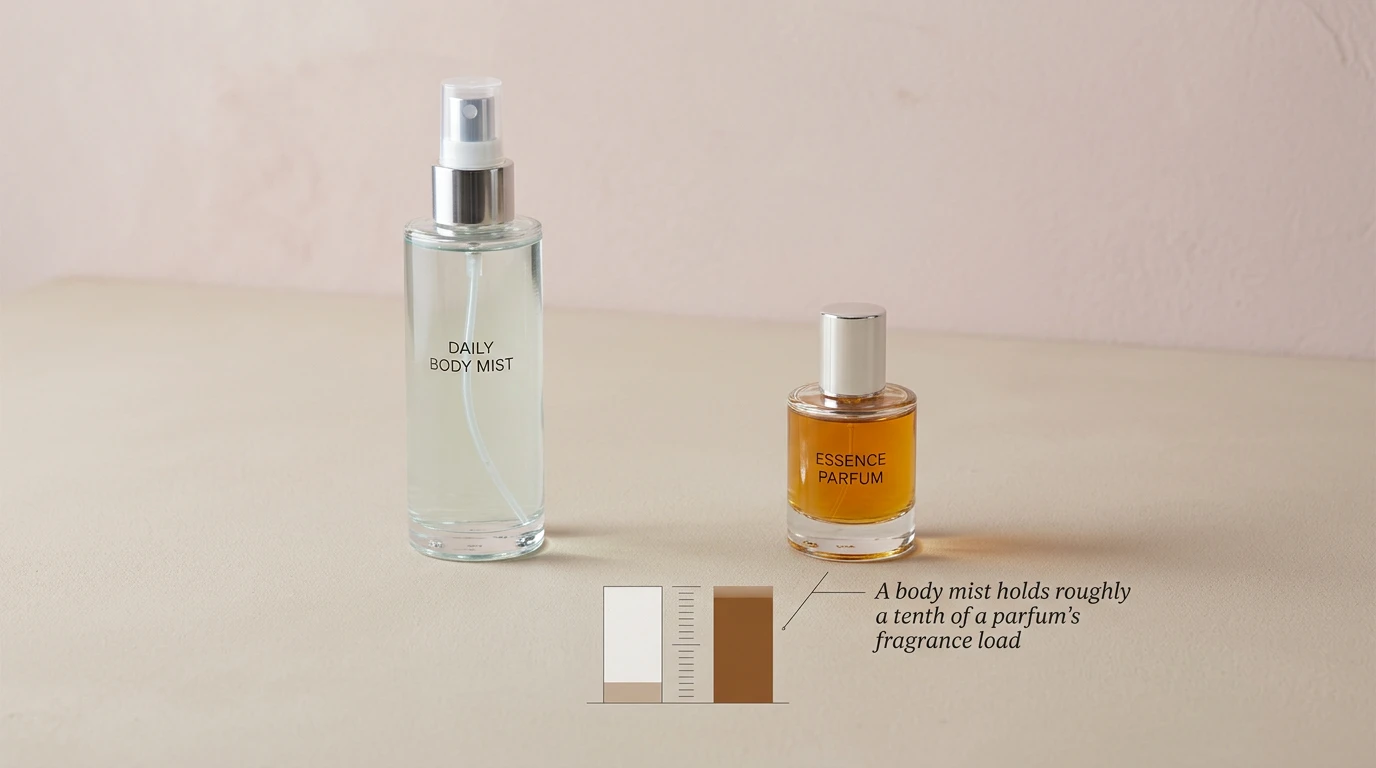
See how far apart the ends of that spectrum sit? A body mist carries roughly a tenth of the fragrance load of a true parfum. That's not a flaw. It's the entire design philosophy.
So, Is a Body Mist a Perfume?
The tidy answer people want is yes or no. The accurate answer: it depends on how strictly you define your terms. If you're asking is body mist a perfume in the sense of belonging to the fragrance family, then yes—it uses the same aromatic materials and lives in the same world.
But in the way most people mean the word—a concentrated, long-wearing scent you apply in small amounts—a mist is a different creature. It's built for coverage over intensity, refreshment over permanence. So when someone insists "a body mist isn't real perfume," they're half right: it's real fragrance, just engineered for a completely different job.
Think of it like coffee. An espresso and a tall iced coffee are both coffee. Nobody's confused about that. But you wouldn't order one expecting the other, and you'd pick between them based on the moment.
Cost, Value, and How Often You'll Reach for Each
Money enters the picture here in a way that actually simplifies your decision. A bottle of designer parfum can cost several times what a mist does, and it carries an emotional weight—you ration it, you save it for occasions, you feel a small pang using it up.
A mist carries none of that baggage. It's a low-commitment purchase, which means you can experiment freely, own several for different moods, and spray without guilt. For anyone still figuring out their taste, that freedom is genuinely valuable. You learn what you love by wearing things, and a mist lets you wear a lot without draining your wallet.
How to Use Body Mist for Maximum Effect
Knowing how to use body mist properly is the difference between a scent that lingers pleasantly and one that vanishes before you've left the driveway. A few small adjustments make a surprising difference.
The Application Method, Step by Step
Start with the basics of how to apply body mist in a way that actually holds:
- Time it right. Spray within a minute or two of stepping out of the shower, while skin is warm and slightly damp. Warm skin diffuses scent; damp skin helps it cling.
- Hold the right distance. Keep the bottle roughly 15–20 cm (about a hand-span) from your body so the mist lands in a fine, even veil rather than a wet patch.
- Hit the warm zones. Focus on pulse points—inner wrists, the base of the throat, behind the ears, the crook of the elbows—where body heat lifts the fragrance through the day.
- Add a light all-over pass if you like. Because mists are gentle, a general spritz across the torso and arms is completely fine and gives that soft, all-around freshness.
Common Mistakes That Waste Your Mist
A few habits quietly sabotage your scent, and almost everyone is guilty of at least one.
The most famous one: spraying a cloud in the air and walking through it. It feels elegant, but most of the fragrance drifts to the floor, and you end up with a faint trace at best. Aim at your skin instead.
Over-application is another trap. Because a mist is light, people assume more is always better and empty half the bottle. What you actually get is a muddled, heavy result that fatigues your own nose. Restraint reads as more refined.
And finally, storage sabotage—leaving your bottle on a sunny windowsill or in a steamy bathroom slowly breaks down the fragrance compounds long before you finish it.
Making a Light Scent Last Longer
Since longevity is a mist's weak spot, here's how to stretch it honestly:
- Moisturize first. Fragrance clings to hydrated skin far better than to dry skin. A layer of unscented lotion creates a surface for the scent to grip.
- Layer within a family. Use a matching scented lotion or shower gel to reinforce the notes from the ground up.
- Reapply strategically. Keep a travel bottle within reach and top up once mid-afternoon instead of piling everything on first thing in the morning.
Choosing the Right Body Mist for You
The shelves are packed. Choosing well has little to do with brand names and everything to do with matching a scent to the life you actually lead. Fragrance is deeply personal, so let's frame this around families and needs rather than a leaderboard.
Matching Scent Families to Occasions
Every scent belongs to a broad family with its own personality. Here's a quick map to help you pair the right mood with the right moment:
| Scent Family | Character | Ideal Moment |
|---|---|---|
| Fresh / Citrus | Bright, clean | Morning, workouts |
| Floral | Soft, romantic | Daytime, spring |
| Fruity | Playful, sweet | Casual outings |
| Warm / Vanilla | Cozy, sensual | Evening, cooler months |
You don't have to pick just one. Many people build a small rotation—a citrus for the gym, a warm vanilla for winter evenings—precisely because mists make that affordable.
Best Body Mist Considerations for Women (and Everyone Else)
Searches for the best body mist for women usually expect a ranked list. But rankings age badly. Formulas get reformulated and favorites shift season to season. A smarter approach is to judge by criteria that stay true.
Look for a scent that reads well on your skin—test it, don't trust the bottle—a formula that won't dry out or irritate your skin type, and a projection level that fits where you'll wear it. And ignore the gender label on the front. Fresh, fruity, floral, and warm notes work for anyone; the "for women" tag is marketing, not chemistry.
Reading a Label Like a Pro
A quick label scan tells you more than any advertisement. Check the alcohol content if your skin runs dry or reactive—lower-alcohol formulas tend to feel kinder. Scan for added skin-conditioning ingredients like aloe or glycerin if you want that refreshing feel.
And if ethics matter to you, look for clear cruelty-free or vegan claims rather than vague "clean" buzzwords. A brand that spells out its standards has usually thought about them.
Safety, Skin, and Storage Notes
Fragrance is delightful. But it's still a cosmetic product that interacts with your skin, and a little care keeps the experience pleasant.
For Sensitive Skin and Allergies
If your skin flares easily, don't gamble. Do a patch test—spray a small amount on your inner forearm and wait 24 hours before committing to broader use. Watch for redness or itching, which usually signals a reaction to fragrance compounds or a high alcohol content.
For very reactive skin, consider spraying onto clothing or hair instead of directly on the body, keeping the fragrance close but off your most sensitive zones. And if you know you react to specific aromatic ingredients, scan the label before buying rather than after.
Storage and Shelf Life
Fragrance is fragile in ways people rarely appreciate. Light, heat, and big temperature swings all speed up the breakdown of aroma molecules, which is why a mist left in a hot car or a sunny window turns flat and slightly "off."
Store your bottles somewhere cool, dark, and stable—a drawer or a closet shelf beats a bathroom counter. Once opened, most mists stay at their best for roughly one to two years, though a lighter, water-based formula may fade a little sooner. Trust your nose: a sour or muted smell means it's past its prime.
Final Thoughts: Finding Your Signature Everyday Scent
One thing worth holding onto: a body mist isn't a watered-down perfume. It's a different tool for a different job. Built for lightness, freedom, and everyday enjoyment—not dramatic, hours-long projection.
If you're just stepping into fragrance, a mist is the gentlest, most forgiving way in. You get to explore scent families, experiment without the financial guilt, and find what genuinely feels like you. That's no compromise. It's a smart place to start.
Your Next Step
Ready to find your everyday signature? First, figure out which scent family suits your daily rhythm—fresh for busy mornings, warm for cozy evenings. Then test a mist on your own skin, not a paper strip. Give it a full day to settle before deciding.
Save this guide for the next time you're standing in the fragrance aisle. Try a few mists that fit your lifestyle. Your ideal everyday scent is out there—and now you know exactly how to find it.
Frequently Asked Questions
Q: Does body mist expire?
A: Yes, though slowly. Most mists remain good for about one to two years after opening, and unopened bottles can last longer if stored away from heat and light. The scent gradually weakens or shifts rather than becoming unsafe, so if it smells noticeably different from when you bought it, it's time to replace it.
Q: Can I use body mist on my hair or clothes?
A: You can, with a light hand. A gentle spritz on the ends of your hair or a passing mist over a scarf works nicely, but don't soak either—alcohol can dry hair over time, and some formulas may leave marks on delicate fabrics. Spray from a distance and let it settle rather than drenching the material.
Q: How is body mist different from body spray?
A: The terms overlap and brands use them loosely, but there's a subtle distinction. A body spray tends to lean toward deodorizing freshness and often carries a higher alcohol punch, while a body mist is usually softer, more fragrance-forward, and formulated with a touch more care for the scent experience. Think of body spray as functional freshness and mist as gentle fragrance.
Q: Is body mist good enough as your only fragrance?
A: Absolutely, if it suits your lifestyle. Plenty of people wear nothing but mist and love it—especially those who prefer a subtle scent, reapply through the day, or work in fragrance-sensitive environments. The only trade-off is longevity, which you solve with a small reapplication rather than a bigger bottle.
Q: How many sprays of body mist should I use?
A: Begin with three to five sprays across your pulse points and torso, then adjust from there. Mists are diluted, so you can use more than you would with perfume—just don't go overboard. Can't smell yourself after a few minutes? That's normal. Your nose adapts fast. Ask a trusted friend before you reach for more.