
Seasonal retail runs on a brutal clock. A shipment of holiday bath bombs that arrives on December 20th isn't a late delivery—it's dead inventory. For B2B buyers, private label brands, and retailers, the difference between a sold-out shelf and a warehouse full of markdown stock often comes down to one decision made months earlier: when to start sourcing.
This guide breaks down the working-backward math—sampling, production, freight, and customs—so you can pinpoint the exact date to kick off your next seasonal order. No guesswork, no fire drills.
Why Timing Makes or Breaks Seasonal Product Success
Seasonal demand doesn't ramp gradually. It spikes, peaks, and collapses within a narrow window. Your product either sits on the shelf during that spike or it doesn't sell at all.
The seasonal product sourcing timeline directly governs three outcomes that decide profitability: sell-through rate, margin protection, and shelf availability during peak demand. Miss the alignment and even a great product underperforms.
The Real Cost of Sourcing Too Late
Late sourcing forces expensive corrections. When ocean freight is no longer an option, buyers switch to air freight—often paying four to six times the per-unit shipping cost just to hit the shelf date.
Worse is missing the window entirely. Products that land after peak get liquidated at 40–70% off. A Christmas gift set discounted in January isn't a sale; it's a loss you're documenting for the tax write-off.
The Hidden Risks of Sourcing Too Early
Over-eager buyers face a quieter set of problems. Ordering too far ahead ties up working capital in inventory that generates zero return for months.
Then there's warehousing cost and shelf-life exposure—shower gels and scented products have finite freshness windows. And in fashion-driven categories like novelty bath products, a fragrance or color trend committed to in January may feel stale by the time it ships in October.
Understanding Holiday Product Manufacturing Lead Time
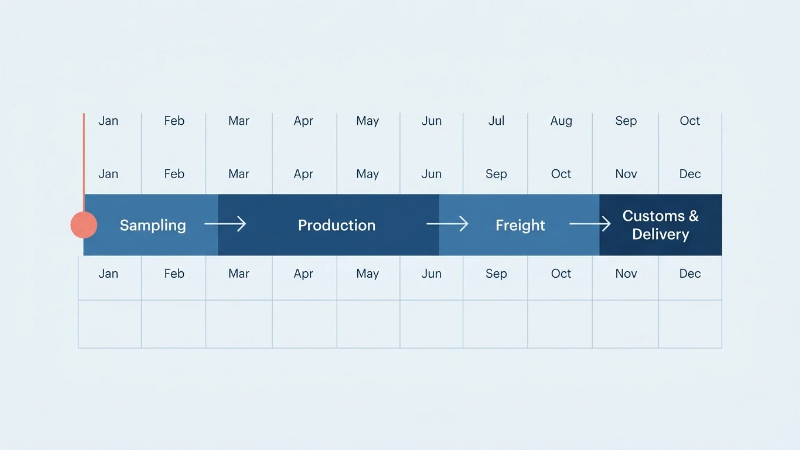
To reverse-engineer your order date, you first have to understand the full production cycle. Many suppliers quote only the "production" number and let buyers discover the other phases the hard way.
Sampling and Approval Phase (7–14 Days)
Custom work starts with samples, not production. For personal care items, a proper sample validates formula, fragrance profile, appearance, and packaging—typically taking 7–14 days depending on complexity.
This is the stage buyers most want to compress and least should. A rushed fragrance approval that gets rejected after bulk production begins costs weeks, not days. Build in room for at least one revision round.
Bulk Production Lead Time (25–30 Days)
Standard bulk production runs 25–30 days once samples are signed off and the deposit clears. That figure isn't fixed—it flexes with order volume, custom mold requirements, and packaging intricacy.
A single-color bath bomb in stock packaging runs at the fast end. A multi-layer formulation with a bespoke mold, embossed logo, and gift-box assembly sits at the longer end. Factories running automated production lines hold this window more reliably than smaller workshops that stack orders in peak season.
Shipping and Customs Clearance Buffer
Transit is the phase buyers routinely underestimate. Ocean freight from China to the US West Coast typically runs 18–25 days; to East Coast ports and Northern Europe, 30–40 days; to major Middle East ports, roughly 20–28 days.
Add a customs and port contingency buffer of 7–14 days for inspections, documentation checks, and seasonal congestion. Q4 port backlogs are predictable—plan for them rather than praying against them.
The Ideal Seasonal Product Sourcing Timeline by Season
Here's the practical centerpiece: working backward from each shelf date. The formula is consistent—sampling + production + freight + buffer + a safety margin—but the start date shifts with your target market.
Christmas & Winter Holiday Season
Q4 is the highest-volume selling period, and it's also when factories and freight lanes are most congested. For products that must hit shelves by early November, kick off sampling in March–April.
That gives you a full sample cycle, a comfortable production slot booked before peak-season crowding, and ocean freight instead of last-minute air. Waiting until summer to start means competing for the same capacity as everyone else who waited.
Valentine's Day & Spring Seasons
Valentine's gifting products and spring launches need to land by mid-January. Begin sourcing in September–October of the prior year.
This timeline is tricky because it overlaps with the Q4 production crunch. Confirming your slot early insulates you from the holiday bottleneck.
Summer & Mid-Year Promotions
Summer peaks are generally lighter and more forgiving, with less freight congestion. Sourcing four to five months ahead—roughly February–March for a July shelf date—is usually sufficient.
Regional variation matters here: what "summer" means for a Northern European retailer differs from a Gulf-region buyer, both in timing and product suitability.
Middle East Seasonal Calendar (Ramadan & Eid)
This is where generic timelines fail. Ramadan and Eid demand is driven by the lunar calendar, which shifts roughly 10–11 days earlier each Gregorian year.
Because gifting and personal-care demand cluster around these dates, buyers must map their sourcing deadline to next year's lunar dates, not a fixed month. A rule of thumb: begin sampling five to six months before the expected retail surge, and verify the lunar date before locking your calendar—an oversight that catches many first-time Middle East importers off guard.
Building Your Custom Bath Bomb Production Schedule
Applying this framework to custom bath products introduces variables specific to OEM/ODM personal care work.
Factoring in Custom Molds and Formulations
Custom molds add an upfront tooling step before your first sample can even be produced. Bespoke shapes for bath bombs or sponges may need a mold lead time layered on top of the sampling window.
Vegan formulations and cruelty-free requirements add ingredient-sourcing and verification steps. These aren't obstacles—they're planning line items to schedule, not discover mid-process.
Accounting for Certification and Compliance
Market-entry readiness depends on documentation, not just product. GMP, ISO, FDA, and SMETA compliance affect what paperwork must accompany your goods into North American, European, and Middle Eastern markets.
Sourcing from a manufacturer that already holds these certifications removes weeks of audit and documentation scramble. Confirm certification status early so compliance paperwork moves in parallel with production rather than after it.

Private Label Seasonal Inventory Planning Best Practices
Timing gets your product to the shelf. Strategy determines whether the right quantity is on it.
Forecasting Demand and Setting Order Quantities
Base seasonal quantities on prior-year sell-through, current retail commitments, and a realistic safety-stock margin. Overordering to "be safe" simply relocates the markdown problem.
Low MOQs—starting at 1,000 units—let you test new seasonal SKUs without overcommitting. Run a modest first batch on an unproven design, then scale the winners in a follow-up order.
Coordinating with a Reliable OEM Partner
Every date in your calendar rests on your supplier hitting theirs. A partner with stable, predictable lead times de-risks the entire seasonal plan; one that slips two weeks turns your ocean shipment into an air-freight emergency.
Reliability—consistent production capacity, transparent communication, and a track record across peak seasons—is worth more than a marginally lower unit price.
OEM Seasonal Order Deadlines: A Quick-Reference Checklist
Work backward from your target shelf date:
- Shelf date minus ~7–14 days: customs clearance and buffer complete.
- Minus ~3–6 weeks: ocean freight departs (varies by destination region).
- Minus ~25–30 days before shipping: bulk production begins—deposit paid, samples approved.
- Minus 7–14 days before production: sample sign-off and any custom mold tooling completed.
- Christmas: start sampling March–April.
- Valentine's/Spring: start September–October.
- Summer: start February–March.
- Ramadan/Eid: start five to six months out—confirm lunar dates first.
Partner With Boymay for On-Time Seasonal Sourcing
If you're looking for a manufacturing partner who treats your seasonal deadlines as their own, Boymay is worth a conversation. Since 1995, we've focused specifically on OEM/ODM production of bath sponges, shower gels, and personal care products—so seasonal planning is a discipline we've refined across three decades.
Our 40,000 m² factory runs 16 automated production lines staffed by 200+ employees, backed by GMP, ISO, FDA, and SMETA certification. That translates to stable 25–30 day bulk production lead times, samples in 7–14 days, MOQs from just 1,000 units, and full documentation ready for North American, European, and Middle Eastern markets.
Whether you're testing a new vegan, cruelty-free bath bomb line or scaling a proven holiday SKU, reach out to map your seasonal calendar with a team that delivers on time.
Frequently Asked Questions (FAQ)
Q: How far in advance should I place a custom seasonal order?
A: Add up the phases: 7–14 days for sampling, 25–30 days for bulk production, plus your region's freight transit and a customs buffer. For high-volume Christmas orders that means starting in March–April; for Valentine's/spring, September–October; for summer, February–March. Always add a safety margin for revisions.
Q: What is the minimum order quantity for custom seasonal products?
A: MOQ starts at 1,000 units. This low threshold is ideal for testing new seasonal designs before committing to a larger follow-up run.
Q: How long does it take to get a custom sample approved?
A: Custom samples are typically prepared within 7–14 days. The exact timing depends on formula complexity, fragrance development, appearance, and packaging requirements—and whether a revision round is needed.
Q: Can seasonal products be made vegan and cruelty-free?
A: Yes. Products can be formulated veganly and are not tested on animals, which supports compliance and consumer expectations across North American, European, and Middle Eastern markets.
Q: What happens if I miss the recommended sourcing deadline?
A: You still have options, but each carries a trade-off. Expedited or air freight can recover time at a significant cost premium; simplifying packaging or using stock molds can shorten production. The best mitigation is confirming your factory slot early—so start the conversation as soon as your season is on the calendar.