
If you formulate, sell, or retail shower steamers, you've probably fielded this question more than once: "Is it safe to use these in my tiny bathroom?" It's a fair concern — and one that carries real implications for product development, labeling, and liability.
Let's break down what actually happens when a shower steamer dissolves in a small, sealed bathroom, what the safety considerations look like, and how brands can respond with smarter formulations and clearer consumer guidance.
What Happens When You Use a Shower Steamer in a Small, Enclosed Bathroom
Understanding the mechanics here is step one. Shower steamers aren't bath bombs — they're designed to sit on the shower floor or a ledge, dissolving slowly as water splashes over them. The steam from your hot shower then carries those released aromatic compounds into the air you breathe.
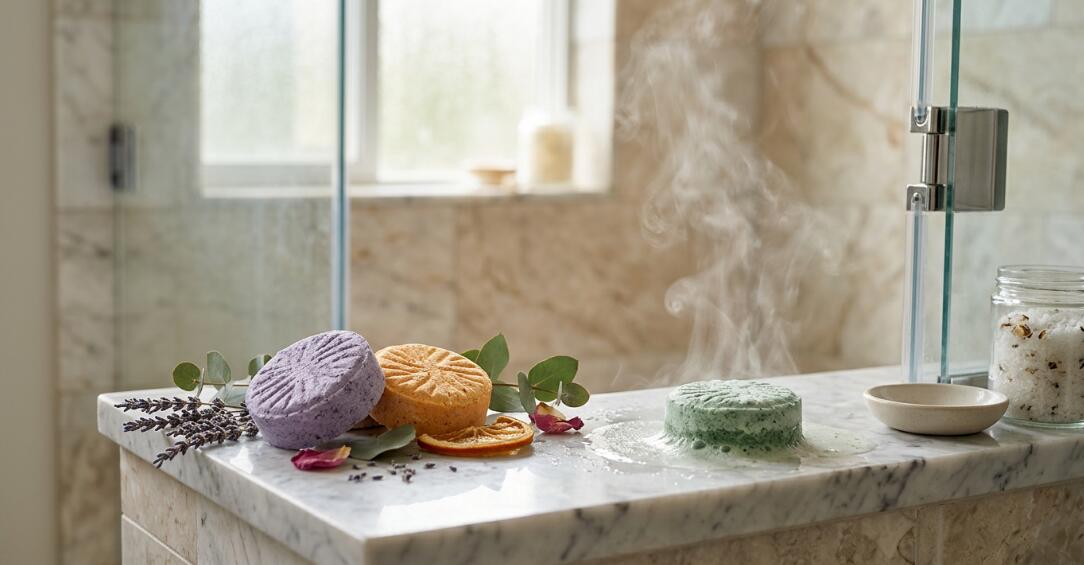
In a spacious, well-ventilated bathroom, those vapors disperse quickly. In a compact, sealed space? They concentrate. And that concentration is where the conversation gets interesting for anyone in the bath and body product industry.
How Shower Steamers Release Aromatic Compounds
The core chemistry is straightforward. When water hits the steamer, citric acid reacts with sodium bicarbonate (baking soda) to produce carbon dioxide gas — that satisfying fizz. This effervescence breaks apart the tablet and releases whatever essential oils or fragrance compounds are embedded in the matrix.
Hot shower steam acts as a carrier, lifting volatile aromatic molecules into the surrounding air. Essential oil vapor inhalation happens passively as you breathe in that warm, scented air. The hotter the shower and the more direct the water contact, the faster the release.
Here's the key variable: cubic footage. A 30-square-foot bathroom with 8-foot ceilings holds roughly 240 cubic feet of air. A 70-square-foot bathroom holds nearly 560. Same steamer, same formula — but the vapor concentration in the smaller space is more than double. That math matters.
Enclosed vs. Semi-Enclosed vs. Open Bathroom Layouts
For the purposes of shower steamer safety, let's define our terms clearly:
Enclosed: No window, no exhaust fan, sealed door, typically under 40 square feet. Common in interior apartments and older buildings.
Semi-enclosed: Has an exhaust fan or small window, but limited natural airflow. The most common residential setup.
Open: Connected to a bedroom or hallway without a full door closure, or featuring large windows. Vapor disperses rapidly.
The distinction matters because aromatherapy in small bathrooms behaves fundamentally differently than in open layouts. Formulators and retailers need to understand which environment their customers are actually using products in — not just the idealized version.
Safety Considerations for Aromatherapy in Small Bathrooms
Let's address the elephant in the room. Are concentrated essential oil vapors in a tight space actually dangerous? The short answer: for most healthy adults using well-formulated products, no. But "most" and "well-formulated" are doing heavy lifting in that sentence.
Respiratory Sensitivity and Essential Oil Vapor Concentration
Eucalyptus, menthol, and camphor are the heavy hitters in shower steamer formulations — they deliver that "spa experience" feeling. But these same compounds are respiratory stimulants. At elevated concentrations, they can trigger bronchospasm in sensitive individuals.
Populations at higher risk include people with asthma, COPD, or reactive airway disease. Young children and the elderly are also more susceptible. And while your customer might not have a pet in the shower with them, vapor that seeps under a bathroom door can affect birds and cats, both of which are highly sensitive to volatile compounds.
The International Fragrance Association (IFRA) sets usage guidelines for individual compounds, but those guidelines assume normal ventilation. Enclosed bathroom ventilation — or the lack thereof — isn't always factored into standard compliance calculations.
Skin and Eye Irritation from Concentrated Steam
When there's no air exchange, volatile compounds don't just stay in the air — they can condense on skin and mucous membranes. This is rarely a serious concern at typical formulation levels (1-3% essential oil load in a 100g tablet), but it's worth noting.
Certain aldehydes and phenols in fragrance blends become mildly irritating when they accumulate on damp skin without dissipating. Eye stinging is the most common complaint consumers report when using strongly scented steamers in enclosed showers.
For formulators, staying within IFRA dermal limits provides a reasonable safety margin even in enclosed use — but it's the inhalation pathway that deserves more attention in these scenarios.
Ingredient-Specific Concerns for Enclosed Use
Not all essential oils behave the same way at high vapor density. Here's a practical breakdown:
Higher risk in enclosed spaces: Cinnamon bark (cinnamaldehyde), clove bud (eugenol at high loads), peppermint above 3% total formula, camphor, and strong eucalyptus varieties (globulus more than radiata).
Generally gentler options: Lavender, Roman chamomile, sweet orange, bergamot (FCF), ylang ylang at low percentages, and frankincense. These compounds tend to be less aggressive on respiratory tissue even at moderate concentrations.
For brands building product lines, this distinction can inform an entire "small space" collection without requiring radical reformulation.
Enclosed Bathroom Ventilation — Best Practices for Product Makers and Retailers
You can't control your customer's bathroom layout. But you can equip them with practical guidance that protects their experience and your brand reputation.
Minimum Ventilation Recommendations
The simplest interventions make the biggest difference:
Crack the door: Even a two-inch gap creates passive airflow that prevents vapor from reaching uncomfortable concentrations.
Run the exhaust fan: A standard bathroom exhaust fan moves 50-80 CFM (cubic feet per minute), which is more than enough to keep vapor density in a safe range.
Use the steamer in the last 3-5 minutes of a shower: This limits total exposure time while still delivering the aromatic experience. The bathroom door opens shortly after, flushing the space.
Place the steamer away from direct water flow: This slows dissolution and reduces the burst of vapor that comes from rapid fizzing.
These aren't complicated steps, but they need to be communicated clearly. Most consumers won't think about enclosed bathroom ventilation unless you prompt them.
Labeling and Consumer Education Strategies
Proactive labeling isn't just good ethics — it's good business. Brands that address enclosed-space use directly on packaging build trust and reduce the "this gave me a headache" one-star reviews.
Consider including language like: "For small or windowless bathrooms, we recommend cracking the door slightly or running your exhaust fan during use. Place the steamer at the far end of the shower floor for a gentler experience."
Product pages and inserts can go deeper — explaining why ventilation matters, suggesting the "last five minutes" approach, and noting which scents in your line are formulated for compact spaces. This positions your brand as knowledgeable and consumer-first.
Formulation Adjustments for Steam Shower Fragrance Tablets Designed for Small Spaces
Here's where it gets commercially interesting. Rather than just warning consumers, forward-thinking brands are developing steam shower fragrance tablets specifically engineered for enclosed environments. It's a product-market fit opportunity hiding in plain sight.
Reducing Essential Oil Load Without Sacrificing Scent Throw
The instinct is to assume less oil means less scent. But perceived intensity and actual vapor concentration aren't the same thing. Several techniques let you maintain the sensory experience while lowering the airborne load:
Encapsulation: Microencapsulated fragrance releases in controlled bursts rather than all at once, spreading the scent experience over a longer period at lower peak concentration.
Slower-dissolve matrices: Adjusting the binder ratio (more hardening agents like cornstarch or kaolin clay) slows the fizz reaction, creating a gentler, more sustained release curve.
Fragrance layering: Combining a small amount of high-impact top note with a larger proportion of mild base notes creates the perception of a strong scent without the respiratory load of a high-concentration single note.
Choosing Safer Carrier Ingredients
Beyond the fragrance itself, the carrier matrix influences how vapors behave in enclosed air. Aggressive fizzing (high citric acid ratios) creates a rapid burst that floods a small space. Gentler alternatives include:
Cream of tartar as a partial citric acid replacement slows the reaction. Colloidal oatmeal and glycerin act as humectants that keep heavier aromatic molecules closer to the shower floor rather than filling the entire air column. Sodium lauryl sulfoacetate (SLSA) at low levels can create a mild foam that traps some volatiles near the water surface.
These adjustments don't require starting from scratch — they're tweaks to existing formulations that can differentiate a "compact space" SKU.
Testing Protocols for Enclosed-Space Claims
If you're going to market a product as "safe for small bathrooms," you need data to back that claim. Here's a practical testing framework:
Controlled environment testing: Use a sealed chamber approximating a small bathroom (240 cubic feet) with controlled humidity and temperature. Measure VOC (volatile organic compound) levels at breathing height over a 10-minute window.
Consumer panel feedback: Recruit panelists to use the product in their actual small bathrooms and report on scent intensity, any irritation, and overall experience. A panel of 20-30 users provides meaningful qualitative data.
Benchmark against IFRA inhalation guidelines: While IFRA primarily addresses dermal exposure, their data on individual compound thresholds provides a useful reference point for airborne concentration limits.
Market Demand and Consumer Behavior Trends
This isn't a theoretical exercise. The market is actively asking for solutions here, and the brands that respond first will own the positioning.
Urban Housing and the Rise of Windowless Bathrooms
Micro-apartments and studio living are expanding globally. In major urban markets, interior bathrooms without windows are the norm rather than the exception. These spaces rely entirely on mechanical ventilation — if the exhaust fan works at all.
This creates a specific consumer segment: wellness-minded urban dwellers who want the at-home spa experience but live in compact spaces. They're searching for products that work in their reality, not in a luxury master bathroom they don't have.
What Consumers Are Asking Retailers and Brands
Retailers report a consistent pattern of customer inquiries: "Will this be too strong for my small bathroom?" "I got a headache last time — is there a milder option?" "Are these safe to use every day in a shower with no window?"
These questions represent purchase hesitation. Every unanswered concern is a potential lost sale or a return waiting to happen. Brands that proactively address enclosed-space use — on packaging, in product descriptions, and through dedicated small-space product lines — convert that hesitation into confidence.
Frequently Asked Questions
Are shower steamers safe to use in a bathroom with no window or exhaust fan?
For most healthy adults, yes — with precautions. Crack the bathroom door at least an inch or two to allow passive airflow. Choose milder scent profiles (lavender, chamomile, citrus) over aggressive menthol or eucalyptus blends. Limit active fizzing time to 3-5 minutes by placing the steamer in indirect water contact. If you experience any lightheadedness or throat irritation, open the door fully and allow the space to air out.
Can essential oil vapors from a shower steamer trigger asthma in an enclosed space?
They can, particularly formulas heavy in menthol, eucalyptus, or camphor. These compounds are respiratory stimulants that may trigger bronchospasm in people with asthma or reactive airway disease. If you have asthma, start with a half-steamer in an enclosed space, keep your rescue inhaler accessible, and ensure at least minimal ventilation. Brands should consider noting this risk on packaging.
How long should a shower steamer be exposed to steam in a small bathroom?
In a small enclosed bathroom, 3-5 minutes of active fizzing is the sweet spot. This delivers a satisfying aromatic experience without allowing vapor concentration to build to uncomfortable levels. A practical approach: save the steamer for the last few minutes of your shower, then open the door when you step out. The scent lingers pleasantly without over-saturating the space.
What ingredients should I avoid in shower steamers if my bathroom is very small?
Watch for high concentrations of cinnamon bark oil, clove bud oil, peppermint oil above 3%, camphor, and eucalyptus globulus. Synthetic fragrance compounds containing high levels of linalool or limonene (which oxidize into sensitizers) also warrant caution in enclosed spaces. Check labels for these and opt for products marketed as "gentle" or "sensitive" formulations when ventilation is limited.
Do shower steamers produce harmful fumes in enclosed spaces?
It's important to distinguish between "fumes" and "vapor." Shower steamers produce aromatic vapor — essential oil molecules carried by steam. They don't produce combustion fumes or toxic gases. At typical formulation levels (1-3% essential oil in a standard tablet), the vapor is not harmful to healthy adults even in enclosed spaces. However, at very high concentrations with zero ventilation over extended periods, some individuals may experience mild respiratory irritation or headaches. This is a comfort issue, not a toxicity issue.
Should brands market a separate product line for small-bathroom users?
Yes — and it's a commercially smart move. A dedicated "compact space" or "gentle release" line addresses a real consumer need, differentiates your brand, reduces negative reviews from customers in small bathrooms, and demonstrates expertise in shower steamer safety. The formulation adjustments (lower oil load, slower dissolve, gentler scent profiles) are relatively simple to implement, and the labeling opportunity builds significant consumer trust.