
Most people underestimate what a simple scented candle can do for your body and mind. I certainly did. But working in personal care manufacturing — where I spend my days surrounded by people who literally engineer how things smell — gave me a front-row seat to the science behind it. Let me walk you through what I've learned, both from personal experience and from an industry that takes fragrance very, very seriously.
What Actually Happens When You Burn a Scented Candle? The Science Nobody Talks About
How Scent Travels to Your Brain
Here's something that blew my mind when I first learned it from our R&D team: smell is the only human sense that has a direct line to the limbic system — the part of your brain that controls emotions and memory. When you light an aromatherapy candle and those fragrance molecules float into the air, they don't take some long detour through your nervous system. They hit olfactory receptors in your nose, and the signal shoots straight to the emotional center of your brain. That's why a scent can make you cry before you even understand why.
I have a cinnamon-vanilla candle that does this to me every single time. It smells exactly like my grandmother's kitchen during the holidays — the sticky cinnamon rolls she'd pull out of the oven on Saturday mornings. I can't explain it logically. I just feel safe when I smell it. That's the limbic system doing its thing.
Not All Candles Are Created Equal
This is where my day job makes me a little opinionated. I've seen what goes into products on the manufacturing side, and I can tell you — the gap between a well-made essential oil candle and a cheap synthetic one is enormous.
Synthetic fragrance candles rely on lab-created scent compounds. Some are perfectly fine. Others contain phthalates and volatile organic compounds that you probably don't want filling your living room. Essential oil candles use plant-derived aromatic compounds — lavender from actual lavender, eucalyptus from actual eucalyptus. The scent is usually softer, less "punchy," but it carries real aromatherapeutic properties.
Then there's the wax. Paraffin is petroleum-derived and burns with more soot. Soy wax burns cleaner and slower. Coconut wax blends are gaining traction too. I've watched our own product development team pivot hard toward soy and coconut in the past eighteen months because consumers are asking the right questions now.
The Real Benefits of Burning Scented Candles in Your Home
Stress Relief and Genuine Relaxation
This isn't just "vibes." Aromatherapy candles made with lavender, chamomile, or sandalwood can actually trigger your parasympathetic nervous system — the "rest and digest" mode that counteracts your stress response. A 2024 study published in the Journal of Integrative Medicine found that participants exposed to lavender aroma showed measurably lower cortisol levels after just twenty minutes.
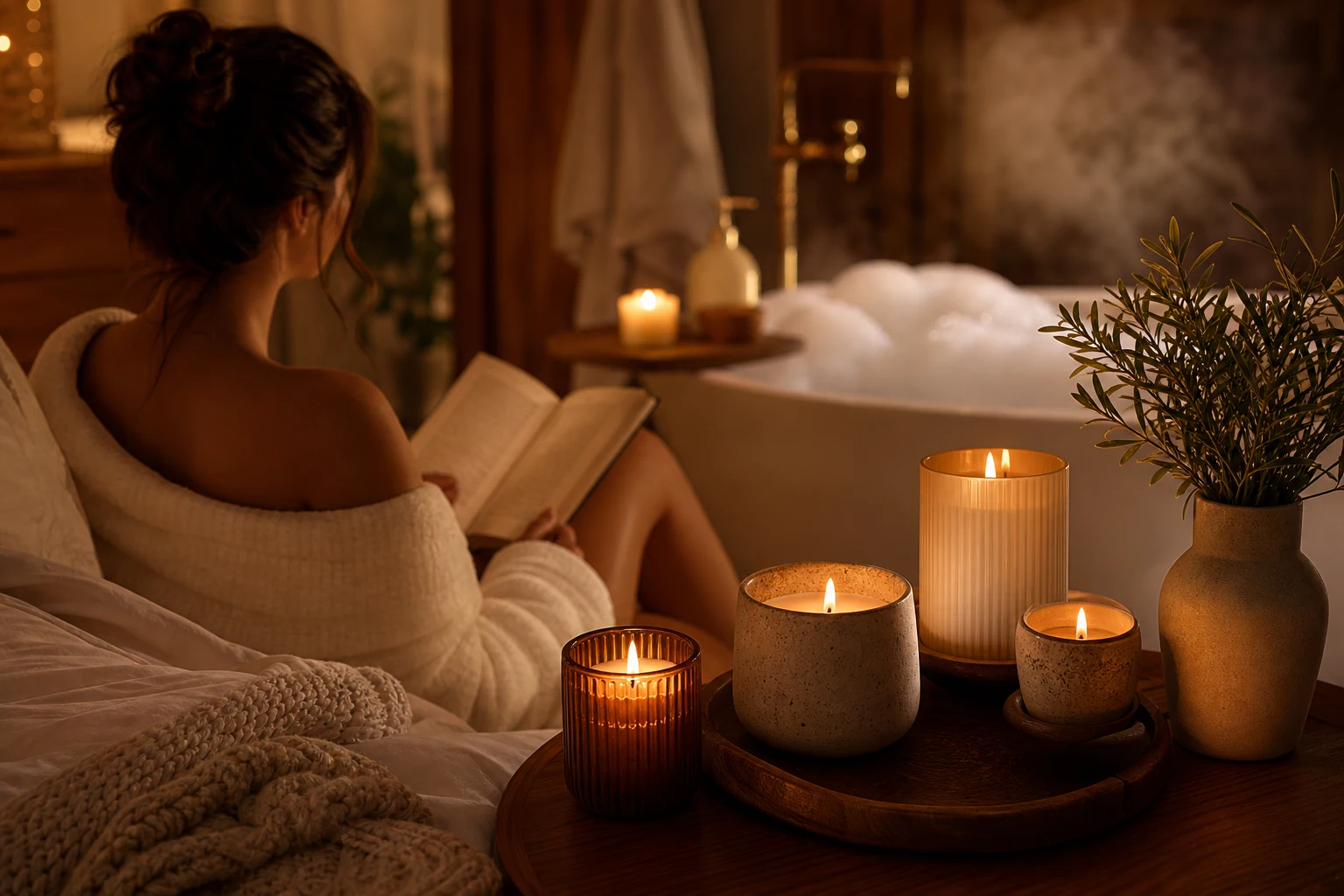
My personal routine is embarrassingly simple. About thirty minutes before I want to be in bed, I light a lavender-cedarwood candle in my bedroom. I don't do anything special — sometimes I read, sometimes I scroll my phone like everyone else. But that scented candle relaxation ritual signals to my brain that the day is done. It works better than any sleep supplement I've tried.
Improved Focus and Mental Clarity
Not every candle is meant for winding down. Peppermint, eucalyptus, and rosemary scents are stimulating — they sharpen your attention rather than soften it. I keep a small eucalyptus candle on my desk at home for when I'm working on product formulation reports or catching up on compliance paperwork in the evenings. It sounds counterintuitive that creating a calming home environment can also make you think more clearly, but it makes sense when you consider what you're actually removing: background stress, sensory clutter, mental noise. A calm space lets your brain focus on what's in front of it.
Better Sleep Quality
The home fragrance benefits that surprised me most were sleep-related. Lavender's effect on slow-wave sleep — the deep, restorative phase — has been documented repeatedly. One practical tip that took me embarrassingly long to figure out: you don't need the candle burning while you sleep. In fact, please don't do that. Light it an hour before bed, blow it out when you're ready to lie down, and let the residual scent in the room do the heavy lifting. The warm wax pool keeps releasing fragrance for a while after the flame is out.
Mood Enhancement and Emotional Balance
Citrus scents are my go-to when I'm dragging emotionally. Orange, lemon, bergamot — they have this almost immediate uplifting quality. During the darker winter months especially, when seasonal mood dips hit hard, I'll burn a blood orange candle in my kitchen while making breakfast. It feels silly to say a candle changed my morning mood, but honestly? It did.
There's also something about the ritual itself. Striking a match, watching the wick catch, the little flicker of flame. It's a tiny deliberate act in a day that's mostly reactive. That small moment of intention feels grounding in a way I didn't expect.
Creating a Welcoming Home Atmosphere
Real estate agents have known this trick forever — a subtly scented home feels warmer, cleaner, more inviting. Hospitality professionals use scent strategically in hotel lobbies for the same reason. What guests notice subconsciously — before the décor, before the music — is how a space smells.
I started layering scents in different rooms about a year ago. A fresh linen candle in the bathroom. Something warm and woody in the living room. A soft floral in the bedroom. It creates a cohesive home fragrance experience that makes the whole apartment feel intentional, like I actually thought about it. And honestly, I did — but it took maybe ten minutes and three candles.
A Surprising Benefit — Reducing Unwanted Odors Naturally
This one comes straight from the manufacturing floor. A good candle doesn't just mask cooking smells or pet odors — certain ingredients actually neutralize them. Beeswax candles, for instance, release negative ions when they burn, which can bind to pollutants and odor particles in the air. Some soy candles are formulated with activated odor-neutralizing compounds that break down the molecules causing the stink rather than just layering perfume on top.
My tip: if a candle smells overwhelmingly strong on the shelf — like it's trying to punch you in the nose — it's probably designed to cover odors rather than eliminate them. Look for candles with cleaner ingredient profiles. They work better, and your sinuses will thank you.
My Personal Opinion
Ingredient Awareness Matters More Than Brand Names
I read candle labels the same way I read skincare labels at work. It's a professional habit I can't turn off, and frankly, it's saved me from some terrible purchases.
Red flags I watch for: the word "fragrance" used as a vague catch-all with no further detail, lead-core wicks (rare now but still out there in imported discount candles), and cheap paraffin blends that produce visible black soot on your walls and ceiling. What I look for instead: cotton or wood wicks, soy or coconut wax bases, and either phthalate-free fragrance oils or pure essential oils. These details matter more than whatever influencer is holding the candle on Instagram.
The Industry Trend Toward Cleaner Home Fragrance
Consumer demand for transparency has exploded in the last couple of years, and I've watched it reshape our own product development pipeline. People want to know what they're breathing. They want non-toxic, sustainable candle options — and they're willing to pay a reasonable premium for them. I've seen our formulation team reformulate three different product lines since early 2025 specifically to remove questionable fragrance compounds. The industry is shifting. It's slow, but it's real.
How to Choose the Right Scented Candle: A Practical Buying Guide
Match the Scent to Your Goal
This is the framework I use personally, and it's dead simple:
- Relaxation: Floral and woody notes — lavender, sandalwood, cedarwood, ylang-ylang
- Energy: Citrus and herbal notes — lemon, grapefruit, basil, lemongrass
- Romance: Warm, spicy notes — vanilla, cinnamon, amber, tonka bean
- Focus: Minty and sharp green notes — peppermint, eucalyptus, rosemary, tea tree
Start with your goal, then find the scent. Not the other way around.
Size, Burn Time, and Placement Tips
A smaller candle in a bedroom actually performs better than a massive three-wick monster. Bedrooms are enclosed spaces — you don't need overwhelming scent throw. Save the big candles for open-plan living areas.
Burn time matters too. You want to burn long enough for the entire top surface to melt evenly each session — usually about one hour per inch of candle diameter. This prevents tunneling, where the wick burns down the center and wastes all that wax around the edges. And the basics: never leave a candle unattended, keep it away from drafts and curtains, and place it on a heat-resistant surface.
Price vs. Quality — What's Actually Worth Paying For
The cheapest candles often cost you more in the long run. Poor scent throw means you burn through them faster trying to actually smell something. Excess soot means cleaning your walls. Short burn life means repurchasing constantly.
You don't need luxury candles — the $65 hand-poured artisan ones are lovely, but they're not necessary. The mid-range sweet spot, somewhere between $18 and $30 for a standard jar candle, is where you'll find clean ingredients, decent burn time, and honest scent performance. My honest take: invest in clean ones, not expensive ones.
Common Mistakes People Make With Scented Candles
- Burning for only 15 minutes: This creates wax memory — the candle "remembers" that small melt pool and tunnels every time after.
- Placing candles near air vents or open windows: Drafts cause uneven burning, excess soot, and scattered scent that never really fills the room.
- Ignoring the trim-the-wick rule: Trim to about ¼ inch before every burn. Long wicks create large, smoky flames and shorten candle life dramatically.
- Mixing too many competing scents in one room: Two or three candles with clashing profiles just create olfactory chaos. Pick one scent per space.
- Buying based on cold throw alone: How a candle smells unlit in the store is completely different from how it smells burning at home. Always check hot throw reviews if you can't test in person.
Final Thoughts — It's a Small Change With an Outsized Impact
If you've never really given this a fair shot, start small. One candle. One room. One evening where you sit with it and just let the scent do its work. You don't need to overhaul your entire home or spend hundreds of dollars. You just need to be a little intentional about how your space smells — and how that makes you feel.
Your home deserves to smell like a place you actually want to be in.
And if you're anything like me — standing in your kitchen after a long day, staring at nothing, wondering why you feel so depleted — maybe all it takes is striking a match.
Frequently Asked Questions
Are scented candles safe to burn every day?
Generally, yes — as long as you're choosing quality candles made with clean wax and non-toxic fragrance, burning in a ventilated room, and keeping sessions to a reasonable length (three to four hours max). I burn one almost every evening and haven't had issues. The key is ventilation and ingredient quality. Crack a window occasionally, and skip anything that produces heavy black soot.
Can scented candles actually help with anxiety?
Aromatherapy candles can be a genuinely helpful complementary tool for managing anxiety. Lavender and chamomile in particular have documented calming effects on the nervous system. But I want to be clear — they're not a replacement for therapy or medication if you need those things. Think of them as one layer in your self-care routine, not a cure. They lower the baseline stress level so everything else you're doing works a little better.
What's the difference between essential oil candles and fragrance oil candles?
Essential oil candles use aromatic compounds extracted directly from plants — steam-distilled or cold-pressed from real botanical sources. Fragrance oil candles use synthetic or semi-synthetic compounds engineered in a lab to replicate specific scents. Neither is inherently "bad," but essential oil candles carry actual aromatherapeutic properties, while fragrance oils primarily just smell nice. From what I've seen on the manufacturing side, the best candles often use a blend of both to balance therapeutic benefit with consistent scent performance.
How long should I burn a scented candle at a time?
Follow the one-hour-per-inch rule. Measure the diameter of your candle — if it's three inches across, burn it for roughly three hours to achieve a full, even melt pool. Never exceed four hours in a single session regardless of size. The container gets too hot, the wick can mushroom, and you risk the fragrance turning acrid.
Do scented candles lose their scent over time?
They absolutely can. Most quality candles have a shelf life of about twelve to eighteen months. After that, the fragrance oils begin to degrade and the scent weakens noticeably. Store candles with their lids on, away from direct sunlight and heat. I keep my backstock in a hallway closet — cool, dark, sealed. They hold up beautifully for over a year that way.
Which scented candle scents are best for bedrooms?
For creating a calming home environment that supports sleep, I'd recommend lavender (the classic for a reason), chamomile (softer and slightly sweet), sandalwood (warm and grounding), or vanilla (comforting without being stimulating). Avoid anything with strong citrus or peppermint in the bedroom — those are energizing scents that can actually keep you alert when you're trying to wind down.