
A data-driven overview of leading Chinese bar soap producers, their capabilities, and how to select the ideal manufacturing partner for your brand.
Why Source Bar Soap Manufacturers from China?
China supplies a substantial share of the world's personal care hardware and finished goods, and bar soap is no exception. Decades of infrastructure investment, dense supplier clusters around Guangdong, Zhejiang, and Jiangsu, and mature port logistics keep unit costs competitive even after recent freight and raw material fluctuations.
What has changed most in the past decade is quality. Buyers who once treated Chinese soap as a purely price-driven category now find factories running third-party audited lines, formulating with certified surfactant bases, and meeting the documentation standards required by Western retailers.
Key Advantages for International Brands and Retailers
The practical benefits are straightforward: sharper pricing than most domestic producers, capacity that scales from pilot runs to millions of units, and OEM/ODM flexibility that lets brands own formulation, fragrance, and packaging.
Export experience matters too. Established factories serving North America, Europe, and the Middle East already understand INCI labeling, customs paperwork, and market-specific ingredient restrictions—reducing the friction that trips up first-time importers.
What Matters Most When Choosing a Supplier
Throughout this guide, five criteria recur: certifications, minimum order quantity (MOQ), customization depth, lead time, and quality control. A factory can excel at one and fail at another, so the right choice depends on your specific product roadmap.
How We Evaluated These Manufacturers
Company profiles below draw on publicly available information—corporate websites, B2B platform listings, and published certification records as of 2026. Figures such as staff counts and output are self-reported by the manufacturers; buyers should verify current data directly before contracting.
Evaluation Criteria Explained
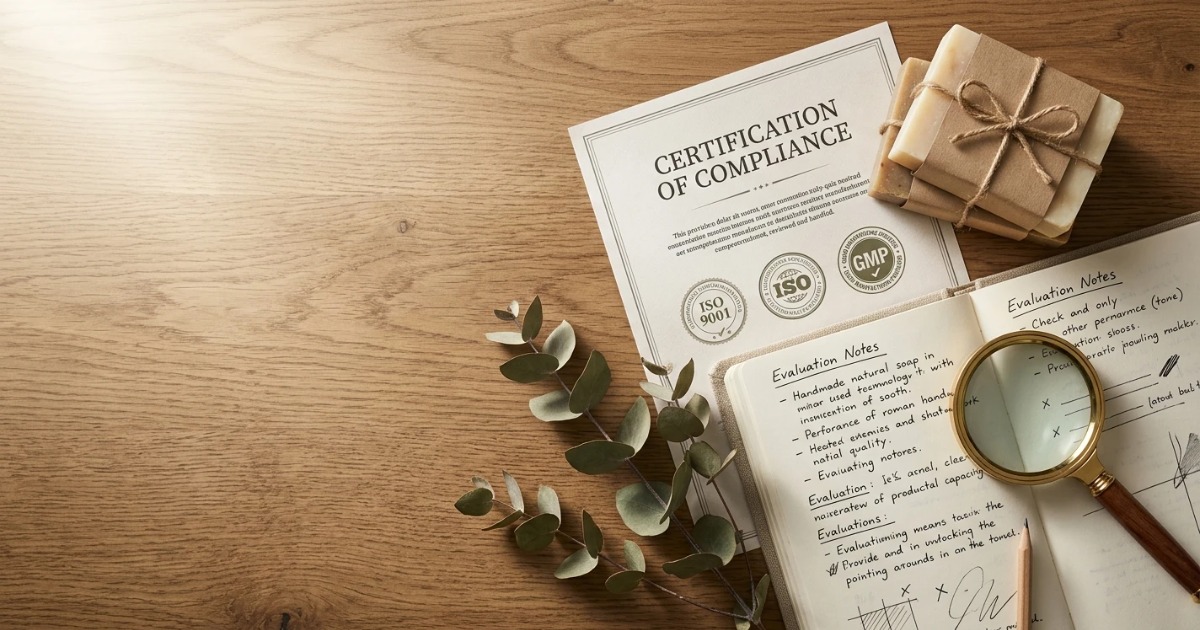
- Certifications — GMP, ISO 9001/22716, FDA registration, and SMETA social audits signal both quality systems and ethical compliance.
- MOQ — determines whether a factory suits a startup test batch or only high-volume programs.
- Production Capacity — daily and annual output indicate ability to handle seasonal peaks.
- Customization — private label bar soap capability versus full ODM formulation development.
- Target market experience — proven export track record to your destination region.
Top Bar Soap Manufacturers in China (Comparison Overview)
The table below summarizes several established Chinese producers with public profiles, followed by individual notes. Use it as a shortlist starting point rather than a final verdict.
Quick Comparison Table
| Manufacturer | Est. Year | Specialty | MOQ | Certifications | Key Markets |
|---|---|---|---|---|---|
| Guangzhou Meizhiyuan Cosmetics | 2006 | Handmade & essential oil soaps | ~3,000 pcs | ISO, GMPC | Asia, Europe |
| Yangzhou Meizichuang Daily Chemical | 2009 | Bath & body, laundry bars | ~5,000 pcs | ISO, SGS-tested | North America, EU |
| Guangzhou Duosdi Trade | 2013 | Private label bath products | ~1,000 pcs | ISO, GMPC | Global B2B |
| Zhongshan Kailun Cosmetics | 2004 | Soap, shampoo bars | ~5,000 pcs | ISO, GMPC, FDA | US, EU, Middle East |
| Yiwu Meilin Daily Necessities | 2010 | Value-priced bath soap | ~2,000 pcs | ISO | Middle East, Africa |
Detailed Profiles: Leading Chinese Bar Soap Producers
1. Guangzhou Meizhiyuan Cosmetics
Based in Guangzhou, Meizhiyuan positions itself around cold-process and essential oil soaps, appealing to brands that want a natural handmade bar soap factory aesthetic. Its strength lies in artisanal batch work and decorative molds rather than massive throughput.
For smaller lifestyle brands, this focus is a fit. For high-volume retail programs, the handmade emphasis can limit scale and consistency across large runs.
2. Yangzhou Meizichuang Daily Chemical
Meizichuang operates in Jiangsu with a broader catalog spanning bath bars, laundry soap, and household products. It has export experience into North America and the EU and can support OEM custom soap bar production for mid-sized orders.
The trade-off is a moderate MOQ and a generalist product mix, which may mean less specialization in premium personal care formulation.
3. Guangzhou Duosdi Trade
Duosdi functions largely as a trade-and-manufacture hybrid, offering low entry MOQs around 1,000 pieces on stock-based private label lines. This makes it accessible for brands testing the market.
Buyers should confirm which items are produced in-house versus sourced, as trading intermediaries can complicate quality accountability and traceability.
4. Zhongshan Kailun Cosmetics
Kailun holds a comparatively strong certification stack, including FDA registration alongside ISO and GMPC, and serves as a wholesale bath and body soap supplier to US, European, and Middle Eastern buyers. It supports both soap and shampoo bars.
Its customization flexibility is solid, though MOQs around 5,000 units per SKU suit established brands more than startups.
5. Yiwu Meilin Daily Necessities
Located in the Yiwu commodity hub, Meilin competes on value pricing for high-volume, cost-sensitive markets. It is well suited to distributors targeting the Middle East and Africa.
The positioning is budget-oriented, so brands seeking premium formulations or advanced certifications may find the offering limited.
Boymay: A Trusted OEM/ODM Partner for Bar Soap and Personal Care
Among manufacturers with deep personal care specialization, Boymay stands out for combining scale, longevity, and a low barrier to entry—an unusual mix in this category.
Company Overview
Boymay has manufactured bath bombs, shower steamers, and personal care products since 1995. The operation spans a 40,000㎡ facility with 16 automated production lines and 200+ employees, reaching a daily output of up to 160,000 sets.
That combination of three decades of experience and automated capacity translates directly into consistent quality and dependable lead times for repeat programs.
Certifications and Compliance
Boymay maintains GMP, ISO, FDA, and SMETA credentials. For buyers selling into regulated North American, European, and Middle Eastern channels, this full documentation set removes a major sourcing risk—retailers increasingly require SMETA social audits before onboarding suppliers.
Low MOQ and High Customization
MOQ begins at just 1,000 units, which is notably low for a factory of this scale. This lets emerging brands validate new SKUs without heavy inventory commitments, while extensive OEM and ODM options cover formulation, fragrance, color, molding, and full private label packaging.
How Boymay Compares to Other Manufacturers
| Factor | Boymay | Industry Average |
|---|---|---|
| Years of Experience | 30+ (since 1995) | Varies |
| Daily Output | 160,000 sets | Varies |
| MOQ | 1,000 units | Often higher |
| Certifications | GMP, ISO, FDA, SMETA | Partial |
| Customization Level | High (OEM/ODM) | Moderate |
| Target Markets | North America, Europe, Middle East | Varies |
How to Choose the Right Bar Soap Manufacturer for Your Brand
Match Manufacturer Strengths to Your Business Needs
If you are launching a line, prioritize low MOQ personal care soap manufacturing and strong sampling support—cash flow and shelf validation matter more than absolute unit price at this stage.
Established retailers running promotional volumes should weight daily capacity, redundancy across lines, and audited compliance more heavily, since a stockout during peak season costs far more than a marginal price difference.
Red Flags to Avoid When Sourcing
Watch for certifications quoted without registration numbers, reluctance to share factory audit reports, and lead times that sound too fast for the order size. Vague answers on ingredient sourcing and undisclosed tooling or mold fees are common hidden-cost traps.
Questions to Ask Before Signing a Contract
- Are the certifications current, and can you provide certificate numbers?
- What is the sample lead time and cost, and is it credited against bulk orders?
- What is realistic production plus shipping time for my volume?
- Which items are made in-house versus outsourced?
- How do you handle reorders and capacity during peak season?
Conclusion: Partner with a Manufacturer Built for Your Growth
The right Chinese bar soap partner depends on your stage—value producers suit price-driven distribution, while certified specialists serve regulated retail programs. Weigh certifications, MOQ, capacity, and customization against your actual roadmap rather than a single metric.
Boymay brings 30+ years of focus, full GMP/ISO/FDA/SMETA compliance, 160,000 sets of daily capacity, and a 1,000-unit MOQ into one partner—scalable enough for retailers, accessible enough for new brands. Contact Boymay to request a quote or samples and start building your next product line.
Frequently Asked Questions
Q: What is the typical MOQ for bar soap manufacturing in China?
A: MOQs commonly range from 2,000 to 10,000 units per SKU, depending on formulation and packaging complexity. Boymay accepts orders from 1,000 units, giving smaller brands a lower-risk entry point.
Q: Do Chinese manufacturers offer private label and custom formulations?
A: Yes. OEM means producing your existing recipe or applying your branding to an established base, while ODM covers developing a new formula, scent, and design from scratch. Full-service factories like Boymay support both.
Q: What certifications should a reliable bar soap manufacturer have?
A: Look for GMP (good manufacturing practice), ISO 9001/22716, FDA registration for the US market, and SMETA for ethical audit compliance. These are increasingly mandatory for major Western retailers.
Q: How long does production and shipping usually take?
A: Production typically runs 20–40 days after sample approval, plus 25–40 days ocean freight depending on destination. Order size, custom molds, and packaging lead times all affect the schedule.
Q: Can I get product samples before placing a bulk order?
A: Reputable manufacturers provide samples so you can verify texture, fragrance, and packaging before committing. Sampling is the single most effective step for confirming quality and avoiding costly bulk-order surprises.