
Solid haircare has quietly taken over bathroom shelves from Brooklyn to Berlin to Dubai. And with that shift, one question keeps surfacing in reviews, subreddits, and shopper forums: what's actually inside these little bars that promise to clean and condition in a single step?
This is the honest, no-fluff version. No chemistry degree required.
Why 2-in-1 Bars Suddenly Show Up Everywhere
Five years ago, you had to hunt for a shampoo bar. Now they sit on the drugstore shelf next to your toothpaste. Part of it is the packaging-free push, part of it is travel convenience, and part of it is that formulas finally caught up with the marketing.
The shift from plastic bottles to solid bars
The zero-waste conversation started with tote bags and reusable straws, but haircare took longer to crack. Liquid shampoo is roughly 70–80% water, which means we've been shipping water around the world in plastic bottles for decades. Solid bars ditch the water and, usually, the plastic too.
That single change forced formulators to rethink everything. Pull the water out and you have to concentrate the surfactants, rebalance the pH, and find a way to hold the whole thing together as a solid puck. It's not as simple as pressing shampoo into a mold.
Why "2-in-1" is trickier than a regular shampoo bar
Here's the tension at the heart of every 2-in-1 bar: cleansing agents want to strip oil away, and conditioning agents want to coat the hair. Combine them carelessly and they cancel each other out. You end up with a bar that either doesn't clean or doesn't condition.
Getting both jobs done in one bar is a formulation puzzle. The bars that actually work do so because someone spent a long time tuning the ratio.
The Core Building Blocks Inside a 2-in-1 Bar
Almost every 2-in-1 bar on the market pulls from the same six ingredient families. Once you can spot them, most labels stop looking intimidating.
1. Surfactants — the cleansing crew
Surfactants lift oil, sweat, and product buildup off your scalp so water can rinse them away. In a solid bar, they usually make up the largest portion of the formula, since there's no water diluting them.
Gentle natural surfactants commonly used
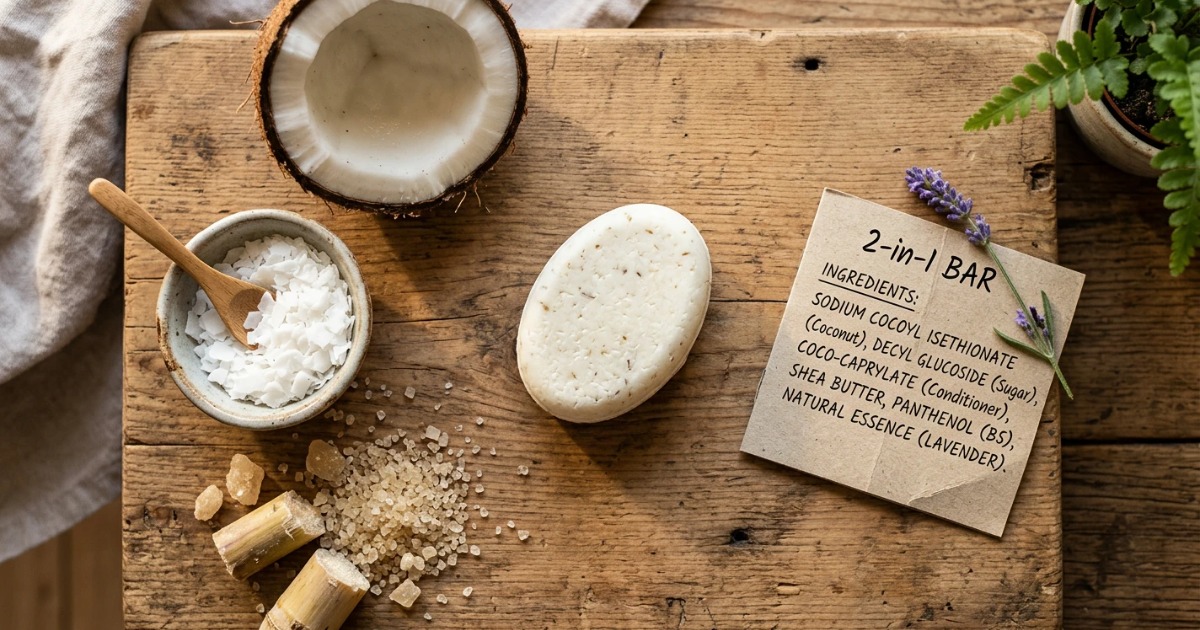
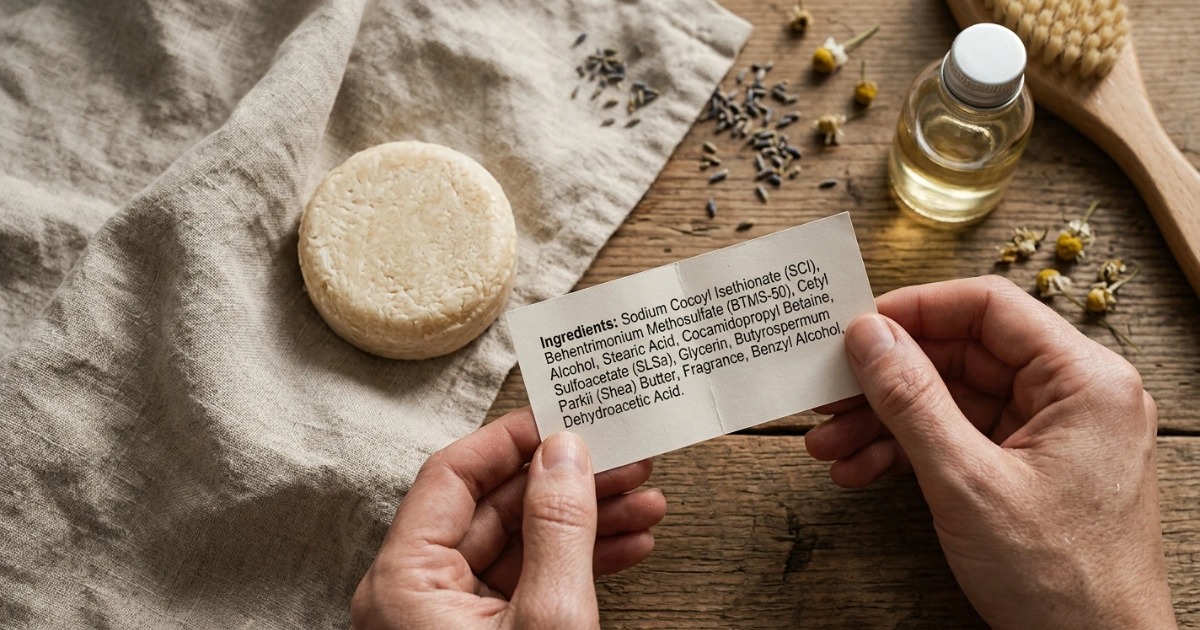
Sodium Cocoyl Isethionate (SCI) — coconut-derived, creates a creamy lather, and is widely considered mild on the scalp. This is the ingredient behind most premium bars.
Sodium Coco Sulfate (SCS) — a stronger cleanser, common in cheaper bars. It's technically coconut-derived, but it behaves closer to SLS than the marketing suggests.
Coco Glucoside / Decyl Glucoside — sugar-based, very mild, and often the go-to for sensitive-scalp formulas.
What "sulfate-free" actually means on a bar
SLS (sodium lauryl sulfate) and SLES (sodium laureth sulfate) are the surfactants most brands avoid when they claim "sulfate-free." The truth is more nuanced. SCS is technically a sulfate too, even if it's coconut-derived. And gentle sulfates aren't inherently harmful for everyone — some scalps handle them just fine.
Sulfate-free is genuinely better for color-treated or curly hair, but it's not automatically better for everyone.
2. Conditioning agents — the softening side
This is where a real 2-in-1 earns its name. Conditioning agents in bars are almost always cationic, meaning they carry a positive charge. Damaged hair carries a slight negative charge, so cationic ingredients cling to the parts of the hair that need help most.
Common conditioning ingredients you'll see
BTMS-50 or BTMS-25 (Behentrimonium Methosulfate) — the workhorse of solid conditioning bars. Derived from rapeseed, it's gentle, effective, and does the heavy lifting on detangling.
Cetyl Alcohol / Cetearyl Alcohol — fatty alcohols that add slip and softness. Despite the name, these aren't the drying kind of alcohol. They're closer to a wax.
Guar Hydroxypropyltrimonium Chloride — a plant-based conditioning polymer, often used when a brand wants to keep the ingredient list looking more "natural."
Why these ingredients matter more in a 2-in-1
Without cationic conditioners, a shampoo bar leaves hair feeling squeaky, tangled, and straw-like. That "why does my hair feel weird?" complaint you sometimes see with plain shampoo bars? Missing or underdosed conditioning agents are usually the culprit.
3. Butters and oils — moisture and nourishment
Butters and oils give hair the fatty, nourishing layer that stops it from feeling stripped after a wash. They also help bind the bar together physically.
Popular picks
Shea butter, cocoa butter, mango butter — richer options, well-suited for dry, thick, or curly hair.
Argan oil, jojoba oil, sweet almond oil — lighter oils that fine hair tolerates better.
Coconut oil — polarizing. Great for some, weighs others down. Protein-sensitive hair can react to it.
4. Humectants — the moisture magnets
Humectants pull water into the hair shaft from the air around you. Think of them as moisture batteries.
Common ones
Glycerin — cheap, effective, and in almost every bar.
Panthenol (Pro-Vitamin B5) — improves softness and adds a subtle shine.
Hydrolyzed proteins (wheat, silk, rice) — small peptides that strengthen the hair shaft. Especially useful for color-treated or heat-damaged hair.
5. Essential oils and botanical extracts
Yes, they smell nice. But the good ones also pull real weight in the formula.
Scent and scalp benefits
Peppermint and rosemary — often sold on scalp stimulation, and there's decent evidence rosemary supports circulation at the follicle.
Lavender and chamomile — calming, common in nighttime or sensitive formulas.
Tea tree — has an antimicrobial reputation, which is why it turns up in anti-dandruff bars.
Botanical extracts worth noticing
Green tea, aloe vera, and nettle extracts show up on a lot of labels. Green tea brings antioxidants, aloe soothes the scalp, and nettle has a long folk history in scalp care. Just know that if an extract sits near the bottom of the ingredient list, it's probably contributing more to the marketing than to your hair.
6. Preservatives, pH adjusters, and the "boring" ingredients
This is the unglamorous part of the label. Skipping over it is a mistake.
Why preservatives still matter in solid products
People assume that because a bar is low in water, nothing can grow in it. Not quite. The moment your bar meets a wet shower shelf, it becomes a friendly environment for bacteria and mold. Small amounts of potassium sorbate, sodium benzoate, or phenoxyethanol are common and, frankly, welcome.
pH balancing
Healthy hair and scalp sit around pH 4.5 to 5.5. Traditional soap-based bars run alkaline, which is why some cause that dreaded "waxy" feel. Modern syndet bars use citric acid or lactic acid to pull the pH into the friendly zone.
What You Probably Won't Find in a Well-Made 2-in-1 Bar
Just as useful as knowing what to look for is knowing what most reputable brands have quietly dropped.
Ingredients many brands now leave out
Parabens
Silicones (dimethicone and its cousins) in "clean" formulations
Synthetic dyes
Phthalates hidden inside fragrance blends
SLS in premium bars
A quick note on silicones
Silicones aren't villains. They give instant slip and shine, and some hair types genuinely love them. The concern is buildup over time. If your bar contains silicones, check whether they're water-soluble versions — some 2-in-1 bars use them as a compromise between performance and cleanliness.
How to Read a 2-in-1 Bar Label Without Getting Lost
The first five ingredients rule
Ingredients are listed by weight. The top five tell you what the bar actually is, regardless of what the front of the packaging shouts. If the first ingredient is SCI and the second is BTMS-50, you're looking at a genuine 2-in-1. If the first ingredient is sodium palmate, you're looking at a soap bar with clever branding.
Spotting marketing dressing vs. functional ingredients
An ingredient needs to be present at roughly 0.5–1% or higher to actually do anything meaningful. If "argan oil" shows up after the preservative on line eighteen, it's there for the label photograph, not your hair.
Matching ingredients to your hair type
Fine or oily hair — lighter oils, glucoside surfactants, low butter content.
Curly or coily hair — richer butters, BTMS-heavy conditioning, humectants like glycerin.
Color-treated hair — sulfate-free, low pH, protein-rich.
Behind the Scenes: How These Ingredients Come Together
Most articles stop at the ingredient list. But how a bar is made matters almost as much as what goes into it.
Cold-process vs. hot-process bars
Cold-process bars are essentially soap. They rely on saponification, run alkaline, and often feel harsh on hair. Modern syndet bars, which include most 2-in-1s worth buying, are made through a controlled heat, blend, and press process. Temperature control is critical. Too much heat degrades the conditioning agents; too little and the ingredients don't blend properly.
Why formulation experience matters
A 2-in-1 bar is not something you nail on your first try. Established manufacturers, some running OEM and ODM operations since the mid-1990s and producing well over 150,000 bars a day for brands across North America, Europe, and the Middle East, have the batch data to know exactly how each surfactant behaves at scale. That's the difference between a bar that lathers cleanly on day one and one that crumbles by day three.
Certifications, consistent quality control, and repeatable batch results are what separate a good idea from a shelf-stable product. It's also why smaller indie brands increasingly partner with experienced factories rather than trying to formulate from scratch. The learning curve is steep.
Are 2-in-1 Shampoo and Conditioner Bars Actually Good for Your Hair?
Where they shine
They travel well, skip the plastic, last a surprisingly long time, and by 2026 the formulas have matured enough that most hair types can find one that works. One well-made bar often replaces two to three bottles of liquid product.
Where they can fall short
Very long, very dry, or heavily processed hair sometimes still wants a separate deep conditioner once a week. That's not a failing of the bar — it's just hair asking for extra love.
Environmental angle, briefly
Cutting water content means lower shipping weight, less plastic, and a smaller carbon footprint per wash. If you care about impact and results equally, this is a real win.
Final Takeaway
The "best" 2-in-1 bar isn't the one with the prettiest label or the loudest claims. It's the one whose ingredient list matches your hair, your water, and your routine. Flip the box over, read the first five ingredients, and let those do the talking.
FAQ
Q: Are 2-in-1 shampoo and conditioner bars safe for daily use?
A: For most hair types, yes, provided the bar is pH-balanced. Daily washing suits fine or oily hair better than very dry or curly hair, which usually prefers a two-to-three-times-a-week rhythm.
Q: Do 2-in-1 bars work on color-treated hair?
A: They can, as long as you choose carefully. Look for sulfate-free formulas with low pH and added proteins. Skip bars with sodium coco sulfate as the first ingredient if you color your hair regularly, since the stronger cleansing can shorten the life of your color.
Q: Why does my hair feel waxy after using a shampoo and conditioner bar?
A: Usually one of three culprits: a pH mismatch (the bar is too alkaline), hard water reacting with a soap-based bar, or a transition period while your scalp rebalances after years of liquid shampoo. A rinse with diluted apple cider vinegar (one tablespoon per cup of water) fixes it in most cases.
Q: How long does one 2-in-1 bar last?
A: Anywhere from 50 to 80 washes, depending on hair length, water hardness, and how well the bar dries between uses. Storing it on a draining dish rather than a puddle roughly doubles its life.
Q: Are all-natural bars better than ones with synthetic ingredients?
A: Not automatically. Some synthetic ingredients, like BTMS-50, are safer and more effective than their "natural" counterparts. What matters is the full formula, not the buzzwords on the front.
Q: Can I use a 2-in-1 bar as body wash too?
A: You can, and many travelers do. Just know that facial skin usually prefers something gentler than a hair-cleansing surfactant, so it's better kept below the neck.
Q: What should I look for if I have a sensitive scalp?
A: Coco glucoside as the main surfactant, no essential oils in the top half of the list, and a fragrance-free option if you can find one. Chamomile and aloe are gentle bonuses.
Q: Can brands create custom 2-in-1 bar formulas?
A: Yes. Most solid haircare on the market is made through OEM or ODM partnerships, where brands can tailor ingredients, scent, shape, color, and packaging. With established manufacturers, minimum orders can start as low as 1,000 units, making it accessible to smaller and mid-sized brands, not just the giants.