
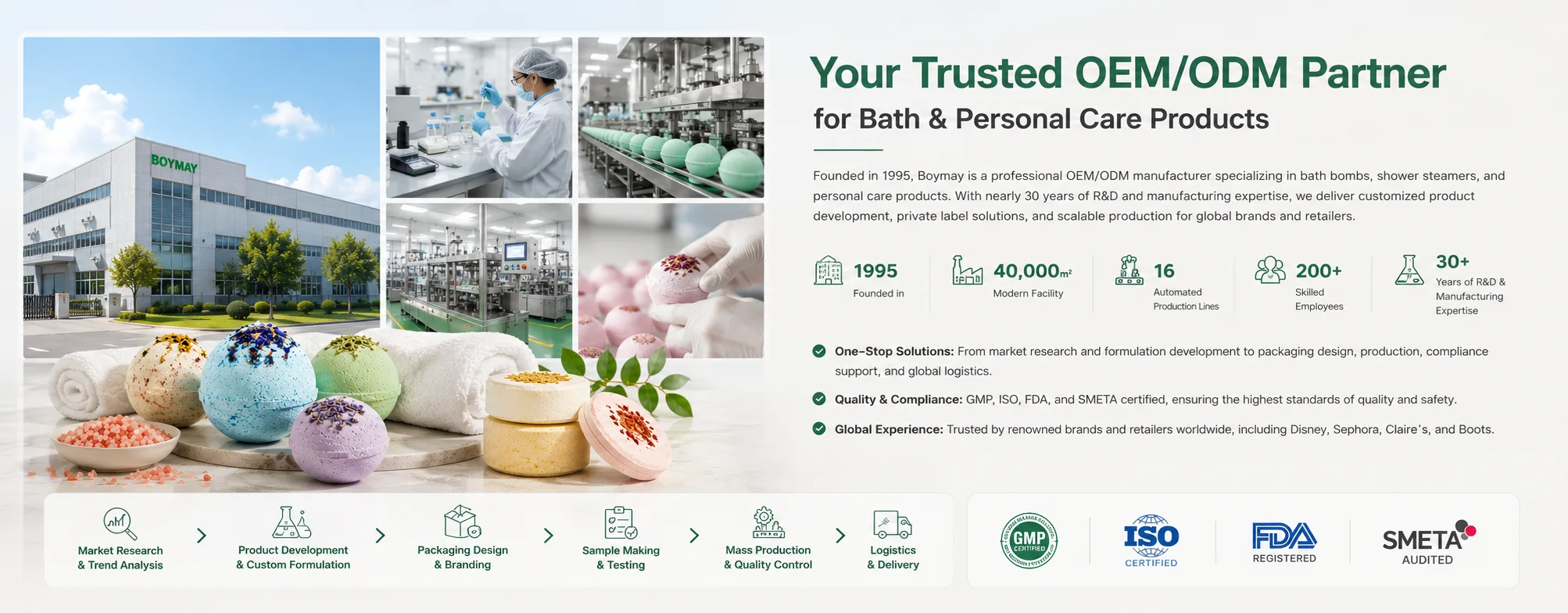
Launching a bath bomb brand sounds simple until you realize how many moving parts sit between your idea and a finished product on a shelf. Formulation chemists, raw material suppliers, packaging designers, compliance consultants, logistics coordinators — managing them separately drains your budget and your sanity. A one-stop bath bomb manufacturer consolidates every stage under one roof, giving entrepreneurs and small business owners a faster, leaner path to market.
This guide breaks down exactly what one-stop service covers, how each component works, and what to look for before you sign a contract.
Why Entrepreneurs Choose One-Stop Bath Bomb Manufacturing Partners
The Hidden Costs of Managing Multiple Vendors
When you split production across separate suppliers — one for formulation, another for bulk bath bomb production, a third for packaging — you absorb coordination costs that never appear on a single invoice. Communication delays, version mismatches, shipping between facilities, and finger-pointing when defects occur all add up. Small brands often report 15–25% cost overruns when juggling three or more vendors compared to using a consolidated partner.
Beyond dollars, fragmented operations create liability gaps. If a finished product fails compliance testing, which vendor owns the problem? A single-source partner carries that accountability end-to-end.
How a Single-Source Partner Accelerates Your Time to Market
Speed matters in the bath and body space, where seasonal trends and social media virality create narrow launch windows. A one-stop manufacturer runs formulation, sampling, production, and contract manufacturing packaging on parallel timelines instead of sequential ones. The result: brands regularly cut 4–6 weeks off their launch schedule compared to multi-vendor setups.
Custom Formulation Services — Where Your Product Begins
Ingredient Sourcing and Safety Compliance
Custom formulation services start with ingredient selection. A capable manufacturer maintains relationships with verified raw material suppliers for citric acid, sodium bicarbonate, carrier oils, botanicals, and active ingredients. They pre-vet every component against safety databases (CIR, SCCS opinions) so your formula passes regulatory review the first time.

This eliminates the risk of building a product around an ingredient that later gets flagged during compliance testing — a costly mistake that sends you back to square one.
Scent Profiling and Color Development
Scent drives repeat purchases in bath products. Experienced manufacturers maintain fragrance libraries with hundreds of profiles and can blend custom accords to match your brand positioning. Color development runs alongside scent work, using skin-safe colorants (lakes, micas, water-soluble dyes) that perform consistently in hard and soft water conditions.
Skin-Benefit Customization (Moisturizing, CBD, Essential Oils)
Today's consumers expect functional benefits beyond fizz and fragrance. Your formulation team can incorporate shea butter for moisturizing, broad-spectrum CBD for relaxation positioning, colloidal oatmeal for sensitive skin, or essential oil blends for aromatherapy claims. Each active ingredient requires specific load percentages and stability considerations — expertise a dedicated formulation lab already has dialed in.
Sample Iterations and Stability Testing
Expect two to four sample rounds before locking a final formula. Each iteration tests fizz duration, hardness, fragrance throw, color bleed, and dissolution rate. Stability testing then subjects approved samples to accelerated aging (high heat, humidity cycling) to confirm a minimum 12-month shelf life. Only after stability clearance does the formula move into bulk bath bomb production.
Bath Bomb Private Label and White Label Options Explained
Private Label vs. White Label — Which Path Fits Your Business?
These terms get used interchangeably, but they represent different business models with distinct cost and timeline implications. Here is a direct comparison:
| Feature | Private Label | White Label |
|---|---|---|
| Custom formulation | ✅ Yes | ❌ Pre-made formula |
| Unique branding | ✅ Yes | ✅ Yes |
| Development time | 4–8 weeks | 1–2 weeks |
| MOQ flexibility | Medium–High | Low–Medium |
| Cost per unit | Higher | Lower |
| Market differentiation | High | Moderate |
If you are building a brand with a unique selling proposition and plan to scale, bath bomb private label manufacturing gives you formula ownership and differentiation. If you need products fast — say, for a holiday gift set or a market test — a white label bath fizzy supplier gets inventory into your hands within weeks using proven formulas.
Branding Integration — Logos, Colors, and Packaging Inserts
Both private and white label paths include branding services. Your manufacturer applies your logo, brand colors, and messaging across packaging, labels, and inserts. Premium partners offer in-house graphic design support, so you only need to supply brand guidelines rather than print-ready files. This keeps brand consistency tight from the product itself through to the unboxing experience.
Bulk Bath Bomb Production — Scaling Without Compromise
MOQ Structures and Volume Pricing Tiers
Most one-stop manufacturers structure MOQs in tiers. A common framework looks like 500 units for initial orders, 2,000–5,000 for standard production runs, and 10,000+ for bulk pricing. Unit costs typically drop 15–30% as you move up tiers because setup and labor costs amortize across larger volumes.
Quality Control Across Large Batches
Scaling introduces consistency challenges. Reliable manufacturers implement in-process quality checks — weight verification, hardness testing, visual inspection — at set intervals throughout production rather than only at the end. AQL (Acceptable Quality Level) sampling at 2.5 or lower ensures defect rates stay below industry standards even on runs exceeding 50,000 units.
Lead Times and Production Scheduling
Standard lead times for bulk bath bomb production range from 2–4 weeks after formula approval, depending on complexity and queue position. Seasonal demand (Q4 holiday orders, Mother's Day) can push timelines out. Smart brands lock production slots 8–12 weeks ahead of peak seasons to avoid delays.
Contract Manufacturing Packaging — From Shrink Wrap to Shelf-Ready
Packaging Design and Structural Engineering
Packaging is not an afterthought — it is a sales tool. One-stop partners offer structural design services that account for product weight, fragility, shipping durability, and retail display requirements. Whether you need a windowed box for visual appeal or a rigid container for luxury positioning, the engineering happens alongside production planning.
Eco-Friendly and Sustainable Packaging Options
Sustainability influences purchasing decisions, especially in the wellness space. Here is how common packaging types compare:
| Packaging Type | Best For | Sustainability Rating |
|---|---|---|
| Shrink wrap | Budget launches | ★☆☆☆☆ |
| Kraft paper box | Eco-conscious brands | ★★★★☆ |
| Rigid gift box | Premium positioning | ★★★☆☆ |
| Compostable film | Zero-waste branding | ★★★★★ |
| Tin container | Reusable/luxury lines | ★★★★☆ |
A capable contract manufacturing packaging partner stocks multiple options and advises on the best fit for your brand story, budget, and target retailer requirements.
Labeling Compliance (FDA, EU Cosmetics Regulation)
Labels must satisfy regulatory bodies in every market you sell into. In the US, FDA requires proper ingredient listing (INCI nomenclature), net weight, manufacturer details, and appropriate cosmetic claims language. EU markets demand compliance with EC 1223/2009 including a responsible person designation. Your one-stop partner builds compliant label templates so you avoid costly market-entry delays.
Logistics, Warehousing, and Fulfillment Support
Domestic and International Shipping Coordination
A full-service manufacturer coordinates freight — ocean, air, or ground — from their facility to your warehouse or directly to distribution points. They handle export documentation, customs classification (HS codes for cosmetic products), and carrier selection based on your cost-vs-speed priorities.
Amazon FBA and DTC Fulfillment Prep
Selling on Amazon? Your manufacturer can prep shipments to FBA specifications: FNSKU labeling, poly-bagging, carton content labels, and pallet configuration. For direct-to-consumer brands, they offer pick-and-pack services, branded mailer boxes, and insert kitting — all flowing from the same production line.
Inventory Management and Reorder Triggers
Advanced partners provide inventory visibility and automated reorder alerts when stock hits predefined thresholds. This prevents stockouts during demand spikes and eliminates the guesswork of manual reorder planning, especially valuable for brands running lean operations with limited in-house staff.
Regulatory and Compliance Assistance
GMP Certification and Facility Standards
Look for manufacturers operating in GMP-certified (Good Manufacturing Practice) facilities. GMP certification confirms standardized processes for sanitation, batch traceability, staff training, and contamination prevention. This is non-negotiable for retail partners like Target, Ulta, or Sephora that audit supplier facilities.
CPSR (Cosmetic Product Safety Reports) for EU Markets
Entering the UK or EU market requires a Cosmetic Product Safety Report prepared by a qualified assessor. One-stop manufacturers either have in-house toxicologists or maintain partnerships with safety assessment firms to deliver CPSRs alongside your finished product — no separate vendor to hire.
MSDS Documentation and Ingredient Disclosure
Material Safety Data Sheets are required for shipping and retailer onboarding. Your manufacturer generates MSDS documents for every SKU, covering composition, hazard identification, handling precautions, and first-aid measures. This documentation travels with your product through every stage of the supply chain.
How to Evaluate a One-Stop Bath Bomb Supplier (Checklist)
Questions to Ask Before Signing a Contract
- Do they handle formulation in-house or outsource to a third-party lab?
- What certifications does the facility hold (GMP, ISO 22716, organic)?
- Can they show references or case studies from white label bath fizzy clients?
- What is their documented defect rate and QC inspection process?
- Do they offer contract manufacturing packaging end-to-end, including structural design?
- What is their capacity ceiling, and can they scale with your growth?
Red Flags That Signal a Fragmented Operation
Watch for these warning signs: the manufacturer cannot provide a single point of contact for all stages, they require you to source your own packaging vendor, they lack in-house stability testing capability, or their lead time quotes exclude packaging and fulfillment prep. Any of these indicate a middleman operation that adds cost without adding control.
FAQ — One-Stop Bath Bomb Manufacturing
What is the typical MOQ for bulk bath bomb production?
Most manufacturers set initial MOQs between 500 and 1,000 units per SKU for first orders. Repeat orders often start at 2,000–5,000 units to access better volume pricing. Some white label programs offer MOQs as low as 200 units for market testing.
How long does custom formulation take from concept to final sample?
Expect 4–8 weeks for custom formulation services, including two to four sample iterations and stability testing. Simple modifications to existing base formulas can shorten this to 2–3 weeks. Complex formulas involving novel actives like CBD may extend timelines to 10 weeks.
Can a one-stop manufacturer handle both private label and white label orders?
Yes. Most full-service manufacturers maintain a library of ready-to-brand white label formulas alongside custom formulation capabilities. You can launch quickly with white label products while developing a private label line simultaneously.
What certifications should I look for in a bath bomb contract manufacturer?
Prioritize GMP certification (or ISO 22716 for cosmetics), cruelty-free certification if relevant to your brand, and organic certifications (COSMOS, USDA) if you market natural or organic products. FDA facility registration is required for US-market cosmetics manufacturers.
Does one-stop service include help with Amazon or retail packaging requirements?
Comprehensive one-stop providers handle Amazon FBA prep (FNSKU labels, poly-bagging, carton specs) and retail-ready packaging that meets specific retailer planogram and display requirements. Confirm this capability explicitly before contracting.
How do I protect my custom formula when using a contract manufacturer?
Request a non-disclosure agreement (NDA) and a formula ownership clause in your manufacturing agreement. Reputable manufacturers acknowledge that custom formulations developed for your brand remain your intellectual property. Verify this is written into the contract — verbal assurances are insufficient.
Next Steps — Requesting Your First One-Stop Service Quote
What to Prepare Before Reaching Out
Come to the conversation with these details ready: your target product type and size (shape, weight, packaging style), estimated monthly or quarterly volume, target markets (US, EU, both), desired ingredients or claims (vegan, CBD, essential oils), brand assets (logo files, color codes), and your ideal launch date. The more specifics you provide upfront, the faster your manufacturer can deliver an accurate quote.
Typical Onboarding Timeline from Inquiry to First Shipment
For bath bomb private label projects with custom formulation, expect 10–14 weeks from initial inquiry to first shipment: 1–2 weeks for quoting and agreement, 4–6 weeks for formulation and sampling, 2–3 weeks for production, and 1–2 weeks for packaging and shipping. White label orders compress this to 3–5 weeks total. Planning your outreach around these timelines ensures you hit seasonal windows without rushing quality.
The right one-stop manufacturing partner does not just make bath bombs — they remove the operational complexity that keeps small brands from scaling. Start your search with the checklist above, ask the hard questions, and choose a partner who owns every stage from formulation to fulfillment.